Showing posts with label non violent protests. Show all posts

Thursday, August 11, 2011

Australia’s repression of BDS movement coordinated with Israel

by Kim Bullimore
The Electronic Intifada: 9 August 2011


Australian solidarity activists are facing intense police repression.
(Erik Anderson/Flickr)

In the largest show of support for the Palestinian-initiated boycott, divestment and sanctions (BDS) campaign so far in Australia, more than 350 persons marched on 29 July in solidarity with the Palestinian struggle — and in opposition to an attempt by Victorian Police to criminalize Palestine solidarity activism in Melbourne.

A month earlier, on 1 July, a similar, peaceful BDS action involving 120 persons was brutally attacked by the Victorian Police. Nineteen individuals were arrested.

Charged with “trespassing” and “besetting,” those arrested are now facing fines of up to AUD $30,000 (approximately US $32,300). The 1 July action, organized by the Coalition Against Israeli Apartheid, had sought to highlight the complicity of two Israeli companies, Jericho and Max Brenner Chocolate, with Israel’s occupation and apartheid policies. The action was the fourth protest against both companies since December 2010.

Jericho, located in Melbourne Central Shopping Centre and other shopping centers around the city, produces cosmetics made from minerals exploited from the Dead Sea. While Jericho and other Israeli companies — such as Ahava, also a target of BDS campaigns — profit from the Dead Sea, Palestinians are regularly denied access by Israel’s military checkpoints, exclusion zones and Israeli-only roads.

Max Brenner Chocolate, the other Israeli company subject to BDS protests in Melbourne, is owned by the Strauss Group — one of Israel’s largest food and beverage companies. On its website, the Strauss Group emphasizes its support for the Israeli military, providing care packages, sports and recreational equipment, books and games for soldiers.

Strauss boasts support for the Golani and Givati Brigades, which were heavily involved in Israel’s military assault on the Gaza Strip in the Winter of 2008-09, which resulted in the killing of approximately 1,400 Palestinians, the majority civilians, including approximately 350 children. While Strauss has removed information about their support for the Golani and Givati brigades from their English language website, information about the company’s support for both brigades remains on their Hebrew language site.

BDS repression coordinated with Israeli government

Trade union and community representatives spoke at the rally on 29 July before the crowd marched through the city. In spite of repeated threats of mass arrests by Victoria Police — and the deployment of police horses in one of the shopping centers — the protest marched into both the Melbourne Central and Queen Victoria centers, staging peaceful sit-ins in front of the Max Brenner stores located within.

Two day earlier, on 27 July, the Victorian police confirmed during a bail variation hearing at the Magistrates’ Court of Victoria (local District Court) for some of the activists arrested on 1 July that a decision had been made to arrest the protesters before the demonstration. This decision was made after discussions with Zionist organizations, the Victorian government, shopping center managements and state and national management of Max Brenner.

In April, the Australian Jewish News (AJN) reported that the Jewish Community Council of Victoria (JCCV) had made representations to the Victorian police. According to the AJN, JCCV president John Searle had “called on the police to stamp down harder on aggressive protesters” (“Police questioned as protests turn violent,” 15 April 2011). Similar calls for a government and police crackdown on BDS protests against Max Brenner in Sydney were made in June by former AJN journalist Walt Secord, who is now a member of the NSW State Parliament (“Police called to action on BDS,” 24 June 2011).

On July 29, the same day as the BDS action against Max Brenner in Melbourne the Australian Jewish News carried a “debate” piece between Vic Alhadeff, the CEO of the NSW Jewish Board of Deputies, and Ted Lapkin, a former staffer with the key pro-Israeli lobby group in Australia, the Australia/Israel and Jewish Affairs Council. The piece reveals that the various calls for police and government crackdown on BDS activism was part of a “nationally coordinated strategy” developed with and backed by the Israeli Foreign Ministry (“BDS: To protest or not to protest?”).

Arguing against any Zionist-organized BDS “counter” protest, Alhadeff writes: “It is important for the community to be aware that our response to BDS forms part of [a] coordinated national strategy. Furthermore, this strategy is endorsed by counterparts abroad and Israel’s Foreign Ministry.”

Alhadeff outlined this coordinated national strategy in response to BDS, stating that it “included, but is not limited to, engagement with civil society and politicians, patronage of boycotted outlets, cooperation with police, shop owners and center managers and exposure of the motives behind the BDS movement.” According to Alhadeff, Zionist policy in response to BDS should be one which seeks to “speak softly” but to also carry “a suggestion of a big stick.”

Activism leadership targeted

During cross-examination by Robert Stary, the lawyer representing the activists, Michael Beattie, an operational support inspector with the the Victorian Police, conceded that both Melbourne Central and Queen Victoria shopping centers were “public places” and that neither center prior to 1 July had sought any civil injunctions to prevent entry to the public places inside.

The cross-examination by Stary also revealed that the main reason that police had decided to criminalize the actions against the Israeli companies was because they had been well-organized, coordinated and effective.

Victorian Police acknowledged that the demonstrations had been peaceful, that solidarity activists hadn’t damaged property and there was no record of police or any member of the public being injured.

According to the testimony given by Inspector Beattie, the police had specifically sought to target the leadership of the protests, in particular those activists the police perceived as “operating a command and control function,” in order to diminish the possibility of well-coordinated demonstrations — and to ensure “no protesters go to property and disrupt targeted business or additional businesses.”

According to Inspector Beattie, “the protesters had their own way” for too long and a “decision [was] made to draw a line in the sand and make arrests.” Another police officer, Senior Sargent Andrew Falconer, also gave testimony at the court hearing and acknowledged that police infiltrators had been sent to pro-Palestine solidarity meetings in order to monitor the activity of BDS activists.

In a statement issued after their arrests, the nineteen activists noted that “the attack on the peaceful BDS action in Melbourne highlights increasing attempts to criminalize BDS and Palestine solidarity activism internationally. Currently in the US, France and Greece, hundreds of pro-Palestine activists are facing criminal charges for nonviolently standing up for Palestinian human rights” (“Support the Boycott Israel 19 Defence Campaign”).

James Crafti, one of the activists arrested, told The Electronic Intifada that “the attempt by Israel and governments around the world to criminalize pro-Palestinian and BDS activism ignores the fact that the real criminal activity is being carried out by the Israeli state.”

“Since its founding in 1948, Israel has sought to ethnically cleanse the indigenous Palestinian people through war, occupation and apartheid practices. Israel regularly engages in collective punishment, arbitrary arrests, extra-judicial assassinations and the demolition of Palestinian homes and civil infrastructure, all of which are illegal under international law,” he added.

Crafti noted that while the Victorian and Australian governments sought to criminalize support for Palestine self-determination, they refused to hold Israel accountable for its human rights abuses, war crimes and apartheid policies.

All of the arrested activists who spoke to The Electronic Intifada said the police attack on the protest also highlighted the increasing repression of civil liberties and freedom of speech by the Victorian (conservative) Baillieu government.

One Palestine solidarity activist, Sue Bolton, who has been charged with “besetting” (obstructing or hindering the right to enter, use or leave a premise), asserted that the police reaction to the action on 1 July was “over the top.”

“There were massive numbers of police, well over a hundred, not counting those behind the scenes in the loading docks,” she said.


According to Bolton, the Queen Victoria Centre loading docks had been cleared of delivery trucks, allowing the police to set up a processing unit and bring in prison transport trucks to be used as holding cells for those arrested.

Bolton described how police had sought to “kettle” the demonstration by corralling protesters and physically pushing them into a smaller and smaller area. According to Bolton, this resulted in a number of protesters being injured and crushed when the police had surrounded and violently pushed protesters from all sides.

Similar tactics have been used by police forces in Canada, the United Kingdom, Germany, France, Finland and Denmark. The use of kettling by police in the UK against student protesters in November 2010 has led to legal challenges and the calling for a ban on the use of the tactic in the British High Court and the European Court of Human Rights.

Damian Ridgwell, another Palestine solidarity protester arrested on 1 July, told The Electronic Intifada that he had been standing away from the peaceful picket, speaking on a megaphone when three policemen grabbed him.

“I was dragged behind police lines,” Ridgwell said. “Once they grabbed me and started dragging me, I went limp and dropped to the ground … As I was being carried through the corridors of the loading dock, I lost consciousness because one of the police had me in a choke hold. I am not sure how long I was out, probably a few minutes. I woke up on the loading dock floor and heard the police saying I was ‘out.’”

Ridgwell, who was charged with trespassing, said “while it is outrageous we were arrested for peacefully demonstrating, our arrests have to be seen in the context of the Australia government’s support for Israel and its continued theft of Palestinian land … it’s important we don’t let the police intimidate protests like this. It is important to keep going with the protests and to keep supporting BDS.”

Australian government’s support of Israeli apartheid

Successive Australian governments, including the current Gillard government, have long supported Israel’s colonial and apartheid policies.

Current Australian Prime Minister Julia Gillard signaled her uncritical support for Israel when she was still deputy Prime Minster of Australia. During the early days of Israel’s bombing of Gaza in the winter of 2008-09, she blamed Palestinians for Israel’s all-out assault, saying that Hamas must “renounce violence” and that Israel had the “right to defend itself.”

During a visit to Israel In 2009, Gillard was thanked by Israeli government minister Isaac Herzog for standing “almost alone on the world stage in support of Israel’s right to defend itself” (“Israel to Gillard: thanks for standing by us,” The Age, 24 June 2009).

The arrested activists noted that in June, the Baillieu government had established a new 42-member riot squad — and the attack on the 1 July protest was the first time it had been used in any significant way.

According to James Crafti, “the Victorian government thinks it can easily get away with attacking a pro-Palestine action because they think they can label us anti-Semitic.” Crafti, who is Jewish, said that the police and those opposed to the BDS actions, however, “underestimate the sympathy towards both Palestine and the [Palestine solidarity] movement in the broader community.”

“The amount of force used by the police and the response of the political elite to our protests, particularly the fact that the Australian Foreign Minister [and former Australian Prime Minister] Kevin Rudd felt the need to go a few days after our protest to Max Brenner as a public relations stunt is a sign of the pro-Israeli forces’ desperation,” he added.

The eleven activists succeeded in changing the original bail conditions preventing them from entering either shopping center (which also host medical clinics and a major train station) until the end of their case, to a lesser restriction of being prohibited from being within fifty meters of Max Brenner in both centers. However, Stary said he was still “anxious about the criminalization of dissent.”

“The police should not be used to protect the interests of an international commercial company,” he said.

Building on the success of 29 July, Melbourne activists will continue to campaign in support of Palestinian rights and oppose the criminalization of Palestine solidarity activism. The next Melbourne BDS action is scheduled for 9 September, the same week those arrested will plead not guilty to the charges against them. The defense campaign in support of the arrested activists has gained wide attention, with well-known public figures such as filmmaker John Pilger, author Norman Finkelstein and radical thinker Noam Chomsky supporting the campaign.

In a media release issued immediately following the success of the 29 July BDS action, Melbourne activists said the Victorian Police “thought that by attacking the BDS demonstration they would put an end to our movement. They were wrong … [we will] not be silenced” (“BDS returns to Max Brenner in spite of police intimidation,” 5 August 2011).

Kim Bullimore has lived and worked in the West Bank of the Occupied Palestinian Territories. She is a member of the Melbourne Coalition Against Israeli Apartheid and a co-organizer of the first national Australian BDS conference, which took place in Melbourne in October 2010. Kim writes regularly on the Palestine-Israel conflict for the Australian newspaper, Direct Action. She has a blog at livefromoccupiedpalestine.blogspot.com.

Friday, May 13, 2011

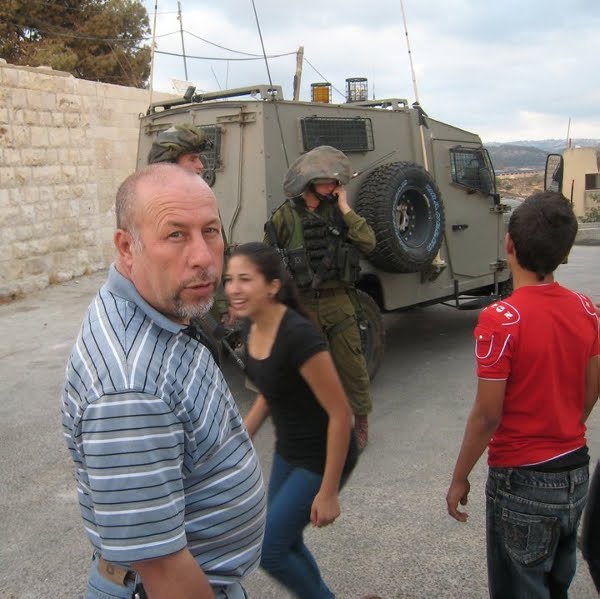
Israeli military exceed even their normal excessive violence against unarmed non-violent protestors in An Nabi Saleh

Nabi Saleh is a regular target for Israeli military aggression. This week, the Israeli military exceeded even their normal excessive violence violently beating and attacking unarmed demonstrators at the weekly non-violent demonstration (which this http://www.blogger.com/img/blank.gifweek marked Al Nakba).

At least 25 unarmed non-violent protestors were injured. One Palestinian women in her 50s who was beaten up so badly, she was evacuated from the Salfeet Hospital to the bigger and more advanced Rafidiya Hospital in Nablus. A 25 year-old American demonstrator suffered a serious head injury and an Israeli activist was diagnosed with two open fractures in his hand. Both were injured by tear-gas projectiles shot directly at them from short range, in violation of the Israeli Army’s open fire regulations. Four protesters were arrested in Nabi Saleh, including two Palestinian women.

You can follow and support the non-violent struggle being carried by the people of An Nabi Saleh by joining their solidarity page on Facebook at: http://www.facebook.com/pages/Nabi-Saleh-Solidarity/177013109017209

Or visit the Nabi Saleh Solidarity blog at: http://nabisalehsolidarity.wordpress.com/

Tuesday, March 29, 2011

Reality vs Propaganda: the truth about the An Nabi Saleh protests

Dear friends,
please find below my latest article. A version of the article has been published by Palestine Chronicle at:http://www.palestinechronicle.com/view_article_details.php?id=16755

As mentioned in the article, I recently produced about An Nabi Saleh, which includes interview with Naji and Bassem Tamimi. YOu can view the video here: http://www.youtube.com/watch?v=-FnaYdG2MJU (or below on this blog).

Please feel free to distribute the article and the video to your networks.

in solidarity, Kim

***

Reality vs Propaganda: the truth about the An Nabi Saleh protests
By Kim Bullimore

On 26 March, a piece of Israeli Occupation Forces propaganda masquerading as journalism was published by YNet, an Israeli news website, which publishes in both Hebrew and English. The Ynet article, headlined “Secrets of Nabi Saleh protests” purported to offer a “behind-scenes look at [the] most violent protests around” [1]. However, the article by Yair Altman did nothing of the sort. Instead it gave carte blanche coverage, with little questioning, to the preposterous and often ridiculous assertions by Israeli Occupation officials against the recently arrested non-violent Palestinian leaders from An Nabi Saleh's Popular Committee against the Occupation.

According to Altman, An Nabi Saleh village leader, Naji Tamimi, who was arrested on 6 March when the Israeli military raided his home at 1.30 am in the morning, was a “pied piper” who “organised [an] army of boys”. Quoting an unnamed Israeli military police official, Altman writes: "Tamimi oversees an army of demonstrators divided in an extremely organized fashion into regiments of 14-17 people”.


Naji Tamimi in An Nabi Saleh

According to Altman's unnamed military police source, Naji Tamimi is “a very charismatic and militant person and is well versed in the rules of the game – what's allowed and what isn't. He does nothing by chance. Every action is well planned – not a folksy protest. He excites them and directs them towards confrontations with IDF forces”.

Altman goes onto state, with absolutely no proof to back up his assertions, that Naji Tamimi directed the demonstrations by phone from “the roof of one of the village's structures”. Altman also asserts in the article that the shabab (young boys) of the village were under the command of another village leader, Bassem Tamimi, who was arrested on March 24 when dozens of Israeli military stormed his home.

When I first read Altman's article, I burst out laughing. I have known both Naji Tamimi and Bassem Tamimi, along with their families, for more than fifteen months. The men described in Altman’s article, along with the actions ascribed to them, bore little resemblance to the men I know or their activities in relation to the non-violent struggle being carried out by their village. Having spent large quantities of time with both men and their families and having attended numerous demonstrations in An Nabi Saleh, very little in Altman's article rang true. Instead it held the stench of unadulterated Israeli military propaganda.

I first met Naji Tamimi and Bassem Tamimi, when I attended the first demonstrations in An Nabi Saleh. In December 2009, An Nabi Saleh - a small village of just 500 people – began holding weekly non-violent demonstrations in opposition to the illegal Israeli colony of Halamish annexing and stealing of more of the village’s land. At the conclusion of the first demonstration I attended in the village, I was invited to visit Naji's home by his brother-in-law. At Naji's home, I was introduced to not only Naji and his family but also to Bassem and his family and other families who were also visiting at the time. In the weeks that followed, I visited the village many times, both on the days of the demonstrations and on days when there were no demonstrations. During my visits to the village, I spent time with Naji and Bassem's families. We spent our time discussing the impact of Israel's occupation on the village and the Palestinian people and the non-violent struggle of the village against the attempts to steal more of the village's land. During these visits, I also played games with the children, learning to bake bread and tried to practice and improve, with the help of my new friends, my limited and badly pronounced Arabic. Over the course of the next year, after I had returned back home, I kept in regular touch with both Naji and Bassem and their families. When I returned to Palestine recently, An Nabi Saleh was the first place I visited in the Occupied Palestinian Territories.

The focus of the dozens of conversations that I had with both men was the importance of the development of a non-violent model of protest. Both Naji and Bassem believed in the power of non-violent struggle and the challenge it provided, in stark contrast, to the brutal colonial violence meted out each week by Israel's Occupation Forces against their tiny village and its non-violent protests.
During the many demonstrations that I attended in An Nabi Saleh, myself and other internationals, as well as Israeli activists opposed to their government’s policies, would join with Naji and Bassem and other members of the village to walk unarmed and peacefully from the centre of the village, out onto the main street of An Nabi Saleh in order to make our way peacefully to the village’s land which were being stolen by the Israeli colony of Halamish.

As we marched peacefully onto the street, we would be hit almost immediately with a barrage of teargas and rubber bullets fired at the peaceful, non-violent demonstration by the Israeli military. On numerous occasions, live ammunition was also fired at us, despite the fact that this is in direct violation of Israeli military operating orders which forbid such actions when Israeli citizens are present at the demonstrations. The non-violent demonstrations would start at noon and the violent assault on the village by the Israeli military would continue for the next five or six hours until the Israeli Occupation Forces would finally leave the village at dusk.

As Bassem noted in a recent video interview I did with both him and Naji before their arrests, the Israeli military was determined to break An Nabi Saleh's model of non-violent resistance to the occupation [2]. The primary aim of the Israeli military, as Bassem noted, was to try and force Palestinians to engage in violent resistance to the occupation by crushing the non-violent resistance by increased Israeli military violence. This way, Israel could justify its continued occupation and oppression of the Palestinian people.

A recent article by the Israeli newspaper, The Jerusalem Post, similarly noted that the primary concern of the Israeli Occupation Forces, particularly in the wake of the recent Egyptian revolution, has been to contain and crush any possible Palestinian non-violent resistance to Israel's ongoing occupation. According to the February 18 Jerusalem Post article, the Israeli military were “concerned by the prospect of the Palestinians replicating [non-violent] Egyptian style mass demonstrations with dozens of simultaneous marches and protests in the West Bank [3]. The Jerusalem Post article reported that “the IDF is beginning to build rapid-response forces”, as the Israeli Occupation Forces Central Comment had assessed “that Palestinians could resort to so-called non-violent resistance, on a scale previously unknown in Israel, in the absence of peace negotiations”. The article went on to note that the primary aim of the rapid response teams would be to “quickly manoeuvre throughout the West Bank and arrive at the scene of a demonstration in its early stages in an attempt to contain it”, with this containment possibly “lead[ing] to a high number of casualties”.

The attempts by the Israeli state and its military to crush the non-violent Palestinian resistance is not new. In 2004, I interviewed the leaders of the non-violent struggle in the tiny village of Budrus about the attempts by the Israeli military to crush their non-violent resistance to the building of the Apartheid Wall. At the time, one of the village leaders told me that he had been informed by commanders of Israel's military that the Israeli Occupation Forces “would do everything in its power to stop the [non-violent] movement, even if it meant people died” [4].

Approximately two years ago, unable to stop the non-violent resistance by Palestinian villages against the building of the Apartheid Wall and the Occupation, the Israeli state and its military introduced its current tactic of arresting and jailing leaders of the non-violent struggle. In 2009, Adeeb Abu Rahma and Abdullah Abu Rahma, two of the leaders of the Bil'in non-violent struggle were arrested and jailed. This month, less than 10 days after the release of Abdullah Abu Rahma, after he had spent a year and half in Israel's prisons for his non-violent activism, Bassem Tamimi was arrested for his non-violent activism. Just twenty-four hours before his arrest on March 24, Bassem had met with leaders of the Bil'in Popular Committee Against the Wall, one of whom had quipped “Now that Abdullah Abu Rahma has been released from jail, the Israeli soldiers and the honorable military tribunal judges will have time for Bassem Tamimi” [6]


Bassem Tamimi (centre) in Bil'in with Abdullah Abu Rahma (on left) after Abdullah's release from Israeli prison.

One of the few positive things about Altman's article about the popular non-violent resistance in An Nabi Saleh is that it clearly outlines the ridiculous charges being levelled against Naji Tamimi by the Israeli Occupation Forces. According to Altman, the charges include “incitement, supporting a hostile organization, taking part in an illegal procession and entering a closed military area ...”. Of course, what Altman or the Israeli military fail to mention is the fact that an occupied people do not need the permission of their occupier to hold demonstrations, instead under international law they have the right to resist colonial occupation and repression and to engage in civil disobedience and demonstrations. While international law affords Palestinians the right, as an occupied people, to engage in armed struggle against their occupier, the people of An Nabi Saleh choose to engage in unarmed and non-violent struggle against their oppressors and occupiers. In addition, far from “entering a closed military area”, Naji Tamimi was simply in his own village and the Israeli military came to him and imposed a closed military zone on the streets and fields of his home.

Altman also points out in his piece that the Israeli Occupation Forces had arrested several boys from the village, all under the age of 16 and that their testimony was being used against Naji Tamimi and Bassem Tamimi. However, as Jonathan Pollak, an Israeli activist who is belatedly quoted in Altman's article notes, what the Israeli military police fail to mention is that the testimonies were extracted from the children via verbal, emotional and physical abuse. The testimony being used against both Naji Tamimi and Bassem Tamimi was obtained primarily from 14 year old Islam Tamimi, as well as his younger brother, 11 year old Kareem.

Islam Tamimi was kidnapped from his home at gun point at 3 am on 23 January by the Israeli military. He was kept incommunicado, beaten and verbally abused. Islam's parents and lawyer were denied access to him. In early February, Kareem was kidnapped from the streets of An Nabi Saleh and held for five hours during which the terrified child was verbally, emotionally and physically abused. The behaviour meted out to both boys was typical of the treatment visited on Palestinian child prisoners by the Israeli military


Islam Tamimi, 14 years old.

As a recent report issued by the UN in January 2011 points out in 2010 Israeli occupation forces regularly arrested children “at checkpoints, off the street or, most commonly, from the family home” [7]. The Report of the Special Rapporteur on the situation of human rights in the Palestinian territories occupied since 1967, went onto note that “in the case of house arrests, large numbers of Israeli soldiers typically surrounded the family home in the middle of the night. Children were beaten or kicked at the time of arrest and put at the back of a military vehicle where they were subject to further physical and psychological abuse on the way to the interrogation and detention centre. Upon arrest, children and their families were seldom informed of the charges against them”. According to the UN report, “Children were often subject to abuse during interrogation”. The report noted that abuse of children in many cases included the children being given electric shocks and sexually assaulted and it was only after this treatment that the children provided their interrogators with confessions

The UN report noted that “each year, approximately 700 Palestinian children (under 18) from the West Bank are prosecuted in Israeli military courts after being arrested, interrogated and detained by the Israeli army”. The report went onto highlight the fact that Palestinian children are subject to a dual legal system which operates in the Occupied Palestinian Territories. This dual system sees settler children, who are rarely apprehended in any violent acts they may have carried out, prosecuted in the Israeli civil courts, while Palestinian children are brought before a military court system, which impose higher degrees of accountability at lower ages.

In the weeks before I left Palestine, I spoke with both Naji and Bassem many times. They knew their arrests were imminent but the remained steadfast and committed to the non-violent popular struggle and the struggle of their village for human rights and dignity. As Naji told me, “we cannot live under the occupation ... we want, like all the people in the world, our rights. We want to build our state and we want a good future for our children”.


Non-violent protest in An Nabi Saleh - Photo by Oren Ziv.

Naji has now been in prison for three and half weeks. It took the Israeli military 19 days to finally come up with charges against him. The Israeli military court has also ordered that he will be kept under indefinite remand until the military legal procedures against him are concluded. No news has come through yet on Bassem since his arrest, but in the coming days we can expect to hear that similar preposterous accusations and charges, similar to the ones outlined in Altman's article against Naji Tamimi, will be laid against him.
Despite the arrests and the repression, the people of An Nabi Saleh are not bowed and they will continue their struggle against the occupation and the stealing of their land. As Bassem told me when I interviewed him before his arrest, “Our duty is to resist the stealing of our life and our land”.
“We are under occupation, the normal thing is to resist against the occupation. The non-normal thing is to be quite and not do anything”.

Kim Bullimore is a volunteer with the International Women’s Peace Service in Palestine (www.iwps.info). Kim writes regularly on the Israel-Palestine conflict for the Australian newspaper, Direct Action (www.directaction.org.au) and has a blog at www.livefromoccupiedpalestine.blogspot.com

[1] http://www.ynetnews.com/articles/0,7340,L-4047503,00.html
[2] http://www.youtube.com/watch?v=-FnaYdG2MJU
[3] http://www.jpost.com/Defense/Article.aspx?ID=208786&R=R1?
[4] http://www.greenleft.org.au/node/30781
[5] http://www.haaretz.com/print-edition/features/mighty-israel-and-its-quest-to-quash-palestinian-popular-protest-1.352248
[6] http://richardfalk.wordpress.com/2011/02/14/report-of-special-rapporteur-to-the-un-human-rights-council-on-occupied-palestinian-territories/