Monday, November 18, 2013

Milestone: Live from Occupied Palestine reaches 150,000 views


Dear friends,
I just wanted to take the time to say a big thank you to all of you who have take the time to visit and read my blog.  Today, Live from Occupied Palestine surpassed 150,000 hits (ie. views).

To be honest, when I started this blog six and half years ago, I never expected to have so many people from all over the world reading it. I expected that only a handful of people would check it out - mainly my friends, family and comrades.

Live from Occupied Palestine is actually my second attempt at a blog. I had previously started a blog called Palestine Eyewitness in 2004, chronicling my first visit to Palestine.  At the time I was new to blogging and didn't really have much experience on how to run blogs and I don't think I fully understood the important role blogs could play in solidarity and social justice activism.  I started Live from Occupied Palestine when I returned to Palestine in 2007.  Unlike the first time around, I had a much better handle on the important role blogs could play in solidarity and social justice activism.

The purpose of both Palestine Eyewitness and Live from Occupied Palestine was originally to chronicle my time living and working on the ground in Occupied Palestine and to stand in solidarity with the people of Palestine and their struggle for freedom, justice and self-determination by providing news and analysis of what was happening on there. Unlike with Palestine Eyewitness, I decided to maintain this blog when I returned home.  My intention was to maintain the blog all year round and to provided news, information, updates and analysis from other activists - Palestinian, Israel and international - who were on the ground in Palestine when I was not there.

From its inception, I had hoped that Live from Occupied Palestine, in some small way, would contribute to cutting across the all to frequent distortions and/or media black in the mainstrea corporate press about the Palestinian people's struggle.   I was under no illusion that Live from Occupied Palestine could have the same outreach as the mainstream press, but I did hope that in some small way it would help challenge the all to frequent media black out on Palestine and that it would be a source of alternative information for those supportive of the Palestinian struggle or wanted to know more about what was really happening on the ground in Palestine. 

But while I had no illusion in what could be achieved with this blog, I also I had not  expected that it would attract as many readers as it has done, from all over the world, over the last few years. Nor did I expect that it would gain a small but steady following.  I am still surprised everyday that so many people are visit and read this blog and are interested enough to check out what I write. 

I think what this really reflects is the changing attitude towards Palestine and the Palestinian struggle.  Over the last decade, we have started to see a real shift in people's attitudes towards the Palestinian people and their struggle.  In Australia, a number of surveys have found that more and more people are supportive of the Palestinian people and their struggle for freedom (see here and here)

People are hungry for news and information that they are not getting in the mainstream press and are looking to blogs and social media for the information the corporate press is not reporting. It reflects the growing support for the Palestinian struggle and the Palestinian BDS campaign.


So thank you to all of you have supported this blog over the years and who continue to visit it.  I hope that one day, in the not distant future, that there won't be a need for this blog and that the people of Palestine will have won the freedom and justice they have struggled so long for and that a Free Palestine will be a reality.
 
But until then Live from Occupied Palestine will continue to support the Palestinian people and their struggle for freedom, justice and self-determination, both on the ground in Palestine and internationally.  As part of this, Live from Occupied Palestine will continue to be strong supporter of the Palestinian initiated Boycott, Divestment and Sanctions campaign and hope you will also be an active supportive of the BDS campaign (for more information on the campaign, click here). 
Thank you again! For a Free Palestine and an end to occupation and apartheid!

In solidarity, Kim


Thursday, November 14, 2013

IN PHOTOS: Gaza without electricity - Israel's illegal siege 7 years on.

Dear friends, 
as you will be aware, since 2006 Israel has been illegally blockading the Gaza Strip.  This coastal region is one of the most densely populated regions in the world and home to more than 1.6 million Palestinians. Israel's land, sea and air blockade of Gaza intensified in 2007 when Hamas took control of the region and has seen Gaza transformed it into the world's largest open air prison. Israel's actions are illegal under international law with collective punishment such as this deemed a war crime.

On November 12, as a result of Israel's blockade, Gaza's Ministry of Health warned that the territory was on the brink of a “health catastrophe”. Due to Israel's illegal siege of Gaza, there is a severe shortage of essential medicines.  Every hospital in the world has list of essential drugs - in Gaza, this includes 480 essential drugs, of which 140 have completely run out. Of the remaing 240, there is only sufficient stock of 70 of them for another 3 month. 

Palestinian hospitals in Gaza are also being severely impacted by the severe fuel shortage in Gaza. Since 2006, the 13 Palestinian hospitals and other essential services in Gaza have been reliant, daily, on emergency generators to power life saving equipment.  This is due to Israel's bombing of much of Gaza's public infrastructure in 2006, which destroyed Gaza's only electricity plant. 


These fuel and power shortage impact on the entire Palestinian population as well. Talking with friends in Gaza, they tell me that they are still being subject to lengthy power cuts, daily, often for between 4 to 8 hours at a time.

 
The Gazan population is further at risk due to the lack of potable water, as a result of Israel's destruction of Gaza's only water purification centre in 2006.  As a result, fuel is also needed to run water purification systems and treat sewage.  On November 13, due to the short of electricity and fuel thousands of gallons of sewage overflowed onto the streets of Gaza. According to the Gaza City Wastewater Department, the spillage has caused widespread environmental and health hazards, affecting more than 20,000 people in the city.

I have included a range of photos below taken recently in Gaza, which highlight the dire situation faced by more than 1.6 million Palestinians living in the region. 

Israel's open air prison in Gaza is yet another reason why the Palestinian Boycott, Divestment and Sanctions campaign should be supported.

In solidarity, Kim 

 
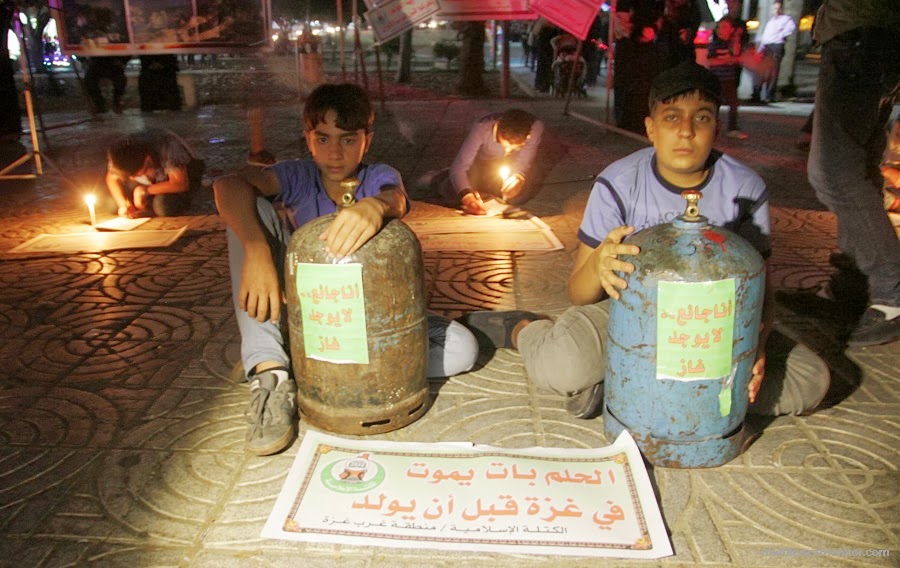
Jabalia refugee camp: Palestinian school boys light candles during a protest against the severe fuel cuts that lead to power shortages and the Israel's illegal 7 year siege.  Photo by:Mohammed Talatene, 7 November 2013.


Children protest power cuts and the impact on their ability to study and receive and education. 3 Nov 2013.


Palestinians in Gaza protest electricity cuts and fuel shortages due to Israel's blockade. Photo by Mohammed Assad, 14 November 2013


Palestinian ambulance and emergency service workers attend a rally in front of the Rafah border crossing with Egypt on February 18, 2012.   The emergency crews and ambulance workers called on Egypt provide the Gaza Strip with electricity and diesel. Photo by. UPI/Ismael Mohamad


Premature babies receive treatment in Nasser Hospital as the hospital is in danger of running out of fuel, in Khan Younis, southern Gaza on February 16, 2012.   Israel's illegal blockade has left Gaza with very little fuel rations for its citizen. Gaza hospitals, due to frequent electricity cuts are forced to rely on emergency generators to run life saving equipment, intensive care units and neo-natal units. Photo by: UPI/Ismael Mohamad

Palestinian worker carries a boy walking down the street flooded with sewage in the Sabra neighborhood in Gaza City. Photo by Mohammed Talatene, 13 Nov 2013.
 
Palestinians walk on the side of a street flooded with waste water in Gaza City, Thursday, Nov. 14, 2013. (AP Photo/Adel Hana)

A Palestinian rides his horse cart in flooded waste water at a main street in Gaza City, Thursday, Nov. 14, 2013.  (AP Photo/Adel Hana)

In February 2013, Egypt flooded tunnels which bring goods and fuel into Gaza as a result of Israel's blockade with sewage: A Palestinian clearing a tunnel of sewage in Rafah, between Egypt and the southern Gaza Strip. Photo by: Hatem Moussa/Associated Press

2010: Sewage flows into the sea as a result of Israel's blockade and destruction of water purification facilities.  Photo by: Anne Paq: Chroniques de Palestine, 21.08.2010.


Sunday, November 10, 2013

Call to Action: Stop Prawer! Stop Israel's ethnic cleansing of Palestinian Bedouins

Dear friends,
as many of you will be aware, the Israeli state is seeking to ethnically cleanse more than 40,000 Palestinian Bedouin from their homes and land in the Naqab (Negev) desert.   For the last year or more, Palestinians both inside the Zionist state and in the Occupied Territories have been protesting against what will be Israel's biggest mass expulsion and ethnic cleansing of Palestinian since 1948 and 1967.  Several national days of actions have taken place and another national and international day of action has been called for the 30th of November, 2013. 

I have included below the call to action, as well as links to my previous posts on the Prawer Plan.  In addition, I have included a news report from the Israeli newspaper, Haaretz which reports on an Israeli cabinet decision on the weekend to ethnically cleanse a Palestinian Bedouin village which has existed since 1956 and replace it with a Jewish only community.  

The Palestinian village of Umm al-Hiran is one of hundreds of "unrecognised villages", many of which have existed prior to 1948 or were established by Palestinian Bedouin in the wake of the 1948 Nabka after they had been  ethnically cleansed from their original place of residence and had become internally displaced refugees.   Israel has refused to recognise these villages and while the residents of the villages pay taxes to the Israeli state they are not afforded the same facilities other Israeli townships are - ie. access to the electricity grid, water grid and public infrastructure (such as roads and public state funded buildings).


The cabinet decision to demolish Umm al-Hiran and replace it with a Jewish only community is a prime example of Israeli apartheid and ethnic cleansing.

Join the international day of action against the Prawer Plan and Israel's planned ethnic cleansing of tens of thousands of Palestinian Bedouins.  You can do a range of things to support the action: Organise a street action/Organise a public campaign stall/Write a letter to your local newspaper/Ask your union/church/community group to support the Stop Prawer campaign/Write a blog post/Share the call to action via twitter and facebook/Share information and articles about the campaign and what the Prawer Plan means via social media etc.

Please see my previous post of my article, "Israel to escalate ethnic cleansing", published by Red Flag which gives an overview of the Prawer Plan and its impact (click here)

For more information on the Prawer Plan and previous days of action please see my previous posts on Live from Occupied Palestine:

July 15th: Anger Strike to stop Prawer Plan (click here)

IN PHOTOS: Palestinian General Strike Against Israel's Prawer-Begin Ethnic Cleansing Plan (click here)

Photos: Stop the Prawer-Begin Plan: Day of Rage - 1 Aug 2013 (click here)

in solidarity, Kim 

**

Stop Prawer Plan: Call to action on November 30th

On 24th of June, the Israeli Knesset approved the Prawer-Begin plan, which if implemented will result in the destruction of more than 35 unrecognized villages in Al-Naqab and the forced expulsion and confinement of more than 70,000 Palestinian Bedouins. The Prawer plan is the largest Israeli land-grab since 1948. It epitomizes the nature of Israel’s policy; Israeli-Jewish demographic expansion and Palestinian-Arab demographic containment.

The International community has repeatedly called on Israel to halt the implementation of the Prawer Plan due to its discriminatory nature and the severe infringement it causes on the rights of Palestinian Bedouins in Al-Naqab. The UN committee on the elimination of Racial Discrimination called on Israel to withdraw the proposed legislation of the Prawer Plan. Also, in 2012, the European Parliament passed a resolution calling on Israel to stop the Prawer plan and its policies of forced displacement and dispossession.

Injustice, humiliation and forced displacement are a recurring theme in Palestine’s history. This is lesson that we as a group of youth take to the heart. We will oppose, resist and work against the continuous assault that our communities, across Palestine face. Therefore, we launched the “Prawer will not pass” campaign with an eye to preventing this plan to be yet another chapter in Palestine’s long and tragic history.

Opposing the Prawer Plan is to oppose ethnic cleansing, displacement and confinement in the 21st century.

Join us by organizing marches, protests, sending letters to those with positions of influence in your country or community, by doing whatever you can, in order to force Israel to stop the Prawer plan.

Join us on the 30th of Nov. in saying “Prawer shall not Pass”.

For more information, please contact us on:
Email: PrawerWontPass@gmail.com
Facebook: https://www.facebook.com/prawershallnotpass

**

Unauthorized village makes cabinet agenda even though its future is in the court's hands.

By Shirly Seidler | Nov. 10, 2013, Haaretz
 
Israel's ministers voted in a special cabinet session on Sunday to demolish an unauthorized Bedouin village and replace it with a religious Jewish community. 

The session was held at Midreshet Ben-Gurion at Sde Boker in the Negev. The new community on the site is to be called Hiran. 

The Bedouin village slated for demolition, Umm al-Hiran, is one of a number of Bedouin communities that were settled without permits. 

The cabinet had already approved a blueprint known as the "Prawer plan," which calls for the resettlement of large numbers of Bedouin from unrecognized communities to recognized Bedouin villages. 

In this specific case, the cabinet met to discuss the fate of Umm al-Hiran even though its future is the subject of a Supreme Court case, which is scheduled to be heard next week.

Residents of the village have been offered a number of alternative places to live, but they plan to demonstrate at the courthouse against what they claim is discriminatory treatment by the state. 

The proposed construction of Hiran and three other new communities in the Negev won cabinet approval more than a decade ago, in 2002. Late in 2009 the National Council for Planning and Building gave its approval to build Hiran on the northern Negev site east of Meitar.

The core group of families slated to move to Hiran are national religious Jews, who are to be joined by secular residents moving to the site from Meitar itself. 

The village of Umm al-Hiran was established in 1956 as a place of residence for Bedouin from the Abu-Alkian tribe who had left a site near Kibbutz Shoval in the northern Negev, apparently due to conflicts with a neighboring clan. Umm al-Hiran is now home to about 500 people, but like other Bedouin villages that lack official recognition as local municipal communities, it lacks infrastructure and electricity. 

Sources at Adallah, the Legal Center for Arab Minority Rights in Israel, said Sunday that the establishment of Jewish communities in the Negev at the same time that the government is advancing the Prawer plan reflects a racist approach toward the Bedouin residents of the Negev. Instead of displacing the indigenous population of Bedouin, the sources said, the government should engage the community in a dialogue over an alternative to the Prawer relocation plan. 

The group organizing the demonstration at the Supreme Court, the Negev Coexistence Forum for Civil Equality, called the proposed demolition plan for Umm al-Hiran a policy that promotes social inequality between Jews and Arabs instead of seeking to bridge social disparities

Wednesday, November 6, 2013

The REAL Truth about the West Bank: Visualising Palestine responds to Danny Ayalon's propaganda video.

Dear friends,
In 2011, Danny Ayalon, who was at the time the Israeli deputy foreign minister, produced a ridiculous propaganda video called “The Truth About the West Bank", which of course was far from the truth and full of untruths. The crew at Visulising Palestine have now produced terrific rejoinder to Ayalon hasbara video.

Please watch and please share widely with your social media networks!
You can check out other great infographics and videos from Visualising Palestine on their website (click here)

In solidarity, Kim

**


Monday, November 4, 2013

BDS and Lawfare in Australia: Shurat HaDin launch spurious case against Palestine activist

Dear friends, 
please find below my latest article published by Red Flag on the Zionist lawfare attack on Professor Jake Lynch and BDS in Australia by the Israeli group, Shurat HaDin. 

It should be noted that The Australian newspaper has run a concerted campaign against Jake Lynch and the BDS campaign for the last year or more, so it unsurprising that Shurat HaDin feel comfortable with attempting this legal intimidation of pro-Palestine activists.

For more background information on Shurat HaDin and the attack on Jake Lynch, please see my earlier posts:

  • SpinWatch: BDS campaigner targeted by law firm with links to Israeli intelligence(click here)
  • BDS, Lawfare & Free speech: Growing support for BDS campaigners (click here)
  • The Australian newspaper and BDS: A case study in obsession (click here)

Asa Winstanley from Electronic Intifada also recently covered Shurat HaDin's lawfare attack on Jake Lynch and Stuart Rees (click here to read the article).

You can also sign on to the petition in support of Jake Lynch, to defend free speech and BDS by clicking here.

In solidarity, Kim 

**
Spurious case against Palestine activist


By Kim Bullimore: Red Flag: 2 November 2013

On 29 October, the Israel-based law centre Shurat HaDin filed a case in the Australian Federal Court against Professor Jake Lynch, the director of the University of Sydney’s Centre for Peace and Conflict Studies, over his support of the Palestinian-initiated boycott, divestment and sanctions (BDS) campaign.
The BDS campaign calls for the boycott of Israeli academic and cultural institutions that are complicit in the system of oppression that denies Palestinians their basic rights.

Lynch had been previously targeted by Shurat HaDin, along with Professor Stuart Rees, when the centre lodged a claim against them and the BDS campaign with the Australian Human Rights Commission on 31 July.

In both instances, Shurat HaDin has accused Lynch and the BDS campaign of breaching the 1975 Racial Discrimination Act, which deems it unlawful to discriminate against a person “based on race, colour, descent or national or ethnic origin”.

The BDS campaign does not target individuals, businesses or institutions on the basis of religion, ethnicity or nationality. Businesses and institutions are boycotted on the basis of their contribution to human rights abuses, their contribution to the violations of international law by the Israeli state and military or their contribution to “rebranding campaigns” that attempt to whitewash Israel’s human rights abuses and war crimes.

Shurat HaDin claims that Lynch’s support for BDS and his refusal to sponsor a fellowship application for Israeli academic Dan Avnon from the Hebrew University violates Australian law.

In December 2012, Avnon approached Lynch for assistance to study civics education in Australia under a fellowship agreement between the Hebrew University and Sydney University. Lynch declined to assist Avnon because of Lynch’s opposition to the fellowship agreement between the two institutions, not because Avnon was Israeli or Jewish, as Shurat HaDin claims.

The Hebrew University has a long history of complicity with Israel’s human rights abuses against the Palestinian people, part of the university’s Jerusalem campus and dormitories being built on stolen Palestinian land in violation of the Fourth Geneva Convention.

The university also has strong ties with the Israeli government and military establishment. A range of Israeli military colleges and training facilities are the responsibility of the university. It also has links to Elbit Systems, one of Israel’s largest military companies. Michael Federman, the chairman of Elbit Systems, is on the Hebrew University Board of Governors. A September 2012 report to the United Nations General Assembly named Elbit Systems for its complicity with Israel’s human rights abuses and war crimes in the occupied Palestinian territories.

Since its launch in 2005 by 171 Palestinian civil society groups, the BDS campaign has gone from strength to strength. In response, Shurat HaDin and a range of other pro-Zionist individuals, groups and organisations have launched a campaign of “lawfare” to undermine the rights of pro-Palestine activists to free speech and freedom of assembly.

Lawfare proponents such as Shurat HaDin regularly use SLAPP suits (strategic lawsuits against public participation) to try to damage political opponents by either financially crippling them or tying them up in court and/or to win public relations victories for the lawfare proponent.

In most instances, SLAPP suit proponents do not expect to win their suit. Their primary goal is to prevent public participation and political activism through intimidation and mounting legal costs.
Shurat HaDin has launched a range of SLAPP suits around the world and in Australia had previously threatened legal proceedings against both World Vision Australia and AusAID, the Australian government developmental aid organisation. It claimed that their support for the Union of Agricultural Work Committees (UAWC) in Gaza violated Australian and US counter-terrorism legislation. After conducting an investigation into the claims, both organisations found that there was no merit whatsoever to Shurat HaDin’s claims.

Shurat HaDin since its inception in 2003 has claimed to be a “fully independent non-profit organisation, unaffiliated with any political party or governmental body”. However, earlier this month, the UK public investigation group Spin Watch revealed that Shurat HaDin in fact acts as a proxy for the Israeli government.

In a 5 October Spin Watch article, Tom Griffin and David Miller cited US government cables opened by WikiLeaks, which revealed that Nitsana Darshan-Leitner, the founder and director of Shurat HaDin, had “privately admitted to taking direction from the Israeli government over which cases to pursue and relying on Israeli intelligence contracts for witnesses and evidence”.

On 31 October, the Executive Council of Australian Jewry (ECAJ), one of the key Zionist lobby groups in Australia, which has opposed the Palestinian BDS campaign and falsely labelled it “anti-Semitic”, issued a press statement distancing itself from Shurat HaDin’s actions.

ECAJ’s executive director, Peter Wertheim, noted that Shurat HaDin’s campaign against Jake Lynch was being pursued “merely as a political tactic”. ECAJ’s attempt to distance itself from Shurat HaDin’s lawfare campaign against Lynch is no doubt informed by the fact that lawfare attempts against other BDS activists in France, England, Scotland, the USA and Australia have failed.

Shurat HaDin’s lawfare attack on Lynch, academic freedom and freedom of speech has also been condemned by more than 2,000 Australian and international human rights advocates from more than 60 countries, who have signed a pledge supporting BDS and offering to be co-defendants in any legal action taken against Lynch.

The case is scheduled to be heard in the Federal Court on 27 November.

Spurious case against Palestine activist

On 29 October, the Israel-based law centre Shurat HaDin filed a case in the Australian Federal Court against Professor Jake Lynch, the director of the University of Sydney’s Centre for Peace and Conflict Studies, over his support of the Palestinian-initiated boycott, divestment and sanctions (BDS) campaign.
The BDS campaign calls for the boycott of Israeli academic and cultural institutions that are complicit in the system of oppression that denies Palestinians their basic rights.
Lynch had been previously targeted by Shurat HaDin, along with Professor Stuart Rees, when the centre lodged a claim against them and the BDS campaign with the Australian Human Rights Commission on 31 July.
In both instances, Shurat HaDin has accused Lynch and the BDS campaign of breaching the 1975 Racial Discrimination Act, which deems it unlawful to discriminate against a person “based on race, colour, descent or national or ethnic origin”.
The BDS campaign does not target individuals, businesses or institutions on the basis of religion, ethnicity or nationality. Businesses and institutions are boycotted on the basis of their contribution to human rights abuses, their contribution to the violations of international law by the Israeli state and military or their contribution to “rebranding campaigns” that attempt to whitewash Israel’s human rights abuses and war crimes.
Shurat HaDin claims that Lynch’s support for BDS and his refusal to sponsor a fellowship application for Israeli academic Dan Avnon from the Hebrew University violates Australian law.
In December 2012, Avnon approached Lynch for assistance to study civics education in Australia under a fellowship agreement between the Hebrew University and Sydney University. Lynch declined to assist Avnon because of Lynch’s opposition to the fellowship agreement between the two institutions, not because Avnon was Israeli or Jewish, as Shurat HaDin claims.
The Hebrew University has a long history of complicity with Israel’s human rights abuses against the Palestinian people, part of the university’s Jerusalem campus and dormitories being built on stolen Palestinian land in violation of the Fourth Geneva Convention.
The university also has strong ties with the Israeli government and military establishment. A range of Israeli military colleges and training facilities are the responsibility of the university. It also has links to Elbit Systems, one of Israel’s largest military companies. Michael Federman, the chairman of Elbit Systems, is on the Hebrew University Board of Governors. A September 2012 report to the United Nations General Assembly named Elbit Systems for its complicity with Israel’s human rights abuses and war crimes in the occupied Palestinian territories.
Since its launch in 2005 by 171 Palestinian civil society groups, the BDS campaign has gone from strength to strength. In response, Shurat HaDin and a range of other pro-Zionist individuals, groups and organisations have launched a campaign of “lawfare” to undermine the rights of pro-Palestine activists to free speech and freedom of assembly.
Lawfare proponents such as Shurat HaDin regularly use SLAPP suits (strategic lawsuits against public participation) to try to damage political opponents by either financially crippling them or tying them up in court and/or to win public relations victories for the lawfare proponent.
In most instances, SLAPP suit proponents do not expect to win their suit. Their primary goal is to prevent public participation and political activism through intimidation and mounting legal costs.
Shurat HaDin has launched a range of SLAPP suits around the world and in Australia had previously threatened legal proceedings against both World Vision Australia and AusAID, the Australian government developmental aid organisation. It claimed that their support for the Union of Agricultural Work Committees (UAWC) in Gaza violated Australian and US counter-terrorism legislation. After conducting an investigation into the claims, both organisations found that there was no merit whatsoever to Shurat HaDin’s claims.
Shurat HaDin since its inception in 2003 has claimed to be a “fully independent non-profit organisation, unaffiliated with any political party or governmental body”. However, earlier this month, the UK public investigation group Spin Watch revealed that Shurat HaDin in fact acts as a proxy for the Israeli government.
In a 5 October Spin Watch article, Tom Griffin and David Miller cited US government cables opened by WikiLeaks, which revealed that Nitsana Darshan-Leitner, the founder and director of Shurat HaDin, had “privately admitted to taking direction from the Israeli government over which cases to pursue and relying on Israeli intelligence contracts for witnesses and evidence”.
On 31 October, the Executive Council of Australian Jewry (ECAJ), one of the key Zionist lobby groups in Australia, which has opposed the Palestinian BDS campaign and falsely labelled it “anti-Semitic”, issued a press statement distancing itself from Shurat HaDin’s actions.
ECAJ’s executive director, Peter Wertheim, noted that Shurat HaDin’s campaign against Jake Lynch was being pursued “merely as a political tactic”. ECAJ’s attempt to distance itself from Shurat HaDin’s lawfare campaign against Lynch is no doubt informed by the fact that lawfare attempts against other BDS activists in France, England, Scotland, the USA and Australia have failed.
Shurat HaDin’s lawfare attack on Lynch, academic freedom and freedom of speech has also been condemned by more than 2,000 Australian and international human rights advocates from more than 60 countries, who have signed a pledge supporting BDS and offering to be co-defendants in any legal action taken against Lynch.
The case is scheduled to be heard in the Federal Court on 27 November.
- See more at: http://redflag.org.au/article/spurious-case-against-palestine-activist#sthash.dxiOXUTQ.dpuf

Spurious case against Palestine activist

On 29 October, the Israel-based law centre Shurat HaDin filed a case in the Australian Federal Court against Professor Jake Lynch, the director of the University of Sydney’s Centre for Peace and Conflict Studies, over his support of the Palestinian-initiated boycott, divestment and sanctions (BDS) campaign.
The BDS campaign calls for the boycott of Israeli academic and cultural institutions that are complicit in the system of oppression that denies Palestinians their basic rights.
Lynch had been previously targeted by Shurat HaDin, along with Professor Stuart Rees, when the centre lodged a claim against them and the BDS campaign with the Australian Human Rights Commission on 31 July.
In both instances, Shurat HaDin has accused Lynch and the BDS campaign of breaching the 1975 Racial Discrimination Act, which deems it unlawful to discriminate against a person “based on race, colour, descent or national or ethnic origin”.
The BDS campaign does not target individuals, businesses or institutions on the basis of religion, ethnicity or nationality. Businesses and institutions are boycotted on the basis of their contribution to human rights abuses, their contribution to the violations of international law by the Israeli state and military or their contribution to “rebranding campaigns” that attempt to whitewash Israel’s human rights abuses and war crimes.
Shurat HaDin claims that Lynch’s support for BDS and his refusal to sponsor a fellowship application for Israeli academic Dan Avnon from the Hebrew University violates Australian law.
In December 2012, Avnon approached Lynch for assistance to study civics education in Australia under a fellowship agreement between the Hebrew University and Sydney University. Lynch declined to assist Avnon because of Lynch’s opposition to the fellowship agreement between the two institutions, not because Avnon was Israeli or Jewish, as Shurat HaDin claims.
The Hebrew University has a long history of complicity with Israel’s human rights abuses against the Palestinian people, part of the university’s Jerusalem campus and dormitories being built on stolen Palestinian land in violation of the Fourth Geneva Convention.
The university also has strong ties with the Israeli government and military establishment. A range of Israeli military colleges and training facilities are the responsibility of the university. It also has links to Elbit Systems, one of Israel’s largest military companies. Michael Federman, the chairman of Elbit Systems, is on the Hebrew University Board of Governors. A September 2012 report to the United Nations General Assembly named Elbit Systems for its complicity with Israel’s human rights abuses and war crimes in the occupied Palestinian territories.
Since its launch in 2005 by 171 Palestinian civil society groups, the BDS campaign has gone from strength to strength. In response, Shurat HaDin and a range of other pro-Zionist individuals, groups and organisations have launched a campaign of “lawfare” to undermine the rights of pro-Palestine activists to free speech and freedom of assembly.
Lawfare proponents such as Shurat HaDin regularly use SLAPP suits (strategic lawsuits against public participation) to try to damage political opponents by either financially crippling them or tying them up in court and/or to win public relations victories for the lawfare proponent.
In most instances, SLAPP suit proponents do not expect to win their suit. Their primary goal is to prevent public participation and political activism through intimidation and mounting legal costs.
Shurat HaDin has launched a range of SLAPP suits around the world and in Australia had previously threatened legal proceedings against both World Vision Australia and AusAID, the Australian government developmental aid organisation. It claimed that their support for the Union of Agricultural Work Committees (UAWC) in Gaza violated Australian and US counter-terrorism legislation. After conducting an investigation into the claims, both organisations found that there was no merit whatsoever to Shurat HaDin’s claims.
Shurat HaDin since its inception in 2003 has claimed to be a “fully independent non-profit organisation, unaffiliated with any political party or governmental body”. However, earlier this month, the UK public investigation group Spin Watch revealed that Shurat HaDin in fact acts as a proxy for the Israeli government.
In a 5 October Spin Watch article, Tom Griffin and David Miller cited US government cables opened by WikiLeaks, which revealed that Nitsana Darshan-Leitner, the founder and director of Shurat HaDin, had “privately admitted to taking direction from the Israeli government over which cases to pursue and relying on Israeli intelligence contracts for witnesses and evidence”.
On 31 October, the Executive Council of Australian Jewry (ECAJ), one of the key Zionist lobby groups in Australia, which has opposed the Palestinian BDS campaign and falsely labelled it “anti-Semitic”, issued a press statement distancing itself from Shurat HaDin’s actions.
ECAJ’s executive director, Peter Wertheim, noted that Shurat HaDin’s campaign against Jake Lynch was being pursued “merely as a political tactic”. ECAJ’s attempt to distance itself from Shurat HaDin’s lawfare campaign against Lynch is no doubt informed by the fact that lawfare attempts against other BDS activists in France, England, Scotland, the USA and Australia have failed.
Shurat HaDin’s lawfare attack on Lynch, academic freedom and freedom of speech has also been condemned by more than 2,000 Australian and international human rights advocates from more than 60 countries, who have signed a pledge supporting BDS and offering to be co-defendants in any legal action taken against Lynch.
The case is scheduled to be heard in the Federal Court on 27 November.
- See more at: http://redflag.org.au/article/spurious-case-against-palestine-activist#sthash.dxiOXUTQ.dpuf

Tuesday, October 29, 2013

Palestinian culture, art & resistance in Israel: Le Mur a Des Oreilles interview with Palestinian actor, Saleh Bakri

Dear friends,
A wonderful interview with my friend Palestinian actor, Saleh Bakri, which wsa conducted earlier this month by Frank Barat from Le Mur a Des Oreilles, a monthly radio show on and for Palestine. Les Mur a Des Oreilles, on Radio Panik in Belguim, hosts a range of interviews with artists, academics, activists and others who share their experiences in the struggle for Palestinians’ rights.
 In the interview Saleh discusses the intersection between cultural, art and politics, including his career as an actor, his rejection of Israeli and Zionists attempts to appropriate both him and his work in order to white wash Israel's occupation and apartheid policies and what it means to be a Palestinian living inside the Zionist state.

Saleh also discusses the documentary Jenin Jenin about Israel's 2002 invasion of Jenin refugee camp which was made by his father - Palestinian actor and director Mohammed Bakri - and the attacks on his father by the Israeli state and military for making the film exposing Israel's warcrimes and the 10 year campaign to censor and discredit the documentary.

The interview is audio only and in english. It goes for 30 minutes and is well worth listening too!
To check out the original upload of the interview at Le Mur a Des Oreilles and listen to other of their programs and interviews, you can visit the show's website here.
Hebrew to English translation of Gideon Levy article on Saleh and Mohammed Bakri 
I have also included along with the audio of the interview with Frank Barat, a translation of Gideon Levy's article on Saleh and Mohammed Bakri which appeared in Haaretz.  Unfortunately, the article only appeared in Hebrew, but my friend Sol Salbe has kindly translated it and made it available for people.  Please see it in full below.

in solidarity,
Kim
Exclusive Interview with Saleh Bakri: 
 Le Mur a Des Oreilles with Frank Barat, 19 October 2013
***
Bakri, Bakri 

by Gideon Levy : Haaretz (Hebrew edition): 24 October 2013
English translation by Sol Salbe

We love our "Israeli Arabs" in flat bread, whether in the smaller thicker pita or the larger, thinner Druze/Lebanese lafa. For us it's hummus at  Abu-Shukri ( "the genuine article" ), Koftas at Diana's and kebabs at Al Barbour - that's the way we love them. That's how we fancied  Muhammad Bakri when he played a leading role in Beyond the Walls. He was awarded the David's Violin prize for it. That's also how we loved his son Saleh: when he starred in the Band's Visit. For that role he won an Ophir Prize - the Israeli equivalent of the Oscars. That's the way we love ourselves as well: Look at us, so enlightened, so egalitarian. Arab actors are beautifully successful in the only democracy. Why, we even broadcast Arab Labour --  which pokes fun at Jewish-Arab relations in this country -- on prime time. How liberal is that?

But look, look at what happens when those "good Arabs" step outside the hummus-chips-salad boundaries that we've designated for them --  they immediately become the enemies of the people. It was like that with Muhammad, and same again with Saleh. Their story stretches far beyond the boundaries of their village, Ba'ana, it extends even beyond their roles in the Israeli theatre and cinema. The Bakri Saga is the story of the Israelis' attitude to the Palestinian citizens of the state.

The slanders against Muhammad Bakri began immediately after several members of his extended family were suspected of involvement in deadly Mount Meron terrorist attack, for which two of them were convicted. Bakri the elder became a marked man. Then came Jenin, Jenin oh, Jenin, Jenin, and he was sentenced to the vilest form of character assassination and to a life of ostracism and persecution. All Israeli propaganda films, whether overt or covert, are all based on pure  unadulterated truth, and only the Jenin, Jenin is a lie that need to haunted to death. No war crimes were committed in the destroyed Jenin camp; of course not. And Bakri who may have exaggerated a little in his film, is the real criminal.

The High Court of Justice, sitting as Film Review Board, decreed that film was made for an improper reasons. That was a particularly puzzling and outrageous criterion, although it rejected the libel suit filed by a group of voluble, patriotic reservists. Since then, this gifted creator, this wonderful actor and esteemed director who was so integrated into the art scene, has become a broken man. He who was opposed to violence on both sides, and who was as sharply critical of his own people at least as much he was of his state has, became a bitter person  his voice has almost been silenced and the fount of his work has almost dried up.

Now it's the son's turn. Saleh said in an interview aired this week in Belgium, that he does not feel any connection to Israel. "It ruined my life, my father's life, the life of my people."  Why should he feel otherwise. Unlike Istvan Szabo's Mephistopheles, Saleh said that he won't act anymore in Israeli plays and films. "My decision is a protest against the rising fascism", he explained. He is unwilling to serve as fig leaf "to make Israel look good, as a flourishing democracy."

Yuck, what ungrateful so-and-sos. The Israelis "let" the father study at Tel Aviv University and appear on the stages of the national theatre Habima, as well as in the Haifa and Khan theatres. The son was  permitted to study at the Ben-Zvi Institute and perform at national theatre and at the Acco Festival [in Acca/Acco/Acre.] To paraphrase the prophet Isaiah: Children [Arabs] we have raised and exalted, yet they have rebelled against us.

When Muhammad was being pursued over his film, almost all his fellow artists, actors and directors remained silent. Almost no one came to his aid, no one protested his persecution because of his work. Now that Saleh has expressed his protest and is willing to pay a heavy personal price, this disgraceful silence of the lambs would continue.

Mohammed and Saleh are bad Arabs. They are unwilling to continue to participate in a masquerade called Israeli democracy. They are unwilling to dance to the sounds of the Israeli Magic Flute, which shows them off as a badge of honour, as long as they are submissive slaves. They are  unwilling to cuddle up to racism whether institutionalised or popular. They don't want to entertain the Israelis who are part of this racism and thus help them feel so good about themselves. But instead of father and son being shown solidarity and esteem, at least among the so-called Israeli avant-garde, the response to their action has been a shameful silence . Bakri and his son will not play with us anymore, so what? We have the next music reality TV coming up.

Hebrew original: http://www.haaretz.co.il/opinions/.premium-1.2147653

Translated by Sol Salbe of the Middle East News Service, Melbourne, Australia. 
 

For the original translation by Sol, which appears on his Facebook page, please click here.
**

List of Saleh Bakri's major roles and films:
Year Title Role Notes
2007 The Band's Visit Khaled Original title: Bikur Ha-Tizmoret
2008 Salt of this Sea Emad Original title: Milh Hadha al-Bahr
2009 The Time That Remains Fuad
2011 The Source Sami Original title: La Source des Femmes
2012 When I Saw You Layth


 2013 Salvo                            Salvo

Salvo

When I Saw You (Palestinian film)

Salt of This Sea (Palestinian film)

Saturday, October 19, 2013

Video: Israel's New Racism: The Persecution of African Migrants in the Holy Land

Dear friends,
for the last couple of years, Israeli journalist David Sheen has been documenting the increasing racism inside Israel against African migrants, refugees and asylum seekers.  Currently, according to the Israeli Interior Ministry there is to 55,000 undocumented workers and asylum seekers from Africa inside the Zionist state.

Please find below Sheen's latest video, produced in collaboration with American Jewish activist and author, Max Blumenthal.  Blumenthal has noted in an article on Electronic Intifada, that their report was initially commissioned by the New York Tiimes.  However, once the New York Times has seen the content of the story, they refused to publish it.  You can read Blumenthal's full article here.


I have also included below an article I wrote in 2007 which looks at Israel's anti-African racism and the connection between it and Israel's anti-Palestinian laws and racism. As Sheen notes in the video the laws used to detain and persecute African migrants and refugees in Israel and deny them rights are an updated version of laws enacted by Israel in the 1950s to prevent Palestinian refugees from returning to their homes and property after their expulsion during the Nakba.  

I have also included an article from JTA which includes interviews with African refugees, outlining the conditions they are forced to live under inside Israel.


You can also keep update on this topic via David Sheen's excellent blog and website on the issue, which you can access here.

In solidarity, Kim 


**


**


Sunday, August 26, 2007 - Green Left Weekly

On August 20, Israel deported 50 Sudanese refugees who had entered the country from Egypt. The deportation went ahead despite 63 of the 120 members of the Knesset (Israel's parliament) signing a petition calling on the Olmert government to allow them to remain in Israel until an alternative country could be found to take them in.

The deported refugees were from the Darfur region of Sudan, where an estimated 200,000 people have been killed in the past two years. There are currently 2800 asylum seekers, primarily from Africa, within Israel. Around 1200 are from Sudan.

Sudanese citizens arrested in Israel are officially considered a "security threat", as Israel has designated Sudan an "enemy state". As a result, Israel has detained many Sudanese refugees under the 1954 Prevention of Infiltration Law, rather than the Entrance to Israel Law. Under the Entrance to Israel Law, refugees and illegal immigrants have the right to judicial oversight. There is no similar provision in the Prevention of Infiltration Law.

The Prevention of Infiltration Law allows refugees to be held for years in detention. Israel first enacted the law in order to prevent 750,000 Palestinian refugees who had fled Zionist terror gangs in 1947 and 1948 from returning to their homes in the territory claimed by the newly established state of Israel. The law was enacted in contravention of international laws and resolutions passed by the UN recognising the right of Palestinian refugees to return to their homes.

Under the law, an "infiltrator" is anyone who "entered Israel knowingly and unlawfully" after November 29, 1947, despite the fact that the state was not established until six months later. According to the law, a person is "unlawful" if they are a citizen of Lebanon, Egypt, Syria, Saudi Arabia, Trans-Jordan, Iraq or Yemen; if they were resident or a visitor of anyone of those countries or any part of Palestine outside of Israel; or if they are a Palestinian citizen or resident without Israeli nationality or citizenship, or whose citizenship is "doubtful" and who had "left his ordinary place of residence in an area which has become part of Israel for a place outside of Israel". Under the law, an "infiltrator" can be jailed for up to 15 years.

Around 30,000 Palestinian refugees were either arrested by Israel and deported to Lebanon, Syria and Jordan or jailed and then expelled when their prison sentence ended. In addition, many internally displaced Palestinian refugees who remained in the borders of what was to become Israel but had been unable to gain Israeli citizenship were rounded up and deported under the law. In an attempt to prevent Palestinian refugees from re-entering Israel, the Zionist state also razed Palestinian villages along the new Israeli border and established settlements. A policy of "free fire" was adopted in the border settlements, enabling the shooting of any Palestinians attempting to return to their homes.

According to Badil, an Israel-based Palestinian residence and refugee advocacy group, the 1954 law worked hand in hand with the "absentee" property laws that allowed the Israeli state to "legally" take control of property and land belonging to Palestinian refugees and prevent their return to their homes.

In the case of the Sudanese refugees, Israel contends that it has the right to return refugees to the country they were "resident" or "visitors" in prior to arriving in Israel, in this case Egypt.

A poll by the Kevoon Institute found that 47% of Israelis supported the government expelling the Sudanese refugees, while 39% opposed it. YNet reported on August 6 that "Of those who identified themselves as strictly Orthodox, 67% were in favor of expulsion compared to 13% who opposed it. Among respondents who identified themselves as religious, 55% were in favor of expulsion compared to 35% who were opposed. Similar figures were noted for respondents who defined themselves as traditional — 52% favored expulsion compared to 31% who opposed it.

"The only sector where support for the government's policy was the minority opinion was among secular respondents — 39% favored expulsion compared to 49% who opposed it."

**

For African migrants in Israel, a life in legal limbo

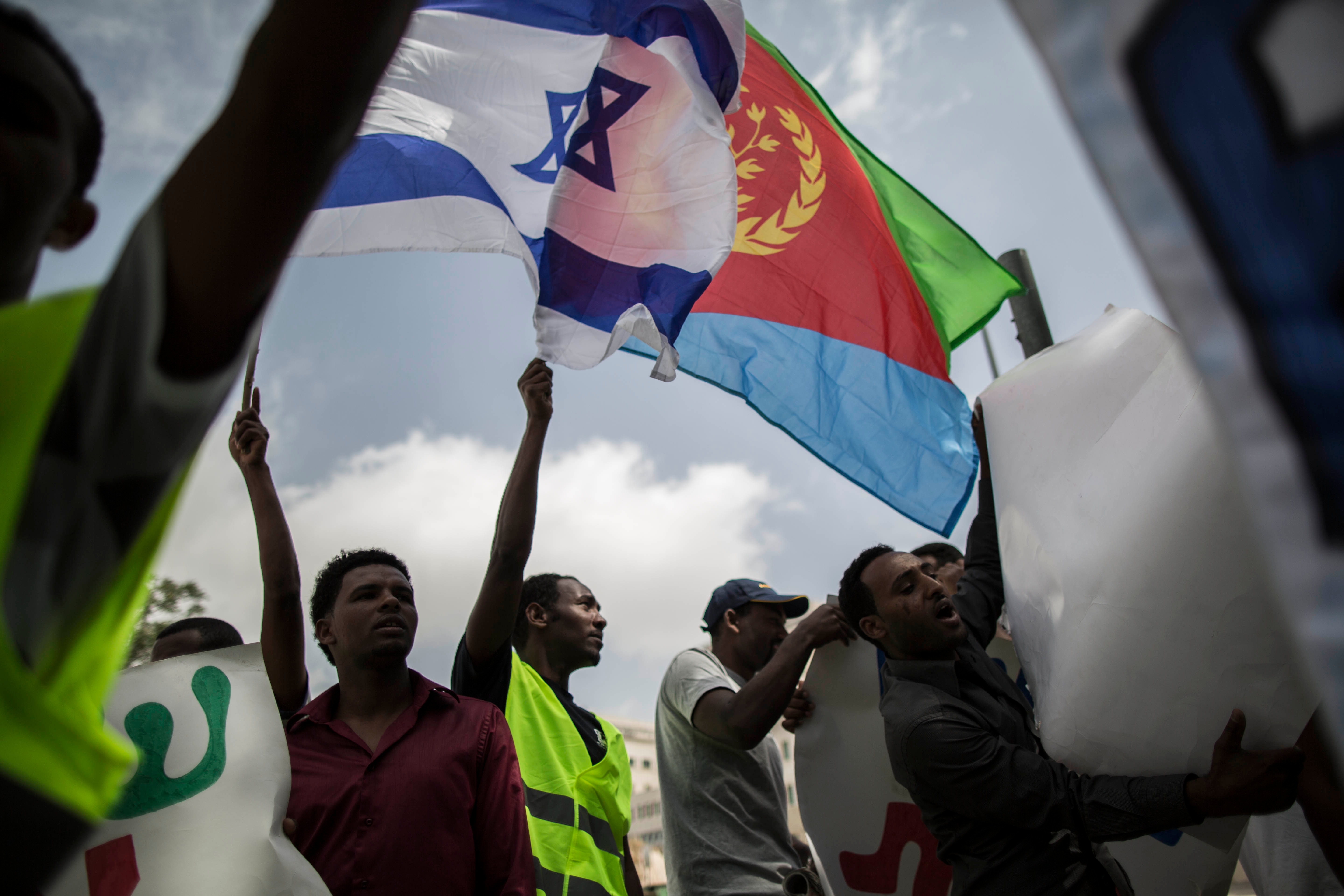
Eritrean refugees gathering outside Prime Minister's Office in Jerusalem for a demonstration against the deportation of refugees from Israel, June 9, 2013. (Yonatan Sindel/Flash90)
Eritrean refugees gathering outside Prime Minister’s Office in Jerusalem for a demonstration against the deportation of refugees from Israel, June 9, 2013. (Yonatan Sindel/Flash90)

TEL AVIV (JTA) — Hanging by his feet in a torture cell in the Sinai Desert, Dawit Demoz knew he had only one way to escape a nearly certain death: He would have to make good on his captors’ demand of a $3,500 ransom to buy his freedom.

Demoz, 23, tells a harrowing tale of escaping mandatory conscription in the Eritrean Army and following a desperate journey through Sudan, Libya and finally Egypt, where a human trafficking gang captured him in 2010 as he made his way toward the Israeli border.

For three weeks, Demoz claims, he was beaten, electrocuted and hung from the ceiling until his family was able to come up with the money to buy his freedom.

Demoz then was smuggled across the border into Israel, following a path that tens of thousands of Eritreans had followed before. He had hoped his struggles might finally be over. But as soon as he crossed the border, he was thrown in jail.

“I heard that Israel is a democratic country with Jewish people who know what a refugee is because they suffered before,” Demoz said. “So I thought Israel could save our life. But it’s not what I expected.”

Demoz is one of an estimated 62,000 migrants who have illegally crossed into Israel since 2006 — most of them Eritrean men driven from their homeland by an oppressive dictatorship that drafts them into the military as teenagers and can keep them there indefinitely. According to the United Nations, there are more than 300,000 Eritrean refugees and asylum seekers worldwide.

In Israel, they live without fear of torture and death. But their rising numbers have led to a backlash here, prompting a government crackdown that has nearly eliminated the cross-border flow. In July, Israel sent 13 detained Eritreans back home and has been urging others to self-deport for more than a year.
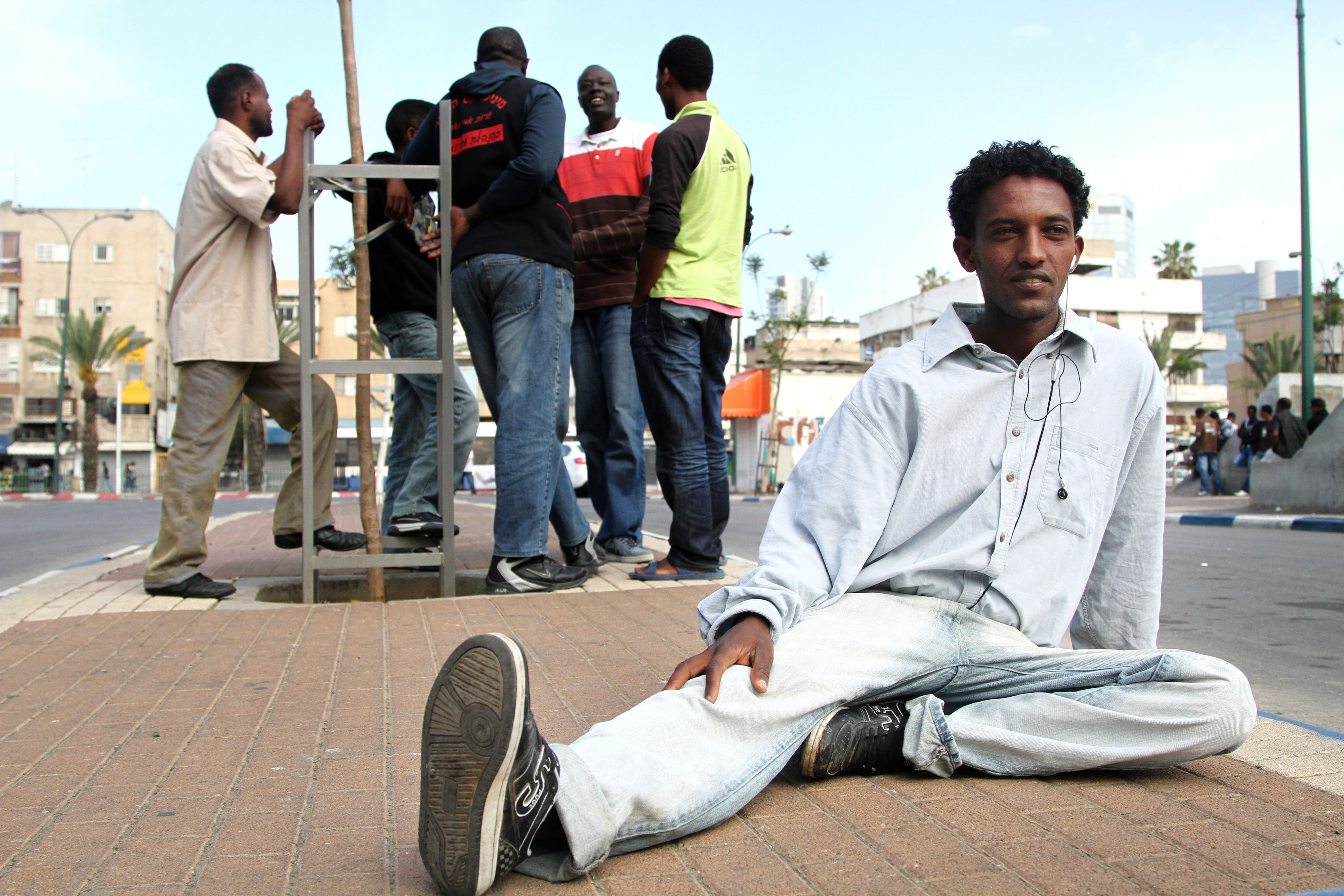
JTA PHOTO: For African migrants in Israel, a life in legal limbo Sudanese and Eritrean refugees gather in the Levinski Park area in south Tel Aviv. (Nicky Kelvin/Flash90/JTA)
Sudanese and Eritrean refugees gather in the Levinski Park area in south Tel Aviv. (Nicky Kelvin/Flash90/JTA)

But though the influx has stopped, nearly 55,000 migrants remain in Israel, most of them in Tel Aviv. The government affords them limited rights and services, but does not recognize them as refugees, instead giving them temporary IDs they must renew every three months.

For these migrants, who arrived in Israel with no money, no Hebrew and no work permit, daily life often is a challenge.

“These are people who are here five years, and when they go to the Interior Ministry, they don’t know what will happen,” said Orit Marom, director of public activism for Assaf, a nonprofit that helps illegal migrants receive social services. “They’re always temporary.”

Like many Eritreans who have crossed into Israel, Demoz spent his first three months in jail while Israel determined his status. Upon his release, the army took him to Beersheva and gave him a one-way bus ticket to Tel Aviv.

His first three nights were spent with other Eritreans in a park across from the Tel Aviv bus station. But then a friend from back home found Demoz and took him into a one-room apartment he shared with three other men. It’s crowded, Demoz says, but better than sleeping outside.

“Some don’t have a place to sleep,” said Nordin Ishag, a Darfurian who came to Israel in 2007 and last year founded Darfur Friends Association, a social service organization. “They were sleeping in the park, the street. We cannot let them sleep outside. They are human beings.”

Despite its refusal to grant them permanent residence, the Israeli government provides a range of services to the migrants. Children receive free education through high school and infants get free medical care. This year, the Health Ministry opened an emergency medical clinic for migrants at the Tel Aviv Central Bus Station, and a Tel Aviv municipal program provides child psychiatric services and access to government services to the migrant population.

An array of community nonprofits also have sprung up to help.

The Schoolhouse provides English classes and helps migrants qualify for employment, while the Darfur Friends Association offers legal advocacy, health care and English classes funded almost entirely by local Darfurians. Ishag estimates the organization receives monthly donations of about $25 each from 300 donors.

For many, $25 is a significant sum. Demoz’s first job in Israel, working seven days a week at a metal shop, paid him just about $6.50 an hour. He has found each of his subsequent jobs — pool cleaning, building platforms for construction and working at a Herzliya hotel — through employment contractors in south Tel Aviv. The contractors match asylum seekers with jobs and pay their salaries — often with fees attached, ostensibly for taxes.

“There is one big problem here — we have no ID, no papers, no life,” said Sammy, 32, an Eritrean who worked 14 hours a day, seven days a week as a restaurant dishwasher before he was fired, with no severance, after three years.

Sammy was interviewed recently at a health clinic for asylum seekers and migrant workers run by Physicians for Human Rights-Israel. The clinic, staffed by volunteer doctors with specialties ranging from gynecology to physiotherapy, treats 7,000 people a year. For many of them, it is their only realistic way to get health care.

“It’s difficult to get a doctor beyond the human rights doctors,” said Ananwuna, 41, who said he owes nearly $10,000 to an Israeli health care provider for the 2010 removal of a uterine tumor.
Some Eritreans have managed to achieve a measure of success. Habton Mehari, 31, who came here in 2007 and calls himself “the luckiest refugee in Israel,” is on a full scholarship at Ben-Gurion University.

As of last year, he’s also a father, but the Interior Ministry won’t register his son in his name. He is also $3,000 in debt from his wife’s labor, he says, and often faces racism when he leaves campus.
For Demoz, the future remains uncertain. He hopes to be able to return home at some point. Until then, he wants the Israeli government to recognize him as a refugee.

“I want to be here and for the Israeli government to treat me like a human being,” he said. “All Eritreans who live in Israel want to go back to Eritrea, but we can’t go back now. These people have no other option.”