Dear friends,
this week my good friend Bassem Tamimi was brought before Israel military occupation courts for organising non-violent demonstrations in opposition to Israel's occupation and apartheid policy and the on going stealing of his village's land by the illegal Israeli colony of Halamish.
Please find below a media release from the Popular Struggle Coordination Committee about Bassem's court appearance. The media release also includes, in full, Bassem's speech to the military court (one which he was not allowed to give in full).
The Real News have also put together an excellent news report on the struggle of An Nabi Saleh and the arrest of Bassem and Naji Tamimi.
You can keep up to date with the struggle of the people of An Nabi SAleh by visiting the Nabi Saleh Solidarity blog at: http://nabisalehsolidarity.wordpress.com/
Or you can join the Nabi Saleh Solidarity facebook page at: http://www.facebook.com/pages/Nabi-Saleh-Solidarity/177013109017209
In solidarity,
Kim
***
Video story by Real News
West Bank Protest Organizer, Bassem Tamimi, to Judge: “Your Military Laws Are Non-Legit. Our Peaceful Protest is Just”
By Popular Struggle Coordination Committee
Press release: Monday, 6 June 2011
West Bank Protest Organizer, Bassem Tamimi, to Judge: “Your Military Laws Are Non-Legit. Our Peaceful Protest is Just”
Tamimi, who has been held in custody for over two months, pleaded not guilty to the charges against him and held a defiant speech explaining his motivation for organizing civil resistance to the Occupation. (See his full statement below)
After more than two months in custody, the trial of Bassem Tamimi, a 44 year-old protest organizer from the West Bank village of Nabi Saleh, finally commenced yesterday. Tamimi, who is the coordinator for the Nabi Saleh popular committee, pleaded not guilty to the charges laid against him.
In a defiant speech handed before a crowded courtroom, Tamimi proudly owned up to organizing the protest in the village saying, “I organized these peaceful demonstrations to defend our land and our people.” Tamimi also challenged the legitimacy of the very system which trys him, saying that “Despite claiming to be the only democracy in the Middle East you are trying me under military laws [...] that are enacted by authorities which I haven’t elected and do not represent me.” (See Tamimi’s full statement at court bellow).
Tamimi was interrupted by the judge who warned him that it was not a political trial, and that such statements were out of place in a courtroom. Tamimi was cut short and not allowed to deliver his full statement.
After Tamimi finished reading his shortened statement, the judge announced that the hearing’s protocol has been erroneously deleted. However he refused to submit the full written statement to the stenographer. She went on to dictate a short summary in her own words for official record.
Media contact: Jonathan Pollak +972-54-632-7736
The indictment against Tamimi is based on questionable and coerced confessions of youth from the village. He is charged with’ incitement’, ‘organizing and participating in unauthorized processions’,’ solicitation to stone-throwing’, ‘failure to attend legal summons’, and a scandalous charge of ‘disruption of legal proceedings’, for allegedly giving youth advice on how to act during police interrogation in the event that they are arrested.
The transcript of Tamimi’s police interrogation further demonstrates the police and Military Prosecution’s political motivation and disregard for the suspect’s rights. During his questioning, Tamimi was accused by his interrogator of “consulting lawyers and foreigners to prepare for his interrogation”, an act that is in no way in breach of the law.
Tamimi’s full statement:
Your Honor,
I hold this speech out of belief in peace, justice, freedom, the right to live in dignity, and out of respect for free thought in the absence of Just Laws.
Every time I am called to appear before your courts, I become nervous and afraid. Eighteen years ago, my sister was killed by in a courtroom such as this, by a staff member. In my lifetime, I have been nine times imprisoned for an overall of almost 3 years, though I was never charged or convicted. During my imprisonment, I was paralyzed as a result of torture by your investigators. My wife was detained, my children were wounded, my land was stolen by settlers, and now my house is slated for demolition.
I was born at the same time as the Occupation and have been living under its inherent inhumanity, inequality, racism and lack of freedom ever since. Yet, despite all this, my belief in human values and the need for peace in this land have never been shaken. Suffering and oppression did not fill my heart with hatred for anyone, nor did they kindle feelings of revenge. To the contrary, they reinforced my belief in peace and national standing as an adequate response to the inhumanity of Occupation.
International law guarantees the right of occupied people to resist Occupation. In practicing my right, I have called for and organized peaceful popular demonstrations against the Occupation, settler attacks and the theft of more than half of the land of my village, Nabi Saleh, where the graves of my ancestors have lain since time immemorial.
I organized these peaceful demonstrations in order to defend our land and our people. I do not know if my actions violate your Occupation laws. As far as I am concerned, these laws do not apply to me and are devoid of meaning. Having been enacted by Occupation authorities, I reject them and cannot recognize their validity.
Despite claiming to be the only democracy in the Middle East you are trying me under military laws which lack any legitimacy; laws that are enacted by authorities that I have not elected and do not represent me. I am accused of organizing peaceful civil demonstrations that have no military aspects and are legal under international law.
We have the right to express our rejection of Occupation in all of its forms; to defend our freedom and dignity as a people and to seek justice and peace in our land in order to protect our children and secure their future.
The civil nature of our actions is the light that will overcome the darkness of the Occupation, bringing a dawn of freedom that will warm the cold wrists in chains, sweep despair from the soul and end decades of oppression.
These actions are what will expose the true face of the Occupation, where soldiers point their guns at a woman walking to her fields or at checkpoints; at a child who wants to drink from the sweet water of his ancestors’ fabled spring; against an old man who wants to sit in the shade of an olive tree, once mother to him, now burnt by settlers.
We have exhausted all possible actions to stop attacks by settlers, who refuse to adhere to your courts’ decisions, which time and again have confirmed that we are the owners of the land, ordering the removal of the fence erected by them.
Each time we tried to approach our land, implementing these decisions, we were attacked by settlers, who prevented us from reaching it as if it were their own.
Our demonstrations are in protest of injustice. We work hand in hand with Israeli and international activists who believe, like us, that had it not been for the Occupation, we could all live in peace on this land. I do not know which laws are upheld by generals who are inhibited by fear and insecurity, nor do I know their thoughts on the civil resistance of women, children and old men who carry hope and olive branches. But I know what justice and reason are. Land theft and tree-burning is unjust. Violent repression of our demonstrations and protests and your detention camps are not evidence of the illegality of our actions. It is unfair to be tryed under a law forced upon us. I know that I have rights and my actions are just.
The military prosecutor accuses me of inciting the protesters to throw stones at the soldiers. This is not true. What incites protesters to throw stones is the sound of bullets, the Occupation’s bulldozers as they destroy the land, the smell of teargas and the smoke coming from burnt houses. I did not incite anyone to throw stones, but I am not responsible for the security of your soldiers who invade my village and attack my people with all the weapons of death and the equipment of terror.
These demonstrations that I organize have had a positive influence over my beliefs; they allowed me to see people from the other side who believe in peace and share my struggle for freedom. Those freedom fighters have rid their conscious from the Occupation and put their hands in ours in peaceful demonstrations against our common enemy, the Occupation. They have become friends, sisters and brothers. We fight together for a better future for our children and theirs.
If released by the judge will I be convinced thereby that justice still prevails in your courts? Regardless of how just or unjust this ruling will be, and despite all your racist and inhumane practices and Occupation, we will continue to believe in peace, justice and human values. We will still raise our children to love; love the land and the people without discrimination of race, religion or ethnicity; embodying thus the message of the Messenger of Peace, Jesus Christ, who urged us to “love our enemy.” With love and justice, we make peace and build the future.
Background
Bassem Tamimi is a veteran Palestinian grassroots activist from the West Bank village of Nabi Saleh, north of Ramallah. He is married to Nariman Tamimi, with whom he fathers four children – Wa’ed (14), Ahed (10), Mohammed (8) and Salam (5).
As a veteran activist, Tamimi has been arrested by the Israeli army 11 times to date and has spent roughly three years in Israeli jails, though he was never convicted of any offence. He spent roughly three years in administrative detention, with no charges brought against him. Furthermore, his attorney and he were denied access to “secret evidence” brought against him.
In 1993, Tamimi was falsely arrested on suspicion of having murdered an Israeli settler in Beit El – an allegation of which he was cleared entirely. During his weeks-long interrogation, he was severely tortured by the Israeli Shin Bet in order to draw a coerced confession from him. During his interrogation, and as a result of the torture he underwent, Tamimi collapsed and had to be evacuated to a hospital, where he laid unconscious for seven days.
As one of the organizers of the Nabi Saleh protests and coordinator of the village’s popular committee, Tamimi has been the target of harsh treatment by the Israeli army. Since demonstrations began in the village, his house has been raided and ransacked numerous times, his wife was twice arrested and two of his sons were injured; Wa’ed, 14, was hospitalized for five days when a rubber-coated bullet penetrated his leg and Mohammed, 8, was injured by a tear-gas projectile that was shot directly at him and hit him in the shoulder. Shortly after demonstrations in the village began, the Israeli Civil Administration served ten demolition orders to structures located in Area C, Tamimi’s house was one of them, despite the fact that it was built in 1965.
Legal background
On the March 24th, 2011, a massive contingent of Israeli Soldiers raided the Tamimi home at around noon, only minutes after he entered the house to prepare for a meeting with a European diplomat. He was arrested and subsequently charged.
The main evidence in Tamimi’s case is the testimony of 14 year-old Islam Dar Ayyoub, also from Nabi Saleh, who was taken from his bed at gunpoint on the night of January 23rd. In his interrogation the morning after his arrest, Islam alleged that Bassem and Naji Tamimi organized groups of youth into “brigades”, charged with different responsibilities during the demonstrations: some were allegedly in charge of stone-throwing, others of blocking roads, etc.
During a trial-within-a-trial procedure in Islam’s trial, motioning for his testimony to be ruled inadmissible, it was proven that his interrogation was fundamentally flawed and violated the rights set forth in the Israeli Youth Law in the following ways:
1.Despite being a minor, he was questioned in the morning following his arrest, having been denied sleep.
2.He was denied legal counsel, although his lawyer appeared at the police station requesting to see him.
3.He was denied his right to have a parent present during his questioning.
4.He was not informed of his right to remain silent, and was even told by his interrogators that he is “expected to tell the truth”.
5.Only one of four interrogators present was a qualified youth interrogator.
While the trial-within-a-trial procedure has not yet reached conclusion, the evidence already revealed has brought a Military Court of Appeals to revise its remand decision and order Islam’s release to house arrest.
Over the past two months, the army has arrested 24 of Nabi Saleh’s residents on protest related suspicions. Half of those arrested are minors, the youngest of whom is merely eleven.
Ever since the beginning of the village’s struggle against settler takeover of their lands in December of 2009, the army has conducted 71 protest related arrests. As the entire village numbers just over 500 residents, the number constitutes approximately 10% of its population.
Tamimi’s arrest corresponds to the systematic arrest of civil protest leaders all around the West Bank, as in the case of the villages Bil’in and Ni’ilin.
Only recently the Military Court of Appeals has aggravated the sentence of Abdallah Abu Rahmah from the village of Bilin, sending him to 16 months imprisonment on charges of incitement and organizing illegal demonstrations. Abu Rahmah was released on March 2011.
The arrest and trial of Abu Rahmah has been widely condemned by the international community, most notably by Britain and EU foreign minister, Catherin Ashton. Harsh criticism of the arrest has also been offered by leading human rights organizations in Israel and around the world, among them B’tselem, ACRI, as well as Human Rights Watch, which declared Abu Rahmah’s trial unfair, and Amnesty International, which declared Abu Rahmah a prisoner of conscience.
Showing posts with label Bassem Tamimi. Show all posts
Showing posts with label Bassem Tamimi. Show all posts
Wednesday, June 15, 2011

Tuesday, March 29, 2011
Reality vs Propaganda: the truth about the An Nabi Saleh protests
Dear friends,
please find below my latest article. A version of the article has been published by Palestine Chronicle at:http://www.palestinechronicle.com/view_article_details.php?id=16755
As mentioned in the article, I recently produced about An Nabi Saleh, which includes interview with Naji and Bassem Tamimi. YOu can view the video here: http://www.youtube.com/watch?v=-FnaYdG2MJU (or below on this blog).
Please feel free to distribute the article and the video to your networks.
in solidarity, Kim
***
Reality vs Propaganda: the truth about the An Nabi Saleh protests
By Kim Bullimore
On 26 March, a piece of Israeli Occupation Forces propaganda masquerading as journalism was published by YNet, an Israeli news website, which publishes in both Hebrew and English. The Ynet article, headlined “Secrets of Nabi Saleh protests” purported to offer a “behind-scenes look at [the] most violent protests around” [1]. However, the article by Yair Altman did nothing of the sort. Instead it gave carte blanche coverage, with little questioning, to the preposterous and often ridiculous assertions by Israeli Occupation officials against the recently arrested non-violent Palestinian leaders from An Nabi Saleh's Popular Committee against the Occupation.
According to Altman, An Nabi Saleh village leader, Naji Tamimi, who was arrested on 6 March when the Israeli military raided his home at 1.30 am in the morning, was a “pied piper” who “organised [an] army of boys”. Quoting an unnamed Israeli military police official, Altman writes: "Tamimi oversees an army of demonstrators divided in an extremely organized fashion into regiments of 14-17 people”.

Naji Tamimi in An Nabi Saleh
According to Altman's unnamed military police source, Naji Tamimi is “a very charismatic and militant person and is well versed in the rules of the game – what's allowed and what isn't. He does nothing by chance. Every action is well planned – not a folksy protest. He excites them and directs them towards confrontations with IDF forces”.
Altman goes onto state, with absolutely no proof to back up his assertions, that Naji Tamimi directed the demonstrations by phone from “the roof of one of the village's structures”. Altman also asserts in the article that the shabab (young boys) of the village were under the command of another village leader, Bassem Tamimi, who was arrested on March 24 when dozens of Israeli military stormed his home.
When I first read Altman's article, I burst out laughing. I have known both Naji Tamimi and Bassem Tamimi, along with their families, for more than fifteen months. The men described in Altman’s article, along with the actions ascribed to them, bore little resemblance to the men I know or their activities in relation to the non-violent struggle being carried out by their village. Having spent large quantities of time with both men and their families and having attended numerous demonstrations in An Nabi Saleh, very little in Altman's article rang true. Instead it held the stench of unadulterated Israeli military propaganda.
I first met Naji Tamimi and Bassem Tamimi, when I attended the first demonstrations in An Nabi Saleh. In December 2009, An Nabi Saleh - a small village of just 500 people – began holding weekly non-violent demonstrations in opposition to the illegal Israeli colony of Halamish annexing and stealing of more of the village’s land. At the conclusion of the first demonstration I attended in the village, I was invited to visit Naji's home by his brother-in-law. At Naji's home, I was introduced to not only Naji and his family but also to Bassem and his family and other families who were also visiting at the time. In the weeks that followed, I visited the village many times, both on the days of the demonstrations and on days when there were no demonstrations. During my visits to the village, I spent time with Naji and Bassem's families. We spent our time discussing the impact of Israel's occupation on the village and the Palestinian people and the non-violent struggle of the village against the attempts to steal more of the village's land. During these visits, I also played games with the children, learning to bake bread and tried to practice and improve, with the help of my new friends, my limited and badly pronounced Arabic. Over the course of the next year, after I had returned back home, I kept in regular touch with both Naji and Bassem and their families. When I returned to Palestine recently, An Nabi Saleh was the first place I visited in the Occupied Palestinian Territories.
The focus of the dozens of conversations that I had with both men was the importance of the development of a non-violent model of protest. Both Naji and Bassem believed in the power of non-violent struggle and the challenge it provided, in stark contrast, to the brutal colonial violence meted out each week by Israel's Occupation Forces against their tiny village and its non-violent protests.
During the many demonstrations that I attended in An Nabi Saleh, myself and other internationals, as well as Israeli activists opposed to their government’s policies, would join with Naji and Bassem and other members of the village to walk unarmed and peacefully from the centre of the village, out onto the main street of An Nabi Saleh in order to make our way peacefully to the village’s land which were being stolen by the Israeli colony of Halamish.
As we marched peacefully onto the street, we would be hit almost immediately with a barrage of teargas and rubber bullets fired at the peaceful, non-violent demonstration by the Israeli military. On numerous occasions, live ammunition was also fired at us, despite the fact that this is in direct violation of Israeli military operating orders which forbid such actions when Israeli citizens are present at the demonstrations. The non-violent demonstrations would start at noon and the violent assault on the village by the Israeli military would continue for the next five or six hours until the Israeli Occupation Forces would finally leave the village at dusk.
As Bassem noted in a recent video interview I did with both him and Naji before their arrests, the Israeli military was determined to break An Nabi Saleh's model of non-violent resistance to the occupation [2]. The primary aim of the Israeli military, as Bassem noted, was to try and force Palestinians to engage in violent resistance to the occupation by crushing the non-violent resistance by increased Israeli military violence. This way, Israel could justify its continued occupation and oppression of the Palestinian people.
A recent article by the Israeli newspaper, The Jerusalem Post, similarly noted that the primary concern of the Israeli Occupation Forces, particularly in the wake of the recent Egyptian revolution, has been to contain and crush any possible Palestinian non-violent resistance to Israel's ongoing occupation. According to the February 18 Jerusalem Post article, the Israeli military were “concerned by the prospect of the Palestinians replicating [non-violent] Egyptian style mass demonstrations with dozens of simultaneous marches and protests in the West Bank [3]. The Jerusalem Post article reported that “the IDF is beginning to build rapid-response forces”, as the Israeli Occupation Forces Central Comment had assessed “that Palestinians could resort to so-called non-violent resistance, on a scale previously unknown in Israel, in the absence of peace negotiations”. The article went on to note that the primary aim of the rapid response teams would be to “quickly manoeuvre throughout the West Bank and arrive at the scene of a demonstration in its early stages in an attempt to contain it”, with this containment possibly “lead[ing] to a high number of casualties”.
The attempts by the Israeli state and its military to crush the non-violent Palestinian resistance is not new. In 2004, I interviewed the leaders of the non-violent struggle in the tiny village of Budrus about the attempts by the Israeli military to crush their non-violent resistance to the building of the Apartheid Wall. At the time, one of the village leaders told me that he had been informed by commanders of Israel's military that the Israeli Occupation Forces “would do everything in its power to stop the [non-violent] movement, even if it meant people died” [4].
Approximately two years ago, unable to stop the non-violent resistance by Palestinian villages against the building of the Apartheid Wall and the Occupation, the Israeli state and its military introduced its current tactic of arresting and jailing leaders of the non-violent struggle. In 2009, Adeeb Abu Rahma and Abdullah Abu Rahma, two of the leaders of the Bil'in non-violent struggle were arrested and jailed. This month, less than 10 days after the release of Abdullah Abu Rahma, after he had spent a year and half in Israel's prisons for his non-violent activism, Bassem Tamimi was arrested for his non-violent activism. Just twenty-four hours before his arrest on March 24, Bassem had met with leaders of the Bil'in Popular Committee Against the Wall, one of whom had quipped “Now that Abdullah Abu Rahma has been released from jail, the Israeli soldiers and the honorable military tribunal judges will have time for Bassem Tamimi” [6]

Bassem Tamimi (centre) in Bil'in with Abdullah Abu Rahma (on left) after Abdullah's release from Israeli prison.
One of the few positive things about Altman's article about the popular non-violent resistance in An Nabi Saleh is that it clearly outlines the ridiculous charges being levelled against Naji Tamimi by the Israeli Occupation Forces. According to Altman, the charges include “incitement, supporting a hostile organization, taking part in an illegal procession and entering a closed military area ...”. Of course, what Altman or the Israeli military fail to mention is the fact that an occupied people do not need the permission of their occupier to hold demonstrations, instead under international law they have the right to resist colonial occupation and repression and to engage in civil disobedience and demonstrations. While international law affords Palestinians the right, as an occupied people, to engage in armed struggle against their occupier, the people of An Nabi Saleh choose to engage in unarmed and non-violent struggle against their oppressors and occupiers. In addition, far from “entering a closed military area”, Naji Tamimi was simply in his own village and the Israeli military came to him and imposed a closed military zone on the streets and fields of his home.
Altman also points out in his piece that the Israeli Occupation Forces had arrested several boys from the village, all under the age of 16 and that their testimony was being used against Naji Tamimi and Bassem Tamimi. However, as Jonathan Pollak, an Israeli activist who is belatedly quoted in Altman's article notes, what the Israeli military police fail to mention is that the testimonies were extracted from the children via verbal, emotional and physical abuse. The testimony being used against both Naji Tamimi and Bassem Tamimi was obtained primarily from 14 year old Islam Tamimi, as well as his younger brother, 11 year old Kareem.
Islam Tamimi was kidnapped from his home at gun point at 3 am on 23 January by the Israeli military. He was kept incommunicado, beaten and verbally abused. Islam's parents and lawyer were denied access to him. In early February, Kareem was kidnapped from the streets of An Nabi Saleh and held for five hours during which the terrified child was verbally, emotionally and physically abused. The behaviour meted out to both boys was typical of the treatment visited on Palestinian child prisoners by the Israeli military

Islam Tamimi, 14 years old.
As a recent report issued by the UN in January 2011 points out in 2010 Israeli occupation forces regularly arrested children “at checkpoints, off the street or, most commonly, from the family home” [7]. The Report of the Special Rapporteur on the situation of human rights in the Palestinian territories occupied since 1967, went onto note that “in the case of house arrests, large numbers of Israeli soldiers typically surrounded the family home in the middle of the night. Children were beaten or kicked at the time of arrest and put at the back of a military vehicle where they were subject to further physical and psychological abuse on the way to the interrogation and detention centre. Upon arrest, children and their families were seldom informed of the charges against them”. According to the UN report, “Children were often subject to abuse during interrogation”. The report noted that abuse of children in many cases included the children being given electric shocks and sexually assaulted and it was only after this treatment that the children provided their interrogators with confessions
The UN report noted that “each year, approximately 700 Palestinian children (under 18) from the West Bank are prosecuted in Israeli military courts after being arrested, interrogated and detained by the Israeli army”. The report went onto highlight the fact that Palestinian children are subject to a dual legal system which operates in the Occupied Palestinian Territories. This dual system sees settler children, who are rarely apprehended in any violent acts they may have carried out, prosecuted in the Israeli civil courts, while Palestinian children are brought before a military court system, which impose higher degrees of accountability at lower ages.
In the weeks before I left Palestine, I spoke with both Naji and Bassem many times. They knew their arrests were imminent but the remained steadfast and committed to the non-violent popular struggle and the struggle of their village for human rights and dignity. As Naji told me, “we cannot live under the occupation ... we want, like all the people in the world, our rights. We want to build our state and we want a good future for our children”.

Non-violent protest in An Nabi Saleh - Photo by Oren Ziv.
Naji has now been in prison for three and half weeks. It took the Israeli military 19 days to finally come up with charges against him. The Israeli military court has also ordered that he will be kept under indefinite remand until the military legal procedures against him are concluded. No news has come through yet on Bassem since his arrest, but in the coming days we can expect to hear that similar preposterous accusations and charges, similar to the ones outlined in Altman's article against Naji Tamimi, will be laid against him.
Despite the arrests and the repression, the people of An Nabi Saleh are not bowed and they will continue their struggle against the occupation and the stealing of their land. As Bassem told me when I interviewed him before his arrest, “Our duty is to resist the stealing of our life and our land”.
“We are under occupation, the normal thing is to resist against the occupation. The non-normal thing is to be quite and not do anything”.
Kim Bullimore is a volunteer with the International Women’s Peace Service in Palestine (www.iwps.info). Kim writes regularly on the Israel-Palestine conflict for the Australian newspaper, Direct Action (www.directaction.org.au) and has a blog at www.livefromoccupiedpalestine.blogspot.com
[1] http://www.ynetnews.com/articles/0,7340,L-4047503,00.html
[2] http://www.youtube.com/watch?v=-FnaYdG2MJU
[3] http://www.jpost.com/Defense/Article.aspx?ID=208786&R=R1?
[4] http://www.greenleft.org.au/node/30781
[5] http://www.haaretz.com/print-edition/features/mighty-israel-and-its-quest-to-quash-palestinian-popular-protest-1.352248
[6] http://richardfalk.wordpress.com/2011/02/14/report-of-special-rapporteur-to-the-un-human-rights-council-on-occupied-palestinian-territories/
please find below my latest article. A version of the article has been published by Palestine Chronicle at:http://www.palestinechronicle.com/view_article_details.php?id=16755
As mentioned in the article, I recently produced about An Nabi Saleh, which includes interview with Naji and Bassem Tamimi. YOu can view the video here: http://www.youtube.com/watch?v=-FnaYdG2MJU (or below on this blog).
Please feel free to distribute the article and the video to your networks.
in solidarity, Kim
***
Reality vs Propaganda: the truth about the An Nabi Saleh protests
By Kim Bullimore
On 26 March, a piece of Israeli Occupation Forces propaganda masquerading as journalism was published by YNet, an Israeli news website, which publishes in both Hebrew and English. The Ynet article, headlined “Secrets of Nabi Saleh protests” purported to offer a “behind-scenes look at [the] most violent protests around” [1]. However, the article by Yair Altman did nothing of the sort. Instead it gave carte blanche coverage, with little questioning, to the preposterous and often ridiculous assertions by Israeli Occupation officials against the recently arrested non-violent Palestinian leaders from An Nabi Saleh's Popular Committee against the Occupation.
According to Altman, An Nabi Saleh village leader, Naji Tamimi, who was arrested on 6 March when the Israeli military raided his home at 1.30 am in the morning, was a “pied piper” who “organised [an] army of boys”. Quoting an unnamed Israeli military police official, Altman writes: "Tamimi oversees an army of demonstrators divided in an extremely organized fashion into regiments of 14-17 people”.
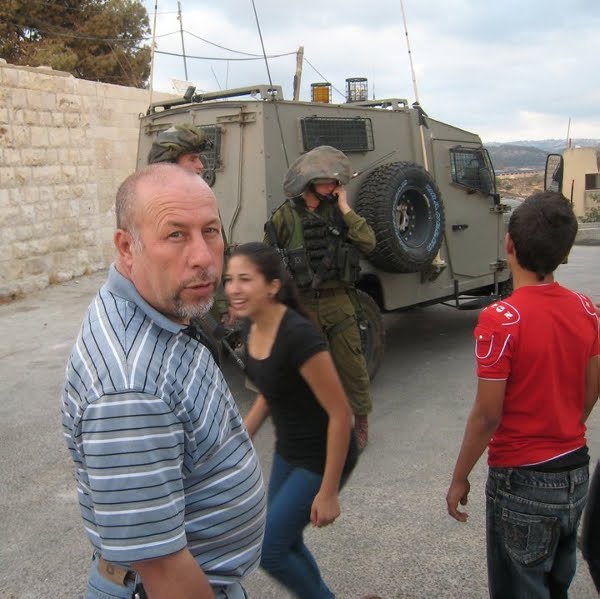
Naji Tamimi in An Nabi Saleh
According to Altman's unnamed military police source, Naji Tamimi is “a very charismatic and militant person and is well versed in the rules of the game – what's allowed and what isn't. He does nothing by chance. Every action is well planned – not a folksy protest. He excites them and directs them towards confrontations with IDF forces”.
Altman goes onto state, with absolutely no proof to back up his assertions, that Naji Tamimi directed the demonstrations by phone from “the roof of one of the village's structures”. Altman also asserts in the article that the shabab (young boys) of the village were under the command of another village leader, Bassem Tamimi, who was arrested on March 24 when dozens of Israeli military stormed his home.
When I first read Altman's article, I burst out laughing. I have known both Naji Tamimi and Bassem Tamimi, along with their families, for more than fifteen months. The men described in Altman’s article, along with the actions ascribed to them, bore little resemblance to the men I know or their activities in relation to the non-violent struggle being carried out by their village. Having spent large quantities of time with both men and their families and having attended numerous demonstrations in An Nabi Saleh, very little in Altman's article rang true. Instead it held the stench of unadulterated Israeli military propaganda.
I first met Naji Tamimi and Bassem Tamimi, when I attended the first demonstrations in An Nabi Saleh. In December 2009, An Nabi Saleh - a small village of just 500 people – began holding weekly non-violent demonstrations in opposition to the illegal Israeli colony of Halamish annexing and stealing of more of the village’s land. At the conclusion of the first demonstration I attended in the village, I was invited to visit Naji's home by his brother-in-law. At Naji's home, I was introduced to not only Naji and his family but also to Bassem and his family and other families who were also visiting at the time. In the weeks that followed, I visited the village many times, both on the days of the demonstrations and on days when there were no demonstrations. During my visits to the village, I spent time with Naji and Bassem's families. We spent our time discussing the impact of Israel's occupation on the village and the Palestinian people and the non-violent struggle of the village against the attempts to steal more of the village's land. During these visits, I also played games with the children, learning to bake bread and tried to practice and improve, with the help of my new friends, my limited and badly pronounced Arabic. Over the course of the next year, after I had returned back home, I kept in regular touch with both Naji and Bassem and their families. When I returned to Palestine recently, An Nabi Saleh was the first place I visited in the Occupied Palestinian Territories.
The focus of the dozens of conversations that I had with both men was the importance of the development of a non-violent model of protest. Both Naji and Bassem believed in the power of non-violent struggle and the challenge it provided, in stark contrast, to the brutal colonial violence meted out each week by Israel's Occupation Forces against their tiny village and its non-violent protests.
During the many demonstrations that I attended in An Nabi Saleh, myself and other internationals, as well as Israeli activists opposed to their government’s policies, would join with Naji and Bassem and other members of the village to walk unarmed and peacefully from the centre of the village, out onto the main street of An Nabi Saleh in order to make our way peacefully to the village’s land which were being stolen by the Israeli colony of Halamish.
As we marched peacefully onto the street, we would be hit almost immediately with a barrage of teargas and rubber bullets fired at the peaceful, non-violent demonstration by the Israeli military. On numerous occasions, live ammunition was also fired at us, despite the fact that this is in direct violation of Israeli military operating orders which forbid such actions when Israeli citizens are present at the demonstrations. The non-violent demonstrations would start at noon and the violent assault on the village by the Israeli military would continue for the next five or six hours until the Israeli Occupation Forces would finally leave the village at dusk.
As Bassem noted in a recent video interview I did with both him and Naji before their arrests, the Israeli military was determined to break An Nabi Saleh's model of non-violent resistance to the occupation [2]. The primary aim of the Israeli military, as Bassem noted, was to try and force Palestinians to engage in violent resistance to the occupation by crushing the non-violent resistance by increased Israeli military violence. This way, Israel could justify its continued occupation and oppression of the Palestinian people.
A recent article by the Israeli newspaper, The Jerusalem Post, similarly noted that the primary concern of the Israeli Occupation Forces, particularly in the wake of the recent Egyptian revolution, has been to contain and crush any possible Palestinian non-violent resistance to Israel's ongoing occupation. According to the February 18 Jerusalem Post article, the Israeli military were “concerned by the prospect of the Palestinians replicating [non-violent] Egyptian style mass demonstrations with dozens of simultaneous marches and protests in the West Bank [3]. The Jerusalem Post article reported that “the IDF is beginning to build rapid-response forces”, as the Israeli Occupation Forces Central Comment had assessed “that Palestinians could resort to so-called non-violent resistance, on a scale previously unknown in Israel, in the absence of peace negotiations”. The article went on to note that the primary aim of the rapid response teams would be to “quickly manoeuvre throughout the West Bank and arrive at the scene of a demonstration in its early stages in an attempt to contain it”, with this containment possibly “lead[ing] to a high number of casualties”.
The attempts by the Israeli state and its military to crush the non-violent Palestinian resistance is not new. In 2004, I interviewed the leaders of the non-violent struggle in the tiny village of Budrus about the attempts by the Israeli military to crush their non-violent resistance to the building of the Apartheid Wall. At the time, one of the village leaders told me that he had been informed by commanders of Israel's military that the Israeli Occupation Forces “would do everything in its power to stop the [non-violent] movement, even if it meant people died” [4].
Approximately two years ago, unable to stop the non-violent resistance by Palestinian villages against the building of the Apartheid Wall and the Occupation, the Israeli state and its military introduced its current tactic of arresting and jailing leaders of the non-violent struggle. In 2009, Adeeb Abu Rahma and Abdullah Abu Rahma, two of the leaders of the Bil'in non-violent struggle were arrested and jailed. This month, less than 10 days after the release of Abdullah Abu Rahma, after he had spent a year and half in Israel's prisons for his non-violent activism, Bassem Tamimi was arrested for his non-violent activism. Just twenty-four hours before his arrest on March 24, Bassem had met with leaders of the Bil'in Popular Committee Against the Wall, one of whom had quipped “Now that Abdullah Abu Rahma has been released from jail, the Israeli soldiers and the honorable military tribunal judges will have time for Bassem Tamimi” [6]

Bassem Tamimi (centre) in Bil'in with Abdullah Abu Rahma (on left) after Abdullah's release from Israeli prison.
One of the few positive things about Altman's article about the popular non-violent resistance in An Nabi Saleh is that it clearly outlines the ridiculous charges being levelled against Naji Tamimi by the Israeli Occupation Forces. According to Altman, the charges include “incitement, supporting a hostile organization, taking part in an illegal procession and entering a closed military area ...”. Of course, what Altman or the Israeli military fail to mention is the fact that an occupied people do not need the permission of their occupier to hold demonstrations, instead under international law they have the right to resist colonial occupation and repression and to engage in civil disobedience and demonstrations. While international law affords Palestinians the right, as an occupied people, to engage in armed struggle against their occupier, the people of An Nabi Saleh choose to engage in unarmed and non-violent struggle against their oppressors and occupiers. In addition, far from “entering a closed military area”, Naji Tamimi was simply in his own village and the Israeli military came to him and imposed a closed military zone on the streets and fields of his home.
Altman also points out in his piece that the Israeli Occupation Forces had arrested several boys from the village, all under the age of 16 and that their testimony was being used against Naji Tamimi and Bassem Tamimi. However, as Jonathan Pollak, an Israeli activist who is belatedly quoted in Altman's article notes, what the Israeli military police fail to mention is that the testimonies were extracted from the children via verbal, emotional and physical abuse. The testimony being used against both Naji Tamimi and Bassem Tamimi was obtained primarily from 14 year old Islam Tamimi, as well as his younger brother, 11 year old Kareem.
Islam Tamimi was kidnapped from his home at gun point at 3 am on 23 January by the Israeli military. He was kept incommunicado, beaten and verbally abused. Islam's parents and lawyer were denied access to him. In early February, Kareem was kidnapped from the streets of An Nabi Saleh and held for five hours during which the terrified child was verbally, emotionally and physically abused. The behaviour meted out to both boys was typical of the treatment visited on Palestinian child prisoners by the Israeli military

Islam Tamimi, 14 years old.
As a recent report issued by the UN in January 2011 points out in 2010 Israeli occupation forces regularly arrested children “at checkpoints, off the street or, most commonly, from the family home” [7]. The Report of the Special Rapporteur on the situation of human rights in the Palestinian territories occupied since 1967, went onto note that “in the case of house arrests, large numbers of Israeli soldiers typically surrounded the family home in the middle of the night. Children were beaten or kicked at the time of arrest and put at the back of a military vehicle where they were subject to further physical and psychological abuse on the way to the interrogation and detention centre. Upon arrest, children and their families were seldom informed of the charges against them”. According to the UN report, “Children were often subject to abuse during interrogation”. The report noted that abuse of children in many cases included the children being given electric shocks and sexually assaulted and it was only after this treatment that the children provided their interrogators with confessions
The UN report noted that “each year, approximately 700 Palestinian children (under 18) from the West Bank are prosecuted in Israeli military courts after being arrested, interrogated and detained by the Israeli army”. The report went onto highlight the fact that Palestinian children are subject to a dual legal system which operates in the Occupied Palestinian Territories. This dual system sees settler children, who are rarely apprehended in any violent acts they may have carried out, prosecuted in the Israeli civil courts, while Palestinian children are brought before a military court system, which impose higher degrees of accountability at lower ages.
In the weeks before I left Palestine, I spoke with both Naji and Bassem many times. They knew their arrests were imminent but the remained steadfast and committed to the non-violent popular struggle and the struggle of their village for human rights and dignity. As Naji told me, “we cannot live under the occupation ... we want, like all the people in the world, our rights. We want to build our state and we want a good future for our children”.

Non-violent protest in An Nabi Saleh - Photo by Oren Ziv.
Naji has now been in prison for three and half weeks. It took the Israeli military 19 days to finally come up with charges against him. The Israeli military court has also ordered that he will be kept under indefinite remand until the military legal procedures against him are concluded. No news has come through yet on Bassem since his arrest, but in the coming days we can expect to hear that similar preposterous accusations and charges, similar to the ones outlined in Altman's article against Naji Tamimi, will be laid against him.
Despite the arrests and the repression, the people of An Nabi Saleh are not bowed and they will continue their struggle against the occupation and the stealing of their land. As Bassem told me when I interviewed him before his arrest, “Our duty is to resist the stealing of our life and our land”.
“We are under occupation, the normal thing is to resist against the occupation. The non-normal thing is to be quite and not do anything”.
Kim Bullimore is a volunteer with the International Women’s Peace Service in Palestine (www.iwps.info). Kim writes regularly on the Israel-Palestine conflict for the Australian newspaper, Direct Action (www.directaction.org.au) and has a blog at www.livefromoccupiedpalestine.blogspot.com
[1] http://www.ynetnews.com/articles/0,7340,L-4047503,00.html
[2] http://www.youtube.com/watch?v=-FnaYdG2MJU
[3] http://www.jpost.com/Defense/Article.aspx?ID=208786&R=R1?
[4] http://www.greenleft.org.au/node/30781
[5] http://www.haaretz.com/print-edition/features/mighty-israel-and-its-quest-to-quash-palestinian-popular-protest-1.352248
[6] http://richardfalk.wordpress.com/2011/02/14/report-of-special-rapporteur-to-the-un-human-rights-council-on-occupied-palestinian-territories/
Thursday, March 24, 2011
Israel Occupation Forces arrest Bassem Tamimi, leader of non-violent struggle in An Nabi Saleh
Dear friends,
at around 12 noon Palestinian time (9pm Australian time) on 24 March, my friend Bassem Tamimi was arrested by the Israeli military when they invaded his home in the village of An Nabi Saleh, arresting him and assaulting his wife and young daughter. Bassem is a key leader of the An Nabi Saleh Popular Committee against the Occupation.
Bassem's arrest comes just under three weeks after the arrest of another dear friend and leader of the An Nabi Saleh non-violent popular resistance, Naji Tamimi, on March 6. Naji was arrested after his home was raided at 1.30am by the Israeli military.
For many months now, An Nabi Saleh has been facing numerious raids and their non-violent demonstrations have been brutally repressed by the Israeli Occupation Forces. At least 10% of the village has been arrested for participating in the non-violent demonstrations. Both Bassem and Naji were aware that they would most likely targeted for arrest for their non-violent resistance against Israel's occupation.
I was in the process of finalising the production of a short 15 minute film/video about An Nabi Saleh and their struggle, when the news of Bassem's arrest came. It has now been completed and the video has now been uploaded on to youtube.
Please feel free to distribute the video to your networks and post to your websites or blogs, as we hope to use it to raise awareness about Naji and Bassem's arrests and the situation in Nabi Saleh, as well as the situation faced by Palestinian people living under Israel's occupation.
As the video notes at the end, one of the ways you can support the people of An Nabi Saleh is by becoming active in the Boycott, Divestment and Sanctions (BDS) campaign against Israel. To find out more about the campaign visit. www.bdsmovement.net
Please find below a media release from the Popular Struggle Coordination Committee on Bassem's arrest. The release also gives an update on Naji's situation.
In solidarity, Kim
An Nabi Saleh and the non-violent struggle against Israel's occupation
Press release - Popular Struggle Coordination Committee
Thursday, 24 March 2011
Israeli Soldiers Arrest Bassem Tamimi, Head of Nabi Saleh Popular Committee
Bassem Tamimi, coordinator of the Nabi Saleh popular committee, was arrested when dozens of soldiers raided his house at noon today beating his wife and daughter in the process. Only yesterday the military court had ordered the indefinite remand of Naji Tamimi, another member of the Nabi Saleh population committee.
Minutes after Bassem Tamimi entered his home to prepare for a meeting with foreign diplomats, dozens of Israeli soldiers stormed his house at the West Bank village of Nabi Saleh and arrested him. The soldiers tried to prevent Tamimi's wife, Nariman Tamimi, from filming the arrest, hitting her and trying to grab the camera from her. When she passed the camera to her 10 year-old daughter, the soldiers grabbed it from her using violence and threw it outside in the mud.
Tamimi is one of the prominent figures of the Palestinian popular struggle in the West Bank and considered by many as the engine behind Nabi Saleh's grassroots mobilization against the occupation and for the protection of the village's lands from settler take over.
Just yesterday, another leading protest organizer from Nabi Saleh, Naji Tamimi, was indicted on charges of incitement and organizing illegal demonstrations. The court extended his arrest until the end of legal proceedings. Bassem Tamimi is expected to face the same charges.
For more information: Jonathan Pollak +972-54-632-7736
Over the past two months, the army has arrested eighteen of Nabi Saleh's residents on protests related suspicions. Half of those arrested are minors, the youngest of whom merely eleven.
The majority of recent Nabi Saleh arrested are made based on incriminations extracted from a fourteen year-old boy from the village, recently arrested at gun-point during a military night raid. The boy was then subjected to verbal and emotional pressure during his interrogation, denied his fundamental right to legal consul and interrogated in absence of his parents, albeit obliged by law. The interrogators have also never bothered informing the boy of his right to remain silent.
Ever since the beginning of the village's struggle against settler takeover of their lands, in December of 2009, the army has conducted 64 arrests related to protest in the village. As the entire village numbers just over 500 residents, the number constitutes a gross 10% of its population.
Tamimi's arrest last night corresponds to the systematic arrest of protest leaders all around the West Bank, as in the case of the villages of Bil'in and Ni'ilin.
Only recently the Military Court of Appeals has aggravated the sentence of Abdallah Abu Rahmah from the village of Bilin, sending him to 16 months imprisonment on charges of incitement and organizing illegal demonstrations. Abu Rahmah was released last week.
The arrest and trial of Abu Rahmah has been widely condemned by the international community, most notably by Britain and EU foreign minister, Catherin Ashton. Harsh criticism of the arrest has also been offered by leading human rights organizations in Israel and around the world, among them B'tselem, ACRI, as well as Human Rights Watch, which declared Abu Rahmah's trial unfair, and Amnesty International, which declared Abu Rahmah a prisoner of conscience.
at around 12 noon Palestinian time (9pm Australian time) on 24 March, my friend Bassem Tamimi was arrested by the Israeli military when they invaded his home in the village of An Nabi Saleh, arresting him and assaulting his wife and young daughter. Bassem is a key leader of the An Nabi Saleh Popular Committee against the Occupation.
Bassem's arrest comes just under three weeks after the arrest of another dear friend and leader of the An Nabi Saleh non-violent popular resistance, Naji Tamimi, on March 6. Naji was arrested after his home was raided at 1.30am by the Israeli military.
For many months now, An Nabi Saleh has been facing numerious raids and their non-violent demonstrations have been brutally repressed by the Israeli Occupation Forces. At least 10% of the village has been arrested for participating in the non-violent demonstrations. Both Bassem and Naji were aware that they would most likely targeted for arrest for their non-violent resistance against Israel's occupation.
I was in the process of finalising the production of a short 15 minute film/video about An Nabi Saleh and their struggle, when the news of Bassem's arrest came. It has now been completed and the video has now been uploaded on to youtube.
Please feel free to distribute the video to your networks and post to your websites or blogs, as we hope to use it to raise awareness about Naji and Bassem's arrests and the situation in Nabi Saleh, as well as the situation faced by Palestinian people living under Israel's occupation.
As the video notes at the end, one of the ways you can support the people of An Nabi Saleh is by becoming active in the Boycott, Divestment and Sanctions (BDS) campaign against Israel. To find out more about the campaign visit. www.bdsmovement.net
Please find below a media release from the Popular Struggle Coordination Committee on Bassem's arrest. The release also gives an update on Naji's situation.
In solidarity, Kim
An Nabi Saleh and the non-violent struggle against Israel's occupation
Press release - Popular Struggle Coordination Committee
Thursday, 24 March 2011
Israeli Soldiers Arrest Bassem Tamimi, Head of Nabi Saleh Popular Committee
Bassem Tamimi, coordinator of the Nabi Saleh popular committee, was arrested when dozens of soldiers raided his house at noon today beating his wife and daughter in the process. Only yesterday the military court had ordered the indefinite remand of Naji Tamimi, another member of the Nabi Saleh population committee.
Minutes after Bassem Tamimi entered his home to prepare for a meeting with foreign diplomats, dozens of Israeli soldiers stormed his house at the West Bank village of Nabi Saleh and arrested him. The soldiers tried to prevent Tamimi's wife, Nariman Tamimi, from filming the arrest, hitting her and trying to grab the camera from her. When she passed the camera to her 10 year-old daughter, the soldiers grabbed it from her using violence and threw it outside in the mud.
Tamimi is one of the prominent figures of the Palestinian popular struggle in the West Bank and considered by many as the engine behind Nabi Saleh's grassroots mobilization against the occupation and for the protection of the village's lands from settler take over.
Just yesterday, another leading protest organizer from Nabi Saleh, Naji Tamimi, was indicted on charges of incitement and organizing illegal demonstrations. The court extended his arrest until the end of legal proceedings. Bassem Tamimi is expected to face the same charges.
For more information: Jonathan Pollak +972-54-632-7736
Over the past two months, the army has arrested eighteen of Nabi Saleh's residents on protests related suspicions. Half of those arrested are minors, the youngest of whom merely eleven.
The majority of recent Nabi Saleh arrested are made based on incriminations extracted from a fourteen year-old boy from the village, recently arrested at gun-point during a military night raid. The boy was then subjected to verbal and emotional pressure during his interrogation, denied his fundamental right to legal consul and interrogated in absence of his parents, albeit obliged by law. The interrogators have also never bothered informing the boy of his right to remain silent.
Ever since the beginning of the village's struggle against settler takeover of their lands, in December of 2009, the army has conducted 64 arrests related to protest in the village. As the entire village numbers just over 500 residents, the number constitutes a gross 10% of its population.
Tamimi's arrest last night corresponds to the systematic arrest of protest leaders all around the West Bank, as in the case of the villages of Bil'in and Ni'ilin.
Only recently the Military Court of Appeals has aggravated the sentence of Abdallah Abu Rahmah from the village of Bilin, sending him to 16 months imprisonment on charges of incitement and organizing illegal demonstrations. Abu Rahmah was released last week.
The arrest and trial of Abu Rahmah has been widely condemned by the international community, most notably by Britain and EU foreign minister, Catherin Ashton. Harsh criticism of the arrest has also been offered by leading human rights organizations in Israel and around the world, among them B'tselem, ACRI, as well as Human Rights Watch, which declared Abu Rahmah's trial unfair, and Amnesty International, which declared Abu Rahmah a prisoner of conscience.
Subscribe to:
Posts (Atom)