Friday, September 25, 2015

A Palestinian family fights against occupation

Dear friends,
Please find below my latest article published by Red Flag on the struggle in Nabi Saleh. I have written extensively before on Nabi Saleh, as I have been fortunate enough to spend time in the village and have come to know many of residents of the village, calling many of them friends.

You can check out my earlier posts on Nabi Saleh below:(hopefully they are in chronlogical order, but they may not be)

Nabi Saleh: Palestinian women overpower Israeli soldier attempting to kidnap child

Nabi Saleh: "We are unbreakable, they can demolish our houses, we will rebuild until the last breath”

First West Bank Martyr in Demonstrations Against the Assault on Gaza

Sometime I'm afraid, Sometime I hit: Nabi Saleh's children speak about Israel's occupation & its impact on them

Palestinian activists stage BDS action against Israeli supermarket in Occupied West Bank - 4 arrested, many injured

Israeli Occupation Forces shoot Palestinan woman at close range in Nabi Saleh

Israeli Occupation Forces resume night raids against the village of An Nabi Saleh

B'Tselem & ACRI on the illegal suppression of protests in Nabi Saleh

Palestinian activists stage BDS action against Israeli supermarket in Occupied West Bank - 4 arrested, many injured

Nabi Saleh: Is this where the third intifada will start? Ben Ehrenreich's article in the New York Times

Occupation/Military Court Judgement in the matter of Nagi Tamimi (Translated from Hebrew)

Israel Occupation Forces arrest Bassem Tamimi, leader of non-violent struggle in An Nabi Saleh

Reality vs Propaganda: the truth about the An Nabi Saleh protests

Mustafa Tamimi: A murder captured on camera

Live Sniper-Fire Injures Protester in Nabi Saleh

Critically Injured Mustafa Tamimi of Nabi Saleh Dies of His Wounds

Palestinian protestor severely injured in Nabi Saleh: Israeli Occupation Forces shoot shoot protestor directly in the face with teargas canister


In solidarity, Kim
**


Every Friday since December 2009, the residents of the small Palestinian village of Nabi Saleh have taken to their streets to protest against Israel’s ongoing occupation.

Every Friday, they are met with violent repression from the Israeli military. On 28 August, an Israeli soldier once again attempted to arrest a child from the village. This time, however, the soldier’s actions were caught on film. The video, shot by Bilal Tamimi, shows the soldier grabbing 11-year-old Mohammed Tamimi, while the child’s 14-year-old sister Ahed, his mother Nariman and his aunt Nawal struggle with and finally overpower the heavily armed man.

Online, Bilal’s video amassed more than 1 million views in less than three days, before it was pulled by YouTube on 1 September – supposedly for violating “community guidelines”.

The events caught on camera in Nabi Saleh are not new. Similar stories of Palestinian women preventing the Israeli military arresting children, youth and men, have been documented by Palestinian, Israeli and international human rights organisations for decades.

However, during the first and second intifadas, images of resistance were not easily accessible because there wasn’t widespread access to cameras, and the social media of today were either non-existent or in their infancy.

In the last decade, that has changed. Armed with hand-held camcorders, cameras and smart phones, Palestinians are able to document their struggle against Israel’s occupation, as well as the human rights abuses they are subject to, and then distribute the unfiltered images almost immediately.

Ahed Tamimi, speaking with Middle East Eye on 30 August, said of the image of her biting the soldier’s hand: “I didn’t know what I was doing; I was just doing anything to get my brother free”.

Nariman said similarly: “I wasn’t thinking about anything but getting that soldier off of my son, no matter what”.

Ahed and Nariman have been at the forefront of village demonstrations since they started. Along with Ahed’s father, Bassem Tamimi, and other relatives in the village, both have played a leading role in the non-violent popular struggle.

In 2011, Bassem was declared an Amnesty International prisoner of conscience after he was jailed, along with another village activist, Naji Tamimi, for playing a leading role in the weekly protests. Nariman has also been arrested twice for her activism.

Increasing documentation of resistance by Palestinians engaged in struggle against Israel’s 48-year military occupation has resulted in backlash not only from Israel’s occupation forces and politicians but also from supporters of the Zionist state.

Following the incident, the Israeli military threatened to have the Tamimi women arrested. It has stepped up harassment in the village, carrying out night raids and arresting three young men on 8 September.

Israeli politicians, furious at the humiliation of one of their soldiers, have ordered a review of live-fire regulations, with an eye to giving the military more room to kill Palestinian youth. Zionist apologists have dubbed the video of the women as “Pallywood” – a virulent racist slur used within Zionist circles to discredit any Palestinian documentation of Israel’s human rights abuses.

These reactions to the video demonstrate an Israeli sense of entitlement as occupier and coloniser of Palestinian land, and ingrained Zionist racism against Palestinians.

Ahed Tamimi and her family have indeed become some of the most visible faces of resistance in Palestine, but not because what they are doing is staged. It is because the Tamimis and their extended kin refuse to be cowed by Israel’s occupation.

Speaking with Red Flag, Bassem Tamimi explained that his family would continue to protest and document their struggle: “The media is very important. The pictures say a lot. It gives us the opportunity to raise our voices to the free people all over the world and show the reality of the Palestinian people”.

Saturday, September 5, 2015

Nabi Saleh: Israeli Occupation Forces issues arrest warrant for Tamimi women and girls

Dear friends,

Israeli Occupation Forces have issued arrest warrants for the women and girls in Nabi Saleh who recently prevented an Israeli Occupation Force soldier from kidnapping and arresting a 12 year old child with a broken arm. 

The arrest warrants have been reportedly issued for 14 year old Ahed Tamimi, her cousin Mahara, as well as her mother Nariman and another female relative Nawal.  Images of the women went viral a week ago when they overpowered and Israeli soldier who was attempting to arrest Ahed's brother and Nariman's son, Mohammed Tamimi.

Over the past week, Ahed has done several interviews and there has been a range of article done on her and the other women in the village.

Mondoweiss ran an interview/profile with both Ahed and Marah (I am not sure why but in the article, Marah is called Nour).  You can read the original post on Mondoweiss by clicking here

I have also included video produced by Al Jazeera, which include an interview with Ahed.

I will keep you updated as news comes to hand on whether the arrest take place or not. 

in solidarity, Kim


Israeli Occupation Forces have issued arrest warrants and are currently threatening to arrest teenage Palestinian girls, cousins Ahed and Marah Tamimi, along with Ahed's mother Nariman and another relative Nawal because they overpowered and humiliated an Israeli soldier preventing him from kidnapping a 12 year old child with a broken arm in Nabi Saleh (the child, Mohammed is the brother of Ahed and son of Nariman).

Photo: Ahed and Marah drinking coffee and eating nuts in their home, awaiting arrest. Photo by Nariman Tamimi - 6 Sept 2015

***

VIDEO:

Interview with Ahed Tamimi
Video published by Al Jazeera.  To see original post, click here


Video of Israeli solider attacking 12 year old Palestinian boy. Video published by Al Jazeera. To see original post, click here.


Nabi Saleh: Palestinian women overpower Israeli soldier attempting to kidnap child

Dear friends,
by now many of you would have seen the viral video and images of the amazing women and girls of Nabi Saleh. 


Every week my friends in Nabi Saleh protest against Israel's occupation, their courage and determination is inspiring. The women and girls of Nabi Saleh have been at the forefront of the demonstrations from the very start. They have been beaten, arrested and jailed but every week they come back and stand up to Israel's occupation Forces. 

This week was no different. When an Israeli soldier tried to kidnap and arrest one 11 year old Mohammed Tamimi from the village, his mother (Nariman) and sister (A'hd), along with another relative (Nawal) over powered the soldier and were able to free Mohammed. The occupation solider was forced scurry off in shame. 

Mohammed's arm a few days before hand when the IOF fired teargas in to his home and he was hit by a high velocity tear gas canister.   No doubt because the Israeli Occupation Forces have been humiliated by a bunch of women and girls from the Tamimi family, they are now seeking to arrest them. Israeli politicians have also state that the soldier should have shot them and Mohammed's parent's Nariman and Bassem have been detained (but later released) at the entrance of their village.

Unsurprisingly, Zionists and Israeli apologists are trying to discredit the very real human rights abuses that Israel's military carry out and which were captured on camera. And predictably they are claiming the footage of the Tamimi women overpowering an Israeli solider to stop him kidnapping a 12 year old is "Pallywood" - a virulent racist slur used in Zionist circles to try and discredit any Palestinian documentation of Israel's human rights abuses. But of course, in order to discredit they have to deliberately lie and mislead, which is why they have been posting a photos of Mohammed Tamimi saying that his injury is a fake (with the cast/bandage appearing on the other arm).  However, what they are not mentioning in their posts is that the comparison photo they are using was taken in May 2014, more than a year ago. 

I will post more interviews and updated on the struggle in Nabi Saleh over the next couple of days.

in solidarity, Kim

**

Palestinian Women, Children Stop IDF Soldier Detaining a Minor
Activists at the protest in the West Bank village of Nabi Saleh say the soldier used violence against the 12-year-old boy.

Gili Cohen Aug 28, 2015

An Israeli soldier tried to detain a minor during clashes in the West Bank village of Nabi Saleh on Friday, but a number of Palestinian women and children managed to stop him.

According to the army, the youth was throwing stones at the troops, who did not realize he was a minor.

Photographs taken by Reuters and AFP show the soldier surrounded by women and children. In one of the images, a young girl is seen biting his hand.

The soldier was lightly wounded as a result of the altercation. The commander in the area decided to release the minor. The army said that one other Palestinian was detained in Friday's clashes, along with one foreign activist.

Activists who were at Friday's protest said that the soldier used violence against the 12-year-old boy, whose arm was in a cast at the time of the attempted arrest. Jonathan Pollak, one of the activists present, said that the boy did not throw stones and that the IDF force, which was in an abandoned building before approaching to detain the boy, could see he was a minor. Pollak told Haaretz that the soldier pointed his gun at the boy when he was detaining him.

The Israeli army spokesman responded in a statement that there was "a violent disturbance of the peace in Nabi Saleh, in which Palestinians threw stones at IDF forces that were in the place. The youth who was photographed was identified by the lookout force as a stone-thrower, and because of this it was decided to detain him. At the time of the arrest, a violent provocation by a number of Palestinians developed, including women and children. In light of the violent altercation, the commander decided to not to go ahead with the detention."
***

Extraordinary moment that desperate Palestinian women fought and BIT an Israeli soldier after he put boy with a broken arm in a headlock at gunpoint

  • Israeli soldier pins boy to the floor with machine gun held up near his cheek in the West Bank village of Nabi Saleh
  • But the gunman is ambushed by young girl who forces weapon from his hand and two women who claw at his face
  • The soldier eventually flees the scene, leaving the young girl to cradle the terrified boy in her arms on the ground
  • Clash happened during demonstrastions against Palestinian land confiscation to expand nearby Jewish settlement
This is the remarkable moment a young girl and two women overpower an Israeli soldier who grappled a Palestinian boy with a broken arm to the floor at gunpoint.
The soldier placed the boy in a headlock while armed with a machine gun during clashes between Israeli security forces and Palestinian protesters in the West Bank.
With terror etched on his face, the boy is powerless to move as the gunman towers over him, with the muzzle of his weapon just inches from his cheek.

Palestinians scuffle with an Israeli soldier as they try to prevent him from detaining a boy during a protest against Jewish settlements in the West Bank village of Nabi Saleh, near Ramallah August 28, 2015. REUTERS/Mohamad Torokman      TPX IMAGES OF THE DAY
Palestinians fight to free a Palestinian boy held by an Israeli soldier during clashes between Israeli security forces and Palestinian protesters
But as he pins the boy to a rock, the soldier suddenly finds himself ambushed by a young girl who forces the weapon from his grasp and bites his hand.
Meanwhile, two women claw at his balaclava-clad face and drag him off the youngster, who has his arm in a sling.
Eventually, the gunman flees the scene, leaving the young girl to cradle the terrified boy in her arms.
It is not clear what the boy had done to provoke the soldier into taking such drastic action, but it is not uncommon for protesters, and sometimes children, to hurl stones at security forces during demonstrations. 
Terrified: An  Israeli soldier puts a young boy in a headlock at gunpoint during clashes between security forces and Palestinian protesters following a march against Palestinian land confiscation to expand the Jewish Hallamish settlement in the West Bank village of Nabi Saleh
Terrified: An Israeli soldier puts a young boy in a headlock at gunpoint during clashes between security forces and Palestinian protesters following a march against Palestinian land confiscation to expand the Jewish Hallamish settlement in the West Bank village of Nabi Saleh
With terror etched on his face, the boy is powerless to move as the gunman towers over him, the muzzle of his weapon inches from his cheek
Attacked: As he pins the boy to a rock, the soldier finds himself ambushed by a  girl, who forces the weapon from his grasp, and two women
Attacked: As he pins the boy to a rock, the soldier finds himself ambushed by a girl, who forces the weapon from his grasp, and two women
Ambushed: As the girl bites his hand, two women claw at his balaclava-clad face and drag him off the youngster, who has his arm in a sling
The soldier fights back as the girl tries to prevent him from detaining the boy during a protest  in the West Bank village of Nabi Saleh
The soldier fights back as the girl tries to prevent him from detaining the boy during a protest in the West Bank village of Nabi Saleh
In her loving arms: Eventually, the gunman flees the scene, leaving the young girl to cradle the terrified boy on the floor

The clash happened in the village of Nabi Saleh, near Ramallah, during protests against Palestinian land confiscation to expand the nearby Jewish Hallamish settlement.

In another flashpoint, Palestinian protester hurled stones at Israeli army bulldozer during clashes which following a protest against Israeli settlements in Qadomem, Kofr Qadom village, near the the West Bank city of Nablus.
They come a day after the European Union's outgoing envoy to the Palestinian territories said the 28-nation bloc was moving forward with measures against Jewish West Bank settlements.

The envoy, John Gatt-Rutter, did not provide a timeframe. But his remarks to reporters underline European discontent with Israel's continued expansion of settlements in territory that Palestinians want for a future state. 


Thursday, August 27, 2015

Between the Lines: On Zionist indoctrination in American Jewish schools


Dear friends,
today I am sharing a very good new documentary made by two young American Jewish women, which explores how Israel is taught in American Jewish Day Schools. 
According to the film makers, Ali Kriegsman and Jana Kozlowski, "Between The Lines offers a deep-dive into how Jewish Day Schools teach Israel's controversial narrative, and the students who emerge with quivering loyalty toward their community and the State. We explore the scope of content offered on Israel's history and the Israeli-Palestinian conflict in various Jewish Day schools across the country."

In the documentary, Kriegsman and Kozlowski seek to explore not only the structure of Jewish day school curricula on Israel and what is and isn't taught about the Israel-Palestine conflict, but also what happens to the students when they go onto college and then feel they were miseducated or undereducated.

What is clear from the documentary is the level of indoctrination about Israel that young American students are receiving is extremely high and that much of the information they are receiving is inaccurate, biased and occurs primarily in order to politically bolster and protect the Israeli state from criticism.

The makers are Ali Kriegsman and Jana Kozlowski, and they say they want to motivate Jewish communities around the country, including “synagogues, camps, schools, programs – to stray from a whitewashed Israel narrative and instead engage alternative perspectives and current day complexities, criticisms, and accomplishments.” - See more at: http://mondoweiss.net/2015/08/student-hysterically-massacre#sthash.amPtBmza.dpuf

Watching the documentary, I was reminded of similar stories recounted to me by many of my American Jewish friends who had become active in Palestine solidarity movement. In particular, it reminded me of a young American Jewish woman I worked with in Palestine several years ago, who story was very similar to many of the young people interviewed in this documentary. This young woman - who has since gone on to become a Rabbi and active in the pro-Palestine BDS campaign - came from a staunchly Zionist family and recounted how during her teenage years she had been active a range of Zionist youth organisations and had regularly visited Israel with her family.  Israel was very much central to her life, so much so that she had decided she would make aliyah (ie. migrate and take up Israeli citizenshp). However, all of this changed when she began attending university in Jerusalem.

For the first time every she encountered Palestinian students who challenged the Zionist narrative she had been taught all her life.  Speaking with me, this young woman recounted how she got in heated arguments with Palestinians students about Nakba.  She refused to believe their account of what happened, refuting that Israel had stolen Palestinian land and had ethnically cleansed Palestinians in 1948. For her Israel was a saviour of people, not an ethnic cleanser. She said it was devastating to be told that Israel had carried out human rights abuses and was not the light unto all nations she had been taught. This began a journey for her, where she started to volunteer with a Jewish peace group to try and learn more. She traveled into the occupied Palestinian territories and began to speak with Palestinians. But still she held her love of Israel. 

Then when Israel began bombing Gaza once more, she organised a gathering in her home town in the USA, which involved prayers for peace and included Jewish, Christian and Muslim worship leaders. She was taken to task by her school for doing so.  My colleague went on to recount how this propelled her even more into wanting to learn why her community could not bear to engage with anything challenged the dominate Zionist narrative. She explained to me how betrayed she felt, by her school, by her religious teachers, by her family and everyone around her.  She felt she had been lied too and deceived and felt a deep sense of betrayal. Eventually, her journey brought to becoming an advocate for Palestine and rejecting Zionism. This caused a major rift with her family, as well as the rest of her community. 

I was fascinated by her story and asked if I could interview her for my blog. She agreed.  But within months of making the interview with her public, she asked me to remove it.  At first, this young woman would not tell why she wanted me to take it down. Her explanation was very confusing. Eventually she admitted that she was being targeted by Zionists at her school, where she was studying to be a Rabbi.  They were attempting to get her kicked out of the school and were using the interview she had done with me to try and get her expelled.  While I would have liked to have kept the interview on my blog, I also did not want her to have to endure any more harassment during a vital stage of her studies, so I agreed to take down the interview.

Hopefully this new documentary will go someway towards the goals that its film makers have set - to encourage American Jewish high school students to do their own outside learning when it comes to Israel's history and current events;
to encourage educators to rethink the curriculum being taught in Jewish Day Schools and Jewish communities to engage with more a critical narrative of Israel rather than continuing to promote a whitewashing of Israel history and actions.

You can check out the website for the documentary by clicking here.

in solidarity, Kim


Sunday, August 23, 2015

Settler violence a logical consequence of Israeli government policies

Dear friends,
please find below my latest article for Red Flag on the murder of Ali Dawabsha and settler violence in the Occupied West Bank.

in solidarity, Kim
**

Settler violence a logical consequence of Israeli government policies


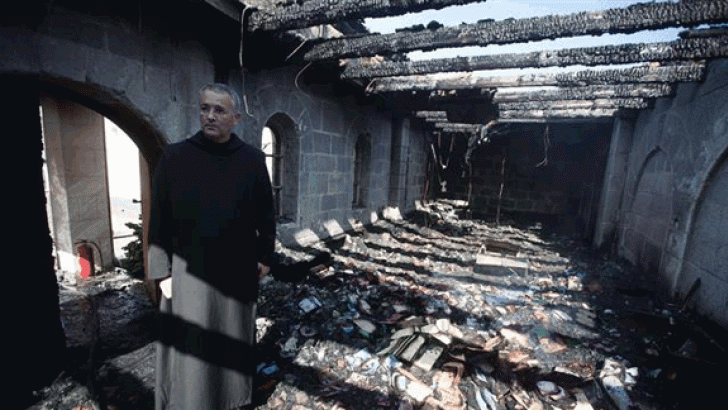
Church in Palestine torched by settlers in June
 
Eighteen-month-old Ali Dawabsha was burnt alive in the occupied West Bank on 31 July. Israeli settlers firebombed his family’s house at 2am.

A week after Ali’s charred body was pulled from the home, his 30-year-old father Saad died from injuries sustained in the same attack. Both Saad and his wife, Reham, suffered second-degree burns to more than 80 percent of their bodies. Their other son, Ahmed, sustained burns to 60 percent of his body.

“Burning Palestinian children to death is becoming an annual event”, tweeted independent journalist Dan Cohen – noting that baby Ali’s death occurred just one year after the murder of Muhammed Abu Khdeir on 2 July 2014. 

Kidnapped by Israeli settlers from outside his home in occupied East Jerusalem, the 16-year-old was taken to a forest, where he was tortured and made to drink petrol before being set alight.

In the aftermath of both Muhammed’s and Ali’s deaths, Israeli prime minister Benjamin Netanyahu and numerous other Israeli politicians expressed “shock” at the brutal murders. In both instances, Netanyahu promised to bring the full force of Israeli law against the perpetrators.

However, the platitudes and condemnations by Netanyahu and other Israeli political figures cannot be taken seriously. They are a performance staged for international consumption. Just one day before the kidnapping of Abu Khdeir, Netanyahu issued a call for vengeance after three missing Israeli settlers were found dead in the West Bank. A week later, Netanyahu launched a murderous 51-day assault on Gaza, killing more than 2,200 Palestinians, including 551 children.

Less than 24 hours after the Dawabshas’ home was firebombed, Israel’s army murdered two more Palestinian teenagers in cold blood. Muhammed Hamid al-Masri was shot dead in Gaza, while Laith al-Khaldi was murdered at Atara checkpoint. Both were 17 years old.

Netanyahu has been one of the leading figures bearing responsibility for settler presence in the occupied West Bank. Elected prime minister in 1996 on a platform of expanding illegal settlement construction, Netanyahu declared during a visit to the illegal Israeli colony of Ariel: “We will be here permanently, forever”.

At the time, 140,000 Israeli settlers were living illegally in the occupied Palestinian territories. Today there are more than 650,000. Campaigning for re-election in January this year, Netanyahu made clear his continued support for the illegal colonies.  “I do not intend to evacuate any settlements”, he told Israel’s Channel Two.

In the two weeks since the death of baby Ali, settlers have continued to firebomb Palestinian homes and attack Palestinian villages. According to the UN Office for the Coordination of Humanitarian Affairs (UNOCHA), settlers have carried out at least 120 violent attacks with impunity on Palestinians in occupied East Jerusalem and the West Bank since the start of 2015.

The murders of Ali and Muhammed are not aberrations, but logical results of the Israeli government’s continued occupation, apartheid and ethnic cleansing.

Saturday, August 15, 2015

Allow My Dress to Introduce Me

Dear friends,
a really wonderful blog by Neveen Hammad about Palestinian women, dress and culture.  This was first published on the Arab American Institute website, but I have added some additional photos at the conclusion of the article.

in solidarity, Kim

***


Allow My Dress to Introduce Me
Posted by Neveen Hammad on August 04, 2015 
Tatreez_Palstn.jpgWhen a Palestinian woman wears her thobe, or traditional Palestinian dress, she is displaying her heritage on her sleeves. Palestinian embroidery, or tatreez, is the artwork featured on each woman’s thobe, and the shapes and colors of the tatreez can be read to understand a woman’s background, heritage, and struggle.

Tatreez dates back to the 8th century CE, and the arrangement of colors and patterns typically indicate what village a woman is from. 

Although it is most often found on women’s thobe, this embroidery is also exhibited on pillowcases and other home accessories. Tatreez embroidery is typically created separately on small pieces of cloth then sown onto larger fabric pieces. Common tatreez designs include geometric shapes and elements of nature, including the sun, moon, stars, mountains, and water. This embroidery is a woman’s form of expression. If a woman from Hebron desires to have children, she would embroider a doll figure on her thobe. Women from the village of Beit Dajan often embroider orange blossoms because that village is known for its orange orchards.

Examining a woman’s thobe is to read about her roots. Certain fabric and thread colors can inform you where she is from, or at least where her thobe was made. While women in the Ramallah region mainly use red for their tatreez designs, which symbolizes life and happiness, other women in Hebron mainly use brown and reddish brown for their tatreez designs. Similarly, the way a woman uses certain colors and designs can tell you about her identity and skill.

Fabrics used to make a thobe include: linen, cotton, wool, and silk. These materials are either produced in Palestine or imported from Egypt, Syria, Europe, India, Damascus, Greece, or Turkey. A type of material used for traditional thobe dresses is referred to as malak, or “royal,” which is a linen material with a high percentage of silk and is predominately used for bridal dresses in Bethlehem.

Traditionally, only a few Palestinian families specialized in the production dyes – using their own secret recipes. Red dye was created from pomegranate skins or insects; the sumac plant was used to make yellow or green dye; purple was made from crushed murex shells; walnut skins were used to produce black dye; and grape leaves produced yellow dye. While indigo fabrics were popular among Bedouins, Biltajeh is a specific indigo-dyed cotton fabric with colored silk borders and is mainly used for dresses in cities along the coast of Palestine. Citizens of Ramallah and Beit Dajan villages prefer white linen and cotton fabrics.

Women in refugee camps in countries other than Palestine still maintain this tradition, which demonstrates that women play an integral role in preserving their ancestral roots, culture, and traditions despite difficult circumstances. 

Neither war, conflict, nor displacement is capable of erasing national identity, culture, or the ability for Palestinians to unite. Tatreez keeps the Palestinian heritage alive. Some Palestinian villages may be gone forever, but tatreez will last and preserve the Palestinian identity, which continues to be under constant threat.


 Palestinian thobes

Soraya Burnat wore a traditional Palestinian thobe at the Oscars in 2014, when her husband Emad Burnat was nominated for an Oscar for  Best Documentary for his film, 5 Broken Camera about their village Bil'in and the struggle of the village and Palestinians against the Israel's apartheid wall and occupation.

                       Palestinian thobes from different Palestinian cities and regions.

Tuesday, August 11, 2015

MAAN NEWS: Father of slain Palestinian infant dies from his wounds

Dear friends,
more sad news from Palestine. Sadly Saad Dawabsha, the father of baby Ali who was burnt to death when settlers firebombed the Dawabsha family home, has also passed away.  Ali's mother and older brother remain in critical condition.

I will post updates as more news comes to hand.

In solidarity, Kim

**

Father of slain Palestinian infant dies from his wounds


MAAN NEWS: Aug. 8, 2015 9:34 A.M.


(MaanImages)


BETHLEHEM, (Ma'an) -- Saad Dawabsha, the father of 18-month-old Ali Dawabsha who was burned alive in an arson attack by Israeli extremists on July 31, died from his injuries early Saturday morning, local sources told Ma'an.

Saad, 30, suffered from third-degree burns covering 80 percent of his body, the Palestinian Minister of Health told Ma'an, and was fighting for his life for more than a week before succumbing to his wounds.

Local sources from the family's village of Duma in the northern West Bank told Ma'an that the family had been notified of the death of Saad soon after he passed, and added that the 30-year-old would be laid to rest on Saturday.
Saad's wife RihamDawabsha, remains in critical condition and suffers third-degree burns across 90 percent of her body.

Saad, along with his wife Riham and other son Ahmad, 4, were immediately taken to the hospital with severe burns after Israeli extremists torched their home in the middle of the night, burning their infant son Ali alive.

Israeli settlers reportedly smashed the windows of two homes in Duma, before throwing flammable liquids and Molotov cocktails inside, killing infant Ali, who was trapped inside the house, and critically injuring the other family members.

The crime has sparked international outrage, with many observers pointing out that settler attacks against the Palestinian community are common and often go unpunished by the Israeli authorities.