Wednesday, June 15, 2016

The Dawayima massacre and Israel's 1948 War Crimes


Dear friends,
this article from earlier this year (March 2016) discusses Israel's war crimes during the Nakba. In particular it discussed the massacre carried out by Zionist forces in Al-Dawayima in Hebron, as well as others that took place.
In solidarity, Kim
***

A poem published by Natan Alterman during Israel's War of Independence criticizing human-rights abuses was lauded by Prime Minister Ben-Gurion, who even distributed 100,000 copies of it among soldiers; other such testimonies were made to disappear.

Yair Auron Mar 18, 2016 / Haaretz


On November 19, 1948, Natan Alterman, whose influential “Seventh Column” – an op-ed in poetry form – appeared every Friday in the daily Davar, the mouthpiece of Israel’s ruling Mapai party (forerunner of Labor), published a poem titled “About This.” Excerpts:

Across the vanquished city in a jeep he did speed –
A lad bold and armed, a young lion of a lad!
And an old man and a woman on that very street
Cowered against a wall, in fear of him clad.
Said the lad smiling, milk teeth shining:
“I’ll try the machine gun”… and put it into play!
To hide his face in his hands the old man barely had time
When his blood on the wall was sprayed.
We shall sing, then, about “delicate incidents”
Whose name, don’t you know, is murder.
Sing of conversations with sympathetic listeners,
Of snickers of forgiveness that are slurred.
For those in combat gear, and we who impinge,
Whether by action or agreement subliminal,
Are thrust, muttering “necessity” and “revenge,”
Into the realm of the war criminal.
(translation by Ralph Mandel)

 Extremely moved by the verses, David Ben-Gurion, then chairman of the Provisional State Council in the nascent Jewish state, wrote Alterman: “Congratulations on the moral validity and the powerful expressiveness of your latest column in Davar… You are a pure and faithful mouthpiece of the human conscience, which, if it does not act and beat in our hearts in times like these, will render us unworthy of the great wonders vouchsafed to us until now.

“I ask your permission to have 100,000 copies of the article – which no armored column in our army exceeds in combat strength – printed by the Defense Ministry for distribution to every army person in Israel.”

What were the war crimes referred to in the poem?


Natan Alterman.Moshe Milner / GP
The massacres perpetrated by Israeli forces in Lydda (Lod) and in the village of Al-Dawayima, west of Hebron, were among the worst mass killings of the entire War of Independence. In an interview in Haaretz in 2004, historian Benny Morris (author of “The Birth of the Palestinian Refugee Problem, 1947-1949”) declared that the most egregious massacres “occurred at Saliha, in Upper Galilee (70-80 victims), Deir Yassin on the outskirts of Jerusalem (100-110), Lod (50), Dawamiya (hundreds) and perhaps Abu Shusha (70).”

Lod was conquered in Operation Dani (July 9-19, 1948), which also targeted nearby Ramle. The political and military leadership viewed the capture of those two towns as crucial, because the concentration of Arab forces there threatened Tel Aviv and its surroundings. Specifically, the aim was for the fledgling Israel Defense Forces to clear the roads and allow access to the Jewish communities on the Tel Aviv-Jerusalem road – which remained under Arab control – and to take control of the hilly areas stretching from Latrun to the outskirts of Ramallah. This would mean a clash with units of Jordan’s Arab Legion, which were deployed – or supposedly deployed – in the area.  


Another goal of Operation Dani, which was led by Yigal Allon with Yitzhak Rabin as his deputy, was to expand the territories of the young Jewish state beyond the boundaries delineated by the UN partition plan.


On July 10, Lod was bombed by the Israeli air force, the first such attack in the War of Independence. A large ground force had also been assembled, including three brigades and 30 artillery batteries, based on the army’s assessment that large Jordanian forces were in the area.
 
To their surprise, the IDF units encountered little or no resistance. Even so, there are Palestinian and other Arab sources that allege that 250 people were massacred after Lod was taken. Claims about the scale of the massacre gain credence from Israeli historian Ilan Pappe, who maintains that the army killed 426 men, women and children in a local mosque and the surrounding streets.

According to him, 176 bodies were found in the mosque, and the rest outside. Testimony of a Palestinian from Lod lends support to these estimates: “The [Israeli troops], violating all the conventions, shelled the mosque, killing everyone who was inside. I heard from friends who helped remove the dead from the mosque that they carried out 93 bodies; others said there were many more than a hundred.” Clearly, though, there are no agreed-upon, precise figures, and the estimates from both sides are tendentious.
Israeli troops went from house to house, expelling the remaining inhabitants to the West Bank. In some cases, soldiers looted abandoned houses and stole from the refugees.

Ben-Gurion’s intentions with respect to Lod remain a subject of debate. Years later, Rabin related how in a meeting with him and Allon, Ben-Gurion, when asked what to do with the residents of Ramle and Lod, gestured with his hand and said, “Expel them.” This version of events was to have been included in Rabin’s memoirs but was banned for publication in Israel, in 1979. His account did appear in The New York Times at the time, and caused a furor. Allon, who also took part in the meeting with Ben-Gurion, vehemently denied Rabin’s account.On July 12, an order was issued by the Yiftah Brigade “to remove the residents from Lod speedily … They are to be directed to Beit Naballah [near Ramle].” .


‘Only a few shots’

With regard to Dawayima, some facts are clear. On October 29, 1948, during Operation Yoav (aka Operation Ten Plagues) in the south, the 89th Battalion, a commando unit, conquered the village. By then, more than three months after the Lod massacre, it was obvious that Israel was winning the war. Now, the goal was to add more territory, to empty the country of Arabs wherever possible and to enter armistice talks under convenient conditions. Extensive areas in the north, and perhaps even more in the south, were seized almost without a battle. The IDF swept through one village after another.

A case in point was Dawayima, population about 4,000, situated on the western slopes of the South Hebron Hills in the Negev (today’s Moshav Amatzia). Many of the villagers, including old people, women and children, were murdered by the Israeli forces. The village offered no resistance – even those who have sought an explanation, or possible justification, for the crime acknowledge that the IDF encountered only light opposition and that the halftracks were subjected to “only a few shots, fired from four rifles,” according to Avraham Vered, one of the commanders of the operation.


Remains of the Palestinian village of Al-Dawayima. Photo: Zafrir Rinat

In his diary entry of November 10, Ben-Gurion quoted Maj. Gen. Elimelech Avner, commander of the military government in the area, as saying that “according to rumor, 70-80 people were ‘slaughtered’ [quotation marks in original] at Dawayima.” The perpetrators were “Yitzhak’s battalion,” referring to the 89th Battalion of the 8th Brigade, under the command of the legendary Yitzhak Sadeh, founder of the pre-state Palmach strike force. The news apparently shocked the top brass, including Sadeh himself and also Allon, who was in charge of the southern front. Several inquiries ensued. An investigation by Isser Be’eri, head of the Military Intelligence Directorate, was never completed and effectively ended in the wake of the general amnesty granted in February 1949 to persons liable to be charged with committing crimes during the war.

Some officers testified that those executed were residents of Dawamiya who were found to be in possession of documents or objects looted during the massacre perpetrated against Jews in the Etzion bloc outside Jerusalem in May 1948. One IDF commander wrote, “We remembered 1929 [the massacre by Arabs of the Jewish community in Hebron] and the Etzion Bloc ... the blood of the slaughtered cries out for revenge.”

Similarly, in an order issued on October 15, during Operation Yoav, Allon stated, “Tonight the brigade will take its revenge. Tonight all the nights of agony of the alliance of the besieged will be revenged.” What underlay the desire for revenge is not clear – probably the difficulty and cruelty of the battles against the Egyptian army in the early part of the war, which resulted in heavy losses on both sides.

Embarrassment apparently ensued from the fact that the Dawayima massacre took place under the command of Sadeh, who was known for his moral sensitivity and insistence on “purity of arms” – i.e., the use of weapons solely for the execution of a mission, without harming noncombatants. Some left-wing sources maintained that the perpetrators of the mass killing in the village were members of the former ultranationalist underground organization Lehi (led originally by Avraham Stern and afterward by Yitzhak Shamir), which had been coopted to the 89th Battalion, much to Yitzhak Sadeh’s pride. But it is patently untrue that the massacre was carried out by former Lehi personnel. The massacres at Ein Zeitun, as well, near Safed, in early May 1948, and at Lod – and others, too – were perpetrated by Palmach units, by the finest of the fledgling state’s young generation.

‘Court poet’
The Dawayima massacre was discussed in at least two cabinet meetings. For his part, on November 19, Prime Minister Ben-Gurion asked the attorney general, Yaakov-Shimshon Shapira, later appointed justice minister, to investigate the event. This was the day Alterman published “About This.” Shapira’s report remains classified to this day – by dint of a decision by a special ministerial committee, and subsequently affirmed by the High Court of Justice. The details of Be'eri's investigation are also still classified.

It has generally been assumed that Alterman’s poem refers to the events at Lod, which had occurred more than four months before it was published. However, jurist Menachem Finkelstein, in his book “The Seventh Column and Purity of Arms” (2011; Hebrew), argues that the column was written about the Dawayima massacre, which took place three weeks before its publication. According to Finkelstein, Alterman heard about the mass killings from his good friend Sadeh and knew a great deal more than what he recounts in the poem, but did not want to embarrass Sadeh or run the risk of intervention by the military censors.

Still, not everyone interprets the column in Davar as an unequivocal condemnation of the massacre. Poet and essayist Yitzhak Laor, who considers Alterman a “court poet,” has speculated that the column may even have been commissioned, and that “it was written with a didactic purpose.” In the view of literary scholar Hannan Hever, Alterman’s poem reflects a Jewish, Zionist voice that condemns the brutal event but does not dare blame the political leadership or Ben-Gurion specifically, the poet’s friend, who spearheaded the policy of occupation and expulsion.

In a 1996 book, “The Southern Front, from Sinai to Hebron” (in Hebrew), the former commander Avraham Vered mocks Alterman, who had been a soldier in the 8th Brigade but, Vered suggests, was relieved of combat duty because the war adversely affected his muse.
“Maybe the stories that were floating around about the conquest of Dawayima reached Alterman in the brigade’s tents,” writes Vered, and, “shocked by the exaggerations overlaid on the stories, he found that the time was appropriate to publish a diatribe against the Palmach in connection with Operation Dani in Lod.”


Natan Alterman in the Haaretz editorial offices, 1930s. Haaretz archive

   
The poem was widely quoted and also drew high praise. Haaretz, reprinting it in full, wrote, “Alterman’s cry of alarm touches on the very essence of the war and its methods.” The philosopher Samuel Hugo Bergman, a member of Brit Shalom, the Jewish-Palestinian Peace Alliance, termed the distribution of copies of the column to soldiers “an extremely important event.”

Mentioning also S. Yizhar’s short story “The Prisoner,” about the shooting, in cold blood, by Israeli troops of a Palestinian prisoner, published in November 1948, while the war still raged, Bergman noted, “The fact that such works can appear in our country in wartime is wonderful testimony to the freedom of spirit that prevails here.” (Yizhar’s short novel “Hirbet Hizeh” dealt with a similar theme.”)

The first meeting of the Provisional State Council (which had legislative and executive authorities until a formal government was established) after the Lod massacre was held on July 14, 1948. Sixty-eight years later, large swaths of its minutes are still classified. In the unclassified section, Ben-Gurion relates that in some places conquered by IDF forces, such as the airport at Lod (as distinct from the city), “almost unbelievable things were done, things that on Thursday [July 8] were still in the realm of thought. An incredible reality was created.” He basks in the successes: “I learned something else – that war is not only wasteful. We acquired something that Israel would not have built in the coming 10 years: the airport at Lod [today Ben-Gurion International Airport] … That airport is worth millions.”

One of the most powerful condemnations of the events at Lod and Dawamiya came from the agriculture minister, Aharon Zisling. The language used on November 17 by the kibbutz member and representative of the left-wing Mapam party, is among the most damning ever heard in an Israeli cabinet meeting. Zisling told those present that after he received information about the events, he had not been able to sleep all night.

“I felt that the things that were going on were wounding my soul, the soul of my family and all of us here,” he said. “I could not imagine where we came from and where we were going.” Noting that he had sometimes disagreed when British occupiers in Palestine were called “Nazis” – even though, he averred, the “British did commit Nazi crimes” – Zisling added: “But now Jews too have behaved like Nazis and my entire being has been shaken. We have to conceal these actions from the public, and I agree that we should not even reveal that we are investigating them, but they must be investigated.”

That text appears in Tom Segev’s book, “1949: The First Israelis” (English translation: Arlen N. Weinstein). Segev and Morris (in “The Birth of the Palestinian Refugee Problem Revisited”) cite a precise source in the archives of the Kibbutz Hameuchad movement. However, I was unable to find the document there. Nor is it likely that the meeting in question ended with Zisling’s remarks. Other ministers certainly spoke, but their comments are classified.

There is no doubt in my mind that Zisling was referring to the Dawayima massacre. His information probably came from a letter sent by a soldier named S. Kaplan to Eliezer Peri, editor of Al Hamishmar, the Mapam newspaper, on November 8, about the Dawayima atrocity.

In fact, another soldier, who was an eyewitness to the event related his experiences to his friend Kaplan, a fellow Mapamnik, who passed it on to Peri, who was also a member of the party’s political committee. In many respects, this letter, apparently written in real time, is of immense importance and significance. It remains relevant and germane today, and is published here in full for the first time. It was found in the archive, typewritten, with several minor corrections and handwritten proofreading, and reads as follows:


Dear Comrade Eliezer Peri,
I read today’s editorial in Al Hamishmar about procedure in our army, which conquers everything except its base instincts.
Eyewitness testimony given to me by a soldier who was in Dawayima on the day after its capture. The soldier is one of ours, an intellectual, 100-percent reliable. He told me what was in his heart because of a psychological need to unburden his soul of the horrific awareness that our cultured and educated people are capable of achieving this level of barbarism. He told me what was in his heart, because not many hearts today are capable of listening. 

There was no battle and no resistance (and no Egyptians). The first conquerors [to enter the village] killed from 80 to 100 [male] Arabs, women and children. They killed the children by smashing their skulls with sticks. There was not a home without its dead. The second wave of the army was a company to which the testifying soldier belonged.

Arab men and women who remained in the village were shut into houses without food or water. Then came sappers to blow up houses. One commander ordered a sapper to put two old Arab women into the particular house that was going to be blow up with them inside. The sapper refused, saying he took orders only from his commander. So the commander ordered his soldiers to shut the women in, and the horror was perpetrated.

One soldier boasted that he had raped an Arab woman and then shot her. Another Arab woman who was carrying a newborn baby was made to clean the courtyard, where the soldiers eat. She did that service for a day or two, and in the end she and her baby were shot. The soldier relates that their cultured, polite commanders, who are considered upstanding members of society, turned into base murderers, and not in the heat and passion of battle but in a system of expulsion and destruction.

The fewer Arabs that will remain, the better. That principle is the political driving force of the expulsions and atrocities, to which no one objects, either in the operational command or in high command. I myself was at the front for two weeks and heard tales of boasting by soldiers and commanders of how they excelled at hunting and “screwing.” To screw an Arab, just like that and under all circumstances, is an honorable mission and there’s competition for winning at this.


We are in a bind. To issue an outcry in the press is to assist the Arab League, as our representative rejects their complaints out of hand. Not to react is [to show] solidarity with baseness of spirit. The soldier told me that Deir Yassin is not the peak of the wildness. Can we shout about Deir Yassin and remain silent about far worse?

We must raise a scandal in the internal channels, demand an internal investigation and punish the guilty. And first of all the army needs to establish a special unit to restrain the army. I myself accuse the government above all – it has no interest in combating these phenomena and is perhaps also indirectly encouraging them. Inaction is in itself encouragement. My commanding officer said that there is an unwritten order not to take prisoners, and each soldier and commander interprets “prisoners” for himself.

A prisoner can be an Arab man, an Arab woman or an Arab child. Only in display windows such as Majdal [Ashkelon] and Nazareth is it not done.

I am writing you this so that the newspaper and the party will know the truth and take effective action. At the very least do not get swept up by false diplomacy that covers blood and murder. The newspaper, too, as far as possible should not remain silent.

[signed] Kaplan

 The original of this letter, which was stored in the Aharon Zisling’s personal archive, has disappeared. A copy was graciously provided to me by Benny Morris. Zisling’s archive is now part of the Yad Tabenkin Archive (formerly the Kibbutz Hameuchad Archive). From that “private archive,” as it is designated, not only minutes of cabinet meetings from decades ago were removed, but also personal letters.

Addendum: Since the original publication of this piece, last month, in Hebrew, I have learned definitively that “S. Kaplan” was the later Shabtai Kaplan, who went on to serve for many years as the correspondent of the Mapam newspaper Al-Hamishmar in the south.

Prof. Yair Auron is a scholar of genocide studies and genocide education. He is a member of Neve Shalom/Wahat al-Shalom, Israel’s only Jewish-Arab village.

Sunday, June 12, 2016

Israel blocks access to historical archives exposing its violent history and ethnic cleansing of Palestinians


Dear friends,
please find below two articles on the Israel's blocking of access to their military and state archives.  As both articles notes, Israel is actively seeking to restrict the release and access to documents which expose its calculated ethnic cleaning of the Palestinians, along with its violent war crimes and human rights abuses.

Historians, academics and activists are currently fighting against Israel's increase repression of historical documents.  The articles outline why this struggle and fight for access is so important.

In solidarity, Kim
**


Why Israel is blocking access to its archives

Israel is concealing vital records to prevent darkest periods in its history from coming to light, academics say.

Al Jazeera, 10 June 2016


Despite Israel's mounting secrecy, historic war crimes are still coming to light [Reuters]
Jerusalem - Israel is locking away millions of official documents to prevent the darkest episodes in its history from coming to light, civil rights activists and academics have warned as the country's state archives move online.

They claim government officials are concealing vital records needed for historical research, often in violation of Israeli law, in an effort to avoid damaging Israel's image.


The Israeli army has long claimed to be the "most moral" in the world.

Accusations of increased secrecy come as Israel marks this week the 49th anniversary of the 1967 war, when it seized and occupied Sinai Peninsula, Gaza Strip, West Bank, and Golan Heights.

Many of the records to which access is being denied refer to that war and the first years of Israel's military rule over Palestinians in Jerusalem, the West Bank and Gaza.

Menachem Klein, a politics professor at Bar Ilan University, near Tel Aviv, said researchers needed such documents to gain a clearer picture of events half a century ago, the goals of policymakers, and human rights abuses. "We have gradually been able to expose some of what happened in 1948 [the war that established Israel], but there is still very little available to help us understand the 1967 war," he told Al-Jazeera.


As part of its commemorations this week, the state archives published testimony by military commanders from 1967. However, local media noted that whole pages had been censored on "security grounds".

Nonetheless, some of the declassified material was revealing. Uzi Narkiss, who headed the army's central command at the time, suggested that he and other commanders hoped to ethnically cleanse most of the territories under cover of fighting. He told fellow officers: "Within 72 hours we'll drive out all the Arabs from the West Bank".

The campaign to open up Israel's archives is being led by the Akevot Institute, a group of Israeli human rights activists, lawyers and researchers trying to document the history of the Israeli-Palestinian conflict. In a new report, Point of Access, they note that only 1 percent of 400 million pages of documents have been made public.

Most of the files should have been accessible after 15 years. In many cases, Akevot says, the classified status of documents has expired, but they have still not been made public. Reasons for denial of access are rarely given.

In other instances, documents that were already declassified - some of them decades ago - have been re-sealed and are now unavailable.

Despite the mounting secrecy, historic war crimes are still coming to light.

In March the largest known massacre of Palestinians by the Israeli army during the 1948 war that founded Israel - what Palestinians call  al-Nakba - was exposed, in spite of official efforts to keep the atrocity under wraps for nearly seven decades.

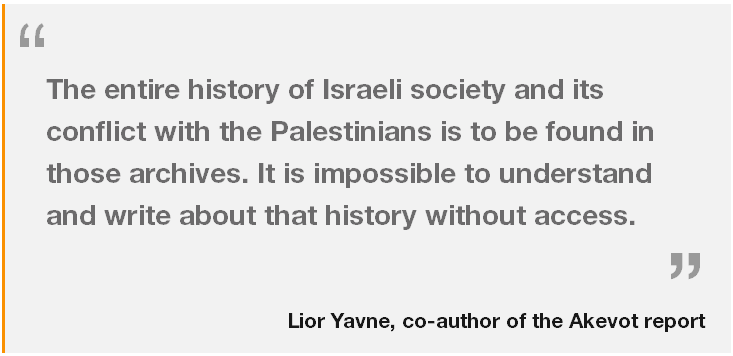
The gag was effectively ended with the publication of a soldier's letter in the Haaretz newspaper, detailing the execution of hundreds of Palestinian men, women and children at the village of Dawaymeh, near Hebron. "The entire history of Israeli society and its conflict with the Palestinians is to be found in those archives," Lior Yavne, co-author of the report, told Al-Jazeera. "It is impossible to understand and write about that history without access." He added: "In practice, most of Israel's archives are permanently closed."

According to Akevot, Israel has exploited a new programme to digitally copy existing paper files to increase secrecy.

Archivists are currently scanning and uploading documents to create a comprehensive database -  a project that is likely to take more than 25 years. The archive's website went live in April.

However, the public nature of the database means hundreds of thousands of national security files have been submitted for the first time to an official body known as the military censor. Until now its powers had been largely restricted to oversight of the Israeli media, said Yavne.

The censor is reported to be refusing to release many of the documents, redacting others and reclassifying as secret many records that were previously available to researchers.

A growing backlog of tens of thousands of files that need to be reviewed has also blocked access to researchers, according to Akevot.

Requests to see documents can be denied if they damage national security or foreign relations, or violate privacy. Yavne said access to records after the specified time restriction had expired was regularly refused without legal authority. Files appeared to be withheld if officials feared they might "highlight human rights violations or shed light on sordid affairs."


The report notes that the records of government decision-making belong to the public but are treated as "a secret to be kept from it".

The current emphasis on concealment contrasts with the late 1980s, when parts of the archives from the 1948 war were opened.

A handful of Israeli historians, most notably Benny Morris, Ilan Pappe and Avi Shlaim, revealed that much of Israel's official history of the state's founding was based on misinformation.

These "new historians" unearthed evidence of wide-scale massacres of Palestinians, rapes and forced expulsions. They also showed that common assumptions about the war - such as that Palestinians had been ordered to flee by their leaders - were later inventions by Israel to minimise international criticism.

One Israeli academic, Shay Hazkani, has estimated that up to a third of records relating to the 1948 war that were declassified have been put under lock again. Given the large number of documents, many had yet to be examined by researchers. 

Nur Masalha, a UK-based Palestinian historian who exposed evidence in Israel's archives of expulsion, or "transfer", policies against Palestinians between 1948 and 1967, told Al Jazeera the clampdown on access to documents was part of wider internal repression in Israel.

It reflected, he said, Israel's mounting concern at the connections being made between Israel's past and present atrocities. "Israel has faced growing international condemnation for its war crimes in Gaza, and at the same time Palestinians, including those inside Israel, have become more determined to focus attention on the Nakba."

Some of the most highly classified records - which have been under lock for 70 years - are due to be made public in less than two years' time. That would turn the spotlight on the most contentious events from Israel's founding. However, according to Akevot, no preparations have been made by Israel's most secretive security agencies, the Shin Bet intelligence service and the Mossad spy agency, to release their archives.

The report says access "is expected to be denied" for the foreseeable future. Yavne said the Shin Bet had already ignored a commitment to make available sections of its archives after 50 years.

Those documents would shed light on Shin Bet policies in the state's early years, when a fifth of Israel's population belonging to the Palestinian minority were placed under a military government.

Details of this period would be embarrassing both because of the harsh treatment of Palestinians during military rule and because the template of the military government was later exported into the occupied territories, said Klein.

 
Archive documents might expose the Shin Bet's detention and torture practices, its use of blackmail and entrapment to recruit informants, and its harassment of Palestinian leaders. "The Shin Bet has always operated beyond the law," he said.

The Israeli prime minister's office, which oversees both the archives and the Shin Bet, declined to comment.

***

The end of history at Israel's state archives?

As part of a welcome digitization process, the Israel State Archives will soon revoke access to original paper documents, and the documents it puts online will be subject to military censorship. But academics and civil liberties groups are fighting back.


Illustrative photo of the digitization of archives. (Lilyana Vynogradova / Shutterstock.com)

(Correction appended below)

Israel’s State Archives (ISA) will no longer give researchers and the public access to its historical materials and documents once it starts putting digitized documents online. Furthermore, and documents it does release will be subject to review by the country’s military censorship apparatus.

Currently, the military censor does not review every document given to researchers.
The changes at the State Archives will lead to a serious reduction in the availability and exposure of historical documents, the burying of documents that have already seen the light of day, and conducting historical research in Israel will become far more difficult than it is today, academics and legal experts are warning.

The new restrictions, which are scheduled to be implemented in the coming days, were formulated behind closed doors and are being presented as a benign digitization project.
 
The changes were revealed for the first time at the end of February, when letters began appearing in the State Archives’ viewing room in Jerusalem, announcing “ending the use of paper files.” The letters, signed by State Archivist Yaacov Lozowick, said that the State Archives plans to launch its new website in April and that it will include more than 10 million scanned pages (a mere 2.5 percent of the 400 million documents in the archive).

Lozowick wrote that the public will be able to request specific documents be scanned within two weeks (it currently takes two days to request a paper document). The letter also notes that “as part of the preparations we will have to cease providing original paper documents.” (The original Hebrew document can be read here.)

Quite ironically, the notice about revoking access to paper archive documents appeared only as a printed letter and not on the State Archives’ new website, which has since been launched.
The doors to the Israel State Archives (Courtesy of Akevot Institute for Israeli-Palestinian Conflict Research)
When the changes were announced, a group of researchers asked for and held a meeting with Lozowick. “We’ve known about the multi-year digitization plan for a long time, but this was the first time they said that the provision of paper documents would cease, not to mention the matter of the censorship,” said Noam Hofstadter, a researcher at the Akevot Institute for Israeli-Palestinian Conflict Research.

The law that regulates Israel’s State Archives obligates the state to publish documents from various government ministries and branches 15 years after they first enter the archives. After 15 years (or longer under certain circumstances) a special ministerial committee can decide to keep specific documents classified based on national security, foreign relations, privacy or maintaining trade secrets. In reality, however, the committee has not met in eight years and it is the state archivist himself who decides whether or not to publish historical documents. We have already seen cases recently in which the State Archives has decided to re-classify documents that were already published.

“What the state archivist told us is that because the Internet is going to become the only channel for viewing documents, releasing documents will be considered publishing them according to the censorship regulations, which means that there will be another body filtering the release of documents,” Hofstadter added. “The state archivist confirmed to us that even documents which have already seen the light of day will go back to being classified.”

“We expect that those people in the State Archives who decide what to publish or not to publish will treat the documents differently now that they know they will be online, indexed by Google, and not just accessible to those researchers who physically come to the archives,” he added.

The Akevot researcher also said the state archivist admitted that scanned documents relating to state security have been scanned and published online without the approval of the military censor, and that in hindsight, the State Archives believes that it broke the law in doing so.

Who needs paper, anyway?

Illustrative photo of archived documents. (Shutterstock.com)
In the letter the Association for Civil Rights in Israel sent to Lozowick last week, Attorney Avner Pinchuk criticized the fact that a process as significant as revoking the public’s access to the physical archives was done without any public debate or announcement, and even without consulting the Higher Archives Council. (No such discussion appears in the council’s published protocols.)

Regarding the matter of censorship, Pinchuk argues that, “as opposed to news media outlets, which [regularly] fight the Censor over the right to publish sensitive information, one cannot reasonably expect the State Archives to be able to or even want to act similarly.” Likewise, the letter continued, the arrangements for censoring archive documents do not contain the usual mechanisms for resolving disputes with those who want to publish censored information.

The letter from ACRI adds that the current censorship regulations forbid mentioning that certain information has been barred for publication, which means that someone accessing the digitized archives will not even know a document has been stricken. The IDF Censor has been widely criticized recently for attempts at extending its reach into social media and other digital media. We wrote here about how +972 was affected by such an over-reach by the IDF Censor earlier this year.

‘Only in Iran’
Also opposing the new arrangement in the State Archives are dozens of members of Israeli academia — deans, heads of university departments dealing with history, the Middle East, Judaism, and more —who recently signed a petition against revoking physical access to paper archive documents.

“It is important to note that digitization is a good thing,” wrote Dr. On Barak, a senior lecturer at Tel Aviv University’s department of Middle Eastern and African history, a member of the Social History Workshop, and a leading voice in opposing the archival changes. “We aren’t just a bunch of old professors nostalgic for the smell of paper. As somebody who has worked in various archives I can say that in other places that are undergoing digitization they are preserving access to the paper documents, even if there’s less demand for it. Only in Iran did the digitization process lead to cutting off access to the paper files.”

According to Barak, there have been numerous studies in recent years about the necessity of preserving access to original paper archive documents. Among other reasons, access to physical documents is so valuable because thumbing through documents or skimming through a book can help find relevant information much faster than advanced digital searches. 

Furthermore, original paper documents can be valuable because of the way they were arranged, the other documents that were placed with them, and even the hand-written annotations or attached notes that can be lost in the scanning process. It is important, therefore, to be able to compare scanned documents with the originals.

“All of that was done without any consultation, public debate or feedback from end users,” Barak said. “Already the archives law is being used to bury [documents] that would otherwise be easily accessible via the freedom of information law. And yet, if they only said that the unscanned documents would be viewable, and if they spoke to those professionals who will be carrying out the scanning and digitization, I would be satisfied. It is clear that a compromise is necessary here.”

According to Hofstadter, Lozowick told him the main reason paper documents will no longer be accessible is budgetary and related to limited manpower resources. “Even in the optimal case the State Archives only expects to scan everything in its possession within 30 years’ time. Can’t they push that to 40 years and leave the public viewing rooms open?”

The Israel State Archives did not respond to our request for comment at the time of publication. Its response will be published here if and when it is received. [Update, April 13: I conducted a full interview with the state archivist, Yaacov Lozowick. Read it here.]

Correction [April 13]:
An earlier version of this article suggested that all documents that the State Archives scan and publish online will be sent for review to the IDF Censor. In reality only those documents deemed to relate to security matters must be sent for censorship. The error did not appear in the original Hebrew article and took place in translation.


This article was first published in Hebrew on Local Call. Read it here

Wednesday, May 18, 2016

REDFLAG: A Palestinian love story too much for Zionists to bear

Dear friends,
please find below my latest article for Red Flag on the recent Zionist and Liberal Party attempt to have Palestinian playwright, Samah Sabawi's play banned from inclusion in the Victorian Education Certificate Drama List.

If you are in Melbourne, I highly recommend you take the opportunity to see the play for yourself. It is currently being staged in Melbourne at La Mama Theatre. You can get your tickets here if you would like to check it out (click here)   The play will also run in Sydney and Adelaide.

In solidarity, Kim

**
A Palestinian love story too much for Zionists to bear

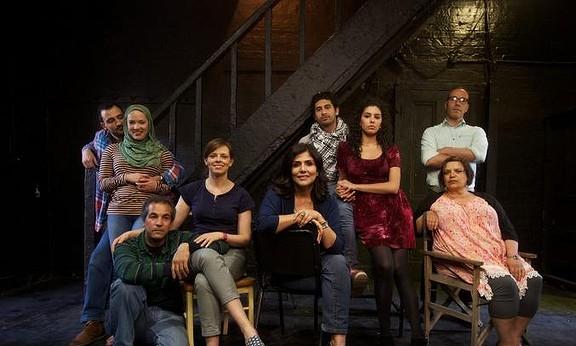
Tales of a city by the sea, a play depicting a love story in Gaza, has come under attack from the Victorian Liberal Party and Zionist organisations.

They have demanded it be withdrawn from this year’s Victorian Education Certificate (VCE) drama list, which is studied by more than 1,300 senior high school students.

The play, written by Palestinian poet Samah Sabawi, is one of 16 included in this year’s curriculum.

Set against the backdrop of Operation Cast Lead, Israel’s brutal 22-day assault on Gaza in 2008-09, the play tells the story of Palestinians living under occupation, siege and bombardment. However, according to Dvir Abramovich, the chair of B’nai B’rith Anti-Defamation Commission, Sabawi’s love story portrays Israel as a “blood-thirsty, evil war-machine”.


On 9 May, the Victorian Liberals also called for the play to be banned. The Liberal MP for Kew, Tim Smith, demanded to know why “an anti-Israel play is being taught to our children”. Smith, who had the backing of party leader Matthew Guy, repeated – word for word – Abramovich’s claim that the play portrayed Israel as “a blood-thirsty, evil war-machine”. Smith was joined in his attack by MPs David Morris and David Southwick.

However, when Liberal MPs were questioned in parliament if they had bothered to read or see A tale of a city by the sea before forming their opinions of it, their response was stone cold silence.

The following day, in a post on his official Facebook page, Smith went further, labelling the play “anti-Semitic”. He provided no evidence to back this allegation.

Education minister James Merlino rejected calls for the play to be taken off the syllabus.

Sabawi has rejected both Zionist and Liberal Party claims, asking “Do we need to tell an Israeli love story every time we tell a Palestinian one?” In a statement issued on 9 May, Sabawi pointed out that that the play was being opposed by “interest groups who failed to see the world outside their ideological filters”, and that it was impossible to “write about ordinary lives in Gaza without writing about the Palestinian people’s daily struggle for normalcy in a war zone”.

The campaign against Sabawi’s play is not the first time that the Zionist lobby in Australia has called for the censorship and banning of theatre works that diverge from the Zionist narrative about the Israel-Palestine conflict.

In 2009 and 2010, Zionist organisations in Melbourne and Perth staged protests against the performance of British playwright Caryl Churchill’s Seven Jewish children, written in the immediate aftermath of Operation Cast Lead.

In both instances, the Zionist opponents of Sabawi and Churchill’s theatre pieces had not bothered to read or see the plays before deeming them “offensive” “racist” or “anti-Semitic”.
The real offence caused by both plays is that they humanise the Palestinian experience under Israeli occupation, siege and apartheid.

Both Sabawi’s and Churchill’s lovingly crafted plays pack a punch precisely because they depict Palestinians as ordinary human beings, who love, cry, dream, get angry, feel joy and mourn – just like the rest of us. Sabawi’s play in particular not only exposes the deplorable conditions faced by Palestinians but also reveals that love and hope can exist even in the most oppressive environments.

The attack on Sabawi’s play is not an isolated incident, but part of the broader campaign by the Israeli state and its supporters to demonise Palestine solidarity activism and censor anything that sheds light on the situation faced by Palestinians.

Monday, May 16, 2016

Plan Dalet & Nakba By The Numbers

Dear friends,
the Institute for Middle East Understanding (IMEU) has published a range of facts sheets and videos on the Palestinian struggle.  They recently issued a new video called Nabka by the Numbers looking at the ethnic cleansing of Palestinians. This builds on the iinfographic they released last year. 

In 2013, IMEU also issued a fact sheet on Plan Dalet, the Zionist plan for the ethnic cleansing of Palestine.  Israeli historian, Ilan Pappe, has written extensively on the plan in his book, The Ethnic Cleansing of Palestine which was published several years ago.

in solidarity, Kim
***

NAKBA BY THE NUMBERS:


***

65th Anniversary of the Adoption of Plan Dalet


March 08, 2013 IMEU

65th Anniversary of the Adoption of Plan Dalet


PLAN DALET

"Transfer" in Zionist Thinking

  • From the earliest days of modern political Zionism, its advocates grappled with the problem of creating a Jewish majority state in a part of the world where Palestinian Arabs were the overwhelming majority of the population. For many, the solution became known as "transfer," a euphemism for ethnic cleansing.
  • As far back as 1895, the father of modern political Zionism, Theodor Herzl, wrote: "We shall try to spirit the penniless population across the border by procuring employment for it in the transit countries, while denying it any employment in our own country... expropriation and the removal of the poor must be carried out discreetly and circumspectly."
  • By August 1937, "transfer" was a major subject of discussion at the Twentieth Zionist Congress in Zurich, Switzerland. Alluding to the systematic dispossession of Palestinian peasants (fellahin) that Zionist organizations had been engaged in for years, David Ben-Gurion, who would become Israel's first prime minister in 1948, stated:
    "You are no doubt aware of the [Jewish National Fund's] activity in this respect. Now a transfer of a completely different scope will have to be carried out. In many parts of the country new settlement will not be possible without transferring the Arab fellahin." He concluded: "Jewish power [in Palestine], which grows steadily, will also increase our possibilities to carry out this transfer on a large scale."
  • In June 1938, Ben-Gurion told a meeting of the Jewish Agency: "I support compulsory transfer. I don't see anything immoral in it."
  • In December 1940, Joseph Weitz, director of the Jewish National Fund's Lands Department, which was tasked with acquiring land for the Zionist enterprise in Palestine, wrote in his diary:
    There is no way besides transferring the Arabs from here to the neighboring countries, and to transfer all of them, save perhaps for [the Arabs of] Bethlehem, Nazareth and Old Jerusalem. Not one village must be left, not one [bedouin] tribe. And only after this transfer will the country be able to absorb millions of our brothers and the Jewish problem will cease to exist. There is no other solution.

Details of Plan Dalet

  • On March 10, 1948, Zionist political and military leaders, including Ben-Gurion, met in Tel Aviv and formally adopted Plan Dalet (or Plan D). The operational military orders specified which Palestinian population centers should be targeted and laid out in detail a blueprint for their forcible depopulation and destruction. It called for: 
    Mounting operations against enemy population centers located inside or near our defensive system in order to prevent them from being used as bases by an active armed force. These operations can be divided into the following categories:
    Destruction of villages (setting fire to, blowing up, and planting mines in the debris), especially those population centers which are difficult to control continuously
    Mounting search and control operations according to the following guidelines: encirclement of the village and conducting a search inside it. In the event of resistance, the armed force must be destroyed and the population must be expelled outside the borders of the state.
  • The Haganah (soon to be Israeli army) launched military operations under Plan Dalet at the beginning of April 1948. Although attacks by Zionist forces against Palestinian population centers actually began a few days after the UN Partition Plan was passed on November 29, 1947, with the adoption of Plan Dalet expulsions accelerated and became systematic, marking a new phase in the conflict in which Zionist and then Israeli forces went on "the offensive," in the words of Israeli historian Benny Morris.
  • Following Israel's establishment on May 14, 1948, the new Israeli government set up an unofficial body, the "Transfer Committee," to oversee the destruction of Palestinian towns and villages or their repopulation with Jews, and to prevent displaced Palestinians from returning to their homes. In a report presented to Ben-Gurion in June 1948, the three-man committee, which included the JNF's Weitz, called for the "destruction of villages as much as possible during military operations."

Results

  • By the time the state of Israel was declared on May 14, 1948, more than 200 Palestinian villages had already been emptied as people fled in fear or were forcibly expelled by Zionist forces, and approximately 175,000 Palestinians had been made refugees. By 1949, at least 750,000 Palestinians had been made refugees, losing their land, homes and other belongings in what became known as the "Nakba" ("catastrophe"). Their flight was accelerated by massacres such as the one that took place on April 9, 1948, at Deir Yassin near Jerusalem, where approximately 100 Palestinian men, women, and children were murdered by Zionist paramilitaries. Today, refugees displaced during Israel's creation and their descendants number approximately 7.1 million people.
  • Some 400 Palestinian towns and villages, including vibrant urban centers, were systematically destroyed or taken over by Israeli Jews. Most of them were demolished to prevent the return of their Palestinian residents, now refugees outside of what would become Israel's internationally recognized borders, or internally displaced inside of them.
  • Only about 150,000 Palestinians remained inside what became Israel, many of them internally displaced people. Although they were granted Israeli citizenship, they were governed by Israeli military rule until 1966, had most of their land taken from them, and continue to suffer widespread, systematic discrimination today.

Controversy Surrounding Plan Dalet

  • Over the years, Plan Dalet has been the subject of controversy, with some Israelis and their supporters claiming that it was not in fact a blueprint for expulsion or ethnic cleansing.
  • Benny Morris, one of the leading so-called "new historians" of Israel, wrote in his landmark work The Birth of the Palestinian Refugee Problem: 1947-1949, that Plan Dalet was "a strategic-ideological anchor and basis for expulsions by front, district, brigade and battalion commanders" providing "post facto a formal persuasive covering note to explain their actions." Morris, a right-wing Zionist ideologically who has at times himself denied there was a premeditated plan for the ethnic cleansing of Palestine, noted that from the beginning of April 1948, there were "Clear traces of an expulsion policy on both national and local levels with respect to certain key districts and localities and a general 'atmosphere of transfer' are detectable in statements made by Zionist officials and officers."
  • In his memoirs, which were censored by the Israeli military but leaked to The New York Times in 1979, the late Israeli Prime Minister Yitzhak Rabin recalled a conversation he had in July 1948 with Ben-Gurion, when Rabin was an officer in the Israeli army, regarding the fate of more than 50,000 Palestinian residents of the cities of Lydda and Ramleh. Rabin wrote:
    "We walked outside, Ben-Gurion accompanying us. [Yigal] Allon repeated his question, 'What is to be done with the Palestinian population?' Ben-Gurion waved his hand in a gesture which said 'Drive them out!'" Rabin added, "I agreed that it was essential to drive the inhabitants out."

Further Reading