Thursday, January 28, 2016

PALESTINE & THE MIDDLE EAST @ MARXISM 2016 - featuring Ali Abunimah & Ramzy Baroud

http://marxismconference.org/index.php


Dear friends,
in case you had not heard Marxism 2016, which is being held over the Easter Weekend (24-27 March), has a fantastic line up of international and local speakers speaking on Palestine and the Middle East.  Please see details below, as well as some of the other featured international and local speakers.

In solidarity, Kim
***


International Palestine & Middle East speakers include:


ALI ABUNIMAH - PALESTINE

Ali Abunimah is the author of One Country: A Bold Proposal to End the Israeli Palestinian Impasse, and co-founder and director of the widely acclaimed publication The Electronic Intifada. Based in the United States, he has written hundreds of articles and been an active part of the movement for justice in Palestine for 20 years. He is the recipient of a 2013 Lannan Cultural Freedom Fellowship.

Ali will be speaking on the panel: The ongoing struggle for a free Palestine, which will discuss the Palestinian struggle for self-determination, the current state of the movement and strategies of liberation. He will be joined by Ramzy Baroud.


RAMZY BAROUD - PALESTINE

Dr. Ramzy Baroud is a US-Arab journalist, media consultant, an author, internationally-syndicated columnist, Editor of Palestine Chronicle (1999-present), former Managing Editor of London-based Middle East Eye (2014-15), former Editor-in-Chief of The Brunei Times, former Deputy Managing Editor of Al Jazeera online. He taught mass communication at Australia’s Curtin University of Technology, Malaysia Campus. Baroud also served as head of Aljazeera.net English’s Research and Studies department. He is the author of three books and a contributor to many others; his latest volume is My Father Was a Freedom Fighter: Gaza’s Untold Story(Pluto Press, London, 2010). His books were translated to several languages including French, Turkish, Arabic, Malayalam, and Korean, among others. Baroud has a Doctorate of Philosophy in Palestine Studies from the European Centre for Palestinian Studies at the University of Exeter (2015).
He is the author of three books: Searching Jenin: Eyewitness Accounts of the Israeli Invasion (Cune Press, Seattle, 2003); The Second Palestinian Intifada: A Chronicle of a People’s Struggle (Pluto Press, London, 2006); and My Father Was a Freedom Fighter: Gaza’s Untold Story (Pluto Press, London). His books are available in French, Turkish, Arabic, Korean and other languages

Ramzy will be joining Ali Abunimah on the panel: The ongoing struggle for a free Palestine, which will discuss the Palestinian struggle for self-determination, the current state of the movement and the strategies for liberation.

FARAH KOBAISSY - LEBANON

Farah KobaissyFarah Kobaissy, is an activist and a researcher in gender, labor and migration. She is also a member of the Socialist Forum in Lebanon. 

Farah will be presenting on the panel:
From garbage disposal to rebellion: Lebanon today, which looks at the privatisation of state assets, cuts to social services, the attacks on the conditions of workers and the poor and the emergence of the "You Reek" movement.


To check out the full list of international and local speakers, please CLICK HERE

To check out the interactive conference program CLICK HERE.


To buy your tickets for Marxism 2016, please CLICK HERE


**


The Palestine and the Middle East stream at Marxism 2016 also includes presentations on the following issues:


Marxist analysis of the Islamic State - Nick Everett
ISIS is perhaps the most commonly discussed topic of foreign affairs today, and yet remarkably few people have seriously attempted to explain its origins. How did a little-known Syrian militia become a multi-million dollar mafia-state, why would anyone join it, and how can it be defeated? All welcome for a discussion on the horrors of ISIS and its origins in the brutal policies of the West and the Syrian regime.

The politics of the Kurdish independence struggle - Kosta Rologas
With the counter-revolution in the Middle-East ascendant, the resistance of the Kurdish population in Kobani was a glimmer of hope for many on the left. This, coupled with success of the HDP, has renewed interest on the Kurdish independence movement and its politics. This talk will look at the politics of the Kurdish independence movement historically and its prospects today.

The left + the Muslim Brotherhood in Egypt under Sisi - Simone White
Debates have raged for decades over the question of how the left should relate to political Islam. These discussions have acquired an added urgency and dynamism in the context of the Arab spring. This session will explore these issues in the aftermath of the military coup against the Muslim Brotherhood.

From opposition to collaboration: Stalinism in the Arab World


In the 1950s and 60s the Middle East exploded in a wave of radical movements for national independence. Communists played a key role in many places, such as in Iraq, where the CP could organise a rally of 1 million people in the streets of Baghdad for May Day in 1959. Yet as a result of the stalinist theory and practices of these parties, they abandoned the working class and ended up collaborating with brutal, counter-revolutionary regimes, an approach which continues to find echoes in the attitude of many Arab leftists to the rise and fall of the Arab Spring.

***

There are also a range of other international and local speakers speaking on other social justice campaigns and struggles from around the world, including:


  • South African activist Mandla Nkosi, an eyewitness and participant to the Soweto Uprising, who will be speaking on the Struggle for Justice in post-Apartheid South Africa;
  • Khury Petersen-Smith will be speaking on the Ferguson/Black Lives Matter campaign;
  • Greek socialist, Panous Petrou who will be speaking on the Greek Revolutionary Left and Popular Unity;Mexican student-teacher activist;
  • Omar Garcia, who is a survivor of the September 26 massacre and the forced disappearance of 43 students in Iguala He will be speaking about on the military attack and disappearance of 43 Ayotzinapa students;
  • Will Ilolahia, a co-founder of the civil rights New Zealand organisation the Polynesian Panthers;
  • Mauritius socialist,Shabeela Kalla, who will be speaking on the campaign against biometric ID cards in that country
  • Irish socialist, Sean Mitchell, speaking on the 1916 Easter Rebellion
     
Some featured Local speakers (for full list see conference program):
  • Aboriginal historian and activist, Gary Foley speaking Aboriginal activism
  • Aboriginal novelist Tony Birch and Aboriginal feminist Celeste Liddle speaking on racism in the Australia media
  • Lydia Shelley, Vice President of Islamophobia Register, speaking on Islamophobia in Australia;
  • Refugee rights activist, Christine Craik on refugees, racism and resistance.
  • former editor of Overland and left-wing writer, Jeff Sparrow speaking on the radical life and music of Paul Robeson;
  • Film lecturer, Liam Ward will be speaking on the union busting, the Academy Awards and the Reds who build the Silver Screen


Wednesday, January 27, 2016

PHOTO ESSAY: Melbourne 2016 Invasion Day Protest & March


Dear friends,
please find below photos from the Melbourne 2016 Invasion Day protest.  The rally and march was organised by Warrior of the Aboriginal Resistance (WAR) and the turn out on the day was fantastic!! 

Although the mainstream media consistently under reported the rally as just a few hundred, more than 3000 people attended, making it one of the biggest Invasion Day rallies in years. Similar rallies were also held in Sydney, Brisbane, Perth and elsewhere, attended by huge crowds (also in their thousands in Sydney).
 
The Melbourne rally took over several intersections along the way and also gate crashed the official route of the Australia Day rally.  The protest ended at Flinders St Station intersection, where people remained for approximately an hour.  The most popular chants on the day included: "No Pride In Genocide" and "Always Was, Always Will Be, Aboriginal Land".


If you would like to use any of the photos below, please acknowledge/credit the photographer (ie.myself) and if possible this blog.

In solidarity, Kim
**

MELBOURNE 2016 INVASION DAY PROTEST & MARCH

All Photographs by Kim Bullimore

Marching down Bourke St in the Melbourne CBD.

Marching down Bourke St in the Melbourne CBD.

Marching down Bourke St in the Melbourne CBD.

Marching down Bourke St in the Melbourne CBD.
Stopping briefly at the Collin St intersection for speeches, having taken over the official Australia Day parade route.

Stopping briefly at the Collin St intersection for speeches, having taken over the official Australia Day parade route.

Stopping briefly at the Collin St intersection for speeches, having taken over the official Australia Day parade route.

Aboriginal activist, Meriki Onus at Collin St intersection, after rally/march had taken over the official Australia Day parade route.

Aboriginal and Torres Strait Islander flags


Arriving at Flinders St Station Intersection - banner opposing the Forced Closure and ethnic cleansing of Aboriginal Communities in Western Australia.

Thousands soon fill Flinders St Station intersection, with people spilling up towards Federation Square to the left of the photo and thousands more filling La Trobe St to the right of the photo.

The intersection at Flinder St Station was completely filled, while thousands more were not able to enter, filling La Trobe St instead.

The crowd at the intersection spilled further up towards Federation square, while the intersection was filled and thousands more filled La Trobe St having marched up from Bourke St.

Steps of Victoria State Parliament, where the Invasion Day march began.
Victoria State Parliament

Victoria State Parliament


Victoria State Parliament

Monday, January 25, 2016

January 26: No Pride in Genocide


Dear friends,
as you will be well aware, this blog is primarily dedicated to providing updates, news and information about Palestine, but occasionally I post on other issues.  Today, my post is specifically about Australia and the anniversary of the European colonisation and ethnic cleansing of this country.
As I have mentioned before, one of the reasons I became active in the Palestine solidarity campaign was because I saw the similarities between the Indigenous struggle of the Palestinian people and the struggle of Aboriginal and Torres Strait Islander communities in Australia. Coming from a family of mixed heritage (my mother is Aboriginal and my father comes from a mixed European background), my first engagement with political activism was around Aboriginal and Indigenous rights and the struggle for land rights and justice in this country.

The 26th January in Australia has been marked officially as "Australia Day" since the mid 1930s. However, for the Aboriginal and Torres Strait Islander (the Indigenous people of this country), it is commemorated as Invasion Day or Survival Day.   It is a day to remember the struggle of our communities against European invasion, colonisation, dispossession and injustice, as well as the continuing struggle of the Indigenous community for their rights.


The images above are by my good friend and comrade, well-known Melbourne visual artist, Van Rudd. The first one depicts the impact of colonisation and dispossession on the Australian Indigenous community, while the second one focuses on the racism against Aboriginal footballer, Adam Goodes. As Van notes: \While this cartoon was released a few months back surrounding the racism inflicted upon Aboriginal AFL footballer Adam Goodes, I thought that it would be worth bringing it out again for the day that many in this country call 'Australia Day'. Just remember that the Union Jack featured in this drawing represents a 227 year old, imperialist, occupying settler force - and it STILL features on the Australian flag. If you are celebrating on 'Australia Day', know that you're celebrating this history of deep seated racism.

Today, I am also posting up two videos to mark Invasion Day.  One is from Buzzfeed, with Aboriginal Australians discussion what "Australia Day" means to them.  While I have some reservations about previous "Aboriginals respond" videos from Buzzfeed, primarily because they were far to apolegetic and defensive (such as the I'm Aboriginal, But I'm Not… video.  I think the subsequent video made by another group of Aboriginal activists, which sought to counter the defensiveness of the Buzzfeed video was much better).

However, the latest one from Buzzfeed does a very good job of showcasing the feelings of Aboriginal community, although some may say it does not go deep enough.


I have also included one of my favourite short videos, which seeks to highlight racism and the struggle for Aboriginal and Torres Strait Islander rights.  The satirical mockumentary, BabaKiueria was released in 1986, in the lead up to the bicentennary in 1988, which saw mass Aboriginal rights protests around the country. 

The 30 minute satirical mocumentary revolves around a role-reversal, with Aboriginal Australians positioned as the invaders and colonisers of the fictious country of BabaKiueria.  The film depicts the impact of invasion, colonisation and dispossession,  while drawing on many of the racist tropes and stereotypes faced by Aboriginal Australians and reversing them in satirical way to inflict them on the "native" BabaKiuerians. 

In this role reversal, white Australians have become the minority, while Aboriginal Australians are in power, having taken all of the available land.  White Australia has been confined to suburban ghettos, where they are expected to follow with out complaint the laws and customs of the colonisers.  They are monitored and viewed through the patronising gaze of the majority culture.


I will be posting up some photos and other posts about Invasion Day protests around the country over the next few days.

You can also read my previous posts on Invasion Day, which include discussion about the history of resistance by Aboriginal Australia to European colonisation and more. 

Always was, Always will be Aboriginal Land: commemorating Invasion Day in Australia 

Invasion Day: Nothing to Celebrate.

January 26: White Australia has a Black History

In solidarity, Kim

Friday, January 15, 2016

Alan Rickman and Palestine


Dear friends,
no doubt, like many of you, I was both shocked and sad to hear the news that talented British actor and director, Alan Rickman had died. Like many others, I loved him as Snape in the Harry Potter movies. I had been a fan of his even before he played Severus Snape but what made me love Rickman even more was the compassion he showed in relation to Palestine.

It was Rickman who was the driving behind the play about Palestine solidarity activist, Rachel Corrie, who was murdered by Israel in 2003. Rickman turned Rachel Corrie's emails, letters and diaries into a one woman tour-de-force play about Palestine, love, compassion and solidarity.

He directed the first production of the play, which took the name "My Name is Rachel Corrie" and it won the new play prize at that year's Theatregoers' Choice Awards in London. Rickman later slammed the censorship of the play in the USA. Today, My Name is Rachel Corrie has been staged around the world and seen by thousands upon thousands.

Rickman recognised the demonisation of Rachel Corrie by pro-Israel apologists and Zionists and sought to redress that imbalance saying, "“We were never going to paint Rachel as a golden saint or sentimentalise her, but we also needed to face the fact that she’d been demonised. We wanted to present a balanced portrait".

In the face of pro-Israel censorship of the play, Rickman defend both Corrie and her participation in the struggle for a free Palestine saying: "Rachel Corrie lived in nobody's pocket but her own. Whether one is sympathetic with her or not, her voice is like a clarion in the fog and should be heard".


Rickman's stance on Palestine (via the play) of course stands in stark contrast to that of Harry Potter author, J K Rowling, who recently came out condemning the Palestinian non-violent Boycott Divestment and Sanctions campaign. While Rickman had not signed on publicly to the BDS campaign (as far as I am aware), My Name Is Rachel Corrie not only challenged the demonisation of Rachel Corrie but also the demonisation of the people of Palestine and their struggle for justice, human rights and self-detemination."

Rickman's compassion for those struggling for justice and human rights saw him also support the cause of refugee rights. In December 2015 he lent his voice to a fundraising viral video to raise funds for groups who aid refugees in the UK.


Rickman was not only a great talent, he  used his talent to help give voice to those whose voices would be marginalised or disenfranchised.
In solidarity, Kim


+++I have included below the statement issued by Rachel Corrie's family on Alan Rickman's death, as well as two articles by Katherine Viner, who worked with Rickman on the production of My Name is Rachel Corrie.  The first article is her farewell article to Alan Rickman, which was published today. And the second one is from 2005, about the production of the play.

+++

 Via the Rachel Corrie Foundation for Peace and Justice

+++

Alan Rickman: the most loyal, playful and generous of friends


 The Guardian, 15 January 2016

Working with Alan on a play, I appreciated his vigour and commitment. When we became friends, I came to know his wit, compassion and keen self-mockery – even late at night, in a whisky bar, in Washington DC
My friendship with the great actor and director Alan Rickman did not have a particularly auspicious start.

It was March 2003 when Alan turned up at London’s Royal Court theatre, clutching an edition of the Guardian’s G2 section featuring the powerful last emails of Rachel Corrie, the American activist killed by a bulldozer in Gaza. Alan had recognised that Rachel’s voice could work brilliantly on stage, and I was commissioned to help him turn her words into a play.


But the theatrical and journalistic worlds are culturally very far apart – the former creative and thoughtful, the latter dynamic and urgent – and, as a Hollywood film star, Alan had been bitten by others in my trade. We had, shall we say, a lot of vigorous debate. Once, when I said something like: “Let’s just get on with it,” he turned to me and said, dripping with flamboyant disdain: ““Dear God, you’re such a fucking JOURNALIST.” We fought. He found me wearisome, then.

But the play we edited together, My Name is Rachel Corrie, had a greater impact than we ever imagined, with two runs at the Royal Court, a West End transfer, and productions around the world, from New York to Haifa. And on the opening night we each admitted that we couldn’t have done justice to Rachel’s words without the other. We’d been a partnership, we agreed, however crotchety.

A friendship was born.

And that was lucky for me, because Alan had a great gift for friendship. He was devoted to a large number of people and would somehow always manage to visit their obscure art exhibition, or phone them at 2am when he heard they were in deep trouble, or attend their opening night even when, as we now know, he was already seriously ill. He threw dinners; he ordered every dessert on the menu if you couldn’t decide.

I once asked if a friend, a teacher from Huddersfield, could cook for him so that she could put it on her CV – “cooked for Alan Rickman” (it made sense at the time). He not only said yes, but acted as her sous-chef and rustled up a top politician and a Hollywood actor as fellow guests. When asked recently about his proudest Royal Court moment, his answer was not about him: he said it was when he took Rachel Corrie’s parents outside the front of the theatre to show them their late daughter’s name in neon lights.

Different people love Alan as an actor for different reasons – there’s the Truly Madly Deeply crowd, the Die Hard set, those who became obsessed after Robin Hood: Prince of Thieves. But his role as Severus Snape in the Harry Potter movies introduced him to a whole new generation. Of course he loved Harry, but as a classical actor he did get fed up with how often it came up. While we were doing interviews for My Name Is Rachel Corrie, Alan would have a rule: they could ask just one Harry question and no more. I remember teasing him: “But Alan, you’re such a wonderful Snape, you’re so good at it!” He turned to me and said, with that languorous diction, “I know what’s required.”

He didn’t mind being teased. His resistance to technology was a running theme (and a way of keeping some privacy in a very public life) until he finally got on email, in 2010, describing himself proudly as a “new computer geek”. From then we’d all receive witty little notes or occasionally, in my case, complaints (particularly about star ratings on Guardian reviews, which in his view made viewers lazy and reviewers power-mad). Like his partner, Rima Horton, a former Labour councillor, Alan was deeply committed to politics – a compassionate Labour man to his core.

He had been recognised everywhere he went for many years, was kind to his fan club (particularly the Arizona branch, who flew en masse to London to see My Name Is Rachel Corrie) and, as one of the Sexiest Men Alive (according to numerous polls), women would stare open-mouthed as he passed.

But the fame reached a new level with Snape. I saw this up close in April, when Alan came to the White House Correspondents’ Dinner as the Guardian’s guest; taking the short walk along a street in Washington DC from the event to a nearby whisky bar he was accosted by a succession of drunk young people, one woman sobbing loudly while begging for a selfie. (He refused all selfies – a solid rule about dignity. Non-selfie photos were fine.) He recovered quickly, and then stayed up until 3am with us all, discussing Obama, this bloody government, our hopes and dreams, the state of the world, the state of that bar, this life.

+++

'Let me fight my monsters'

Two years ago Rachel Corrie, a 23-year-old American protester, was killed by an Israeli bulldozer in Gaza. Since then she has become a potent symbol for both sides of the conflict. But who was the real Rachel? Katharine Viner, who has edited her writings for a new play, on an ordinary woman with an extraordinary passion


The Guardian: Saturday 9 April 2005 

There is a particular entry in Rachel Corrie’s diary, probably written some time in 1999, four years before she was killed by an Israeli bulldozer in the Gaza Strip trying to prevent the demolition of Palestinian homes. She is aged 19 or 20. “Had a dream about falling, falling to my death off something dusty and smooth and crumbling like the cliffs in Utah,” she writes, “but I kept holding on, and when each foothold or handle of rock broke I reached out as I fell and grabbed a new one. I didn’t have time to think about anything - just react as if I was playing an adrenaline-filled video game. And I heard, ‘I can’t die, I can’t die,’ again and again in my head.”

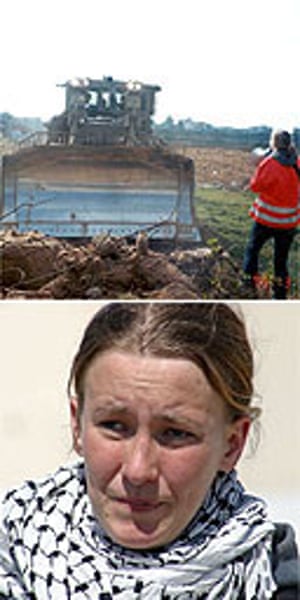
 Activist Rachel Corrie (bottom, photo: Lorenzo Scaraggi/Getty), who was killed by an Israeli bulldozer on March 16 2003 (top, photo: AP)

Last year, I was asked by the Royal Court theatre to edit the writings of Rachel Corrie into a drama with Alan Rickman, who was also directing. I had read the powerful emails she sent home from Gaza, serialised in G2 in the days after her death, and I’d read eye-witness accounts on the internet. But I didn’t know that Rachel’s early writing - before she even thought of travelling to the Middle East, from her days as a schoolgirl, through college, to life working at a mental-health centre in her home town of Olympia, Washington - would be similarly fascinating, and contain such elements of chilling prescience. Nor did I have a sense of the kind of person Rachel Corrie was: a messy, skinny, Dali-loving, listmaking chainsmoker, with a passion for the music of Pat Benatar. I discovered all that later.

Rachel was killed, aged 23, on March 16 2003, by a Caterpillar D-9 bulldozer, a vehicle especially built to demolish houses. Three decades before, her father had driven bulldozers in Vietnam for the US army. Her death was the first of a string of killings of westerners in Gaza in spring 2003, as the war was taking place in Iraq: Briton Tom Hurndall, 22, shot on April 11; another Briton, cameraman James Miller, 34, shot on May 16. She and Hurndall were activists in the International Solidarity Movement (ISM), an organisation set up “to support Palestinian non-violent resistance to Israel’s military occupation”. Rachel was killed only two days before the start of the assault on Baghdad while the world was mostly looking elsewhere.

She became a martyr to the Palestinians, a victim of their intifada who had stood up to the mighty Israeli army; Edward Said praised her actions as “heroic and dignified at the same time”. But many Israelis considered her at best naive, interfering in a situation she didn’t understand. And to some Americans she was a traitor; websites blared that “she should burn in hell for an eternity”; “Good riddance to bad rubbish”; “I’m thankful she died.”

Those close to Rachel would rather she had not become famous for being the blonde American girl who got killed. As her ex-boyfriend Colin Reese said in the documentary Death of an Idealist: “The person that I knew has been summed up as a bullet point... Everything that Rachel was, every brilliant idea she had, every art project she did, it doesn’t matter, because she has become her death.” Reese committed suicide last year.

In developing this piece of theatre, we wanted to uncover the young woman behind the political symbol, beyond her death. As Alan Rickman, whose idea it was to turn Rachel’s work into drama, says: “We were never going to paint Rachel as a golden saint or sentimentalise her, but we also needed to face the fact that she’d been demonised. We wanted to present a balanced portrait.” We hoped to find out what made Rachel Corrie different from the stereotype of today’s consumerist, depoliticised youth. Having received permission from Rachel’s parents to shape her words into drama, we were sent an enormous package - 184 pages of her writing, most of which had not been seen before.

The material revealed a woman who was both ordinary and extraordinary: writing poems about her cat, her friends, her grand mother, the wind; but also, from a strikingly young age, engaging passionately with the world, trying to find her place in it. The earliest material we have is political; aged 10, Rachel wrote a poem about how “children everywhere are suffering” and how she wished to “stop hunger by the year 2000”. Her juvenilia shows, as Rickman says, that she “already knew what language was. She was witty, a storyteller, she had flights of fancy”. It also shows a rather sweet seriousness, and an insight into the wider world and her place in it. Aged 12, she writes, “I guess I’ve grown up a little. It’s all relative anyway; nine years is as long as 40 years depending on how long you’ve lived”.

In her teens, Rachel started to write about the “fire in my belly” that was to become a recurring theme. She visited Russia, a trip that opened her eyes to the rest of the world - she found it “flawed, dirty, broken and gorgeous”. And she engaged in a striking way with her parents, with writing that beautifully expresses ordinary anxieties about safety and freedom, which become particularly poignant in light of Rachel’s violent death. Aged 19 she wrote to her mother, “I know I scare you... But I want to write and I want to see. And what would I write about if I only stayed within the doll’s house, the flower-world I grew up in?... I love you but I’m growing out of what you gave me... Let me fight my monsters. I love you. You made me. You made me.”

She stewed, in typical late-teens fashion, on her future, and wrote about men and sex, from falling “in love with someone who is perpetually leaving you... and tells all stories as if they are blues songs” to bumping into an ex-boyfriend with his “hoochie-ass” new lover. Her wit was of the sardonic kind, and is one of the main things her friends remember about her.

Rachel’s political evolution gathered pace in her early 20s. She went to Evergreen state college, a famously liberal university in Olympia, itself a famously liberal town. She began railing against how “the highest level of humanity is expressed through what we choose to buy at the mall”. After September 11, she became involved in community activism, organising a peace march, but questioned the wider relevance of what she was doing: “People [are] offering themselves as human shields in Palestine and I [am] spending all of my time making dove costumes and giant puppets.” When she finally decided that she wanted to go to the Middle East, she explained her reason quite specifically: “I’ve had this underlying need to go to a place and meet people who are on the other end of the portion of my tax money that goes to fund the US and other militaries.”

When Rachel arrived in Rafah in the Gaza Strip, as Rickman says, “the rhythm of the writing changes dramatically. She has less time to consider but you can feel the growing fear.” The Gaza dispatches are hard-hitting and intense, representing a profound experience. On arrival in Jerusalem she was shocked to see the Star of David spray-painted on to doors in the Arab section of the old city: “I have never seen the symbol used in quite that way... I am used to seeing the cross used in a colonialist way”. In Gaza, she carried the body of a dead man on a stretcher while the Israeli army shot in front of her, but mostly her activism involved protection: staying overnight in the homes of families on the front line to stop their demolition; standing in front of water workers at a well in Rafah as they they came under fire; “close enough to spray debris in their faces”. (Before her death, Rachel believed, as did many activists, that her “international white person privilege” would keep her relatively safe.) Witnessing the occupation in action inspired in Rachel her strongest writing; in her last days her rage and bafflement at what she saw led to work of astonishing and cumulative power.

But the quantity of the material left us with a series of questions. How much of Rachel’s life before she went to Gaza should we include? And should we quote other people? The trend in political theatre, from David Hare’s The Permanent Way to Victoria Brittain and Gillian Slovo’s Guantánamo, is journalistic: the use of testimony, of interviews and on-the-record material rather than invention.

But for us there could be no re-interviewing to fill in the gaps. We had a finite amount of words to work with, as Rachel was dead. I was very keen to use some of the emails that Rachel’s parents, Cindy and Craig, sent to their daughter while she was in Gaza. They are full of the kind of worries any parent might have if their child was in a dangerous situation, but because Rachel never came home, they have a devastating poignancy. Two weeks before her daughter’s death, Cindy emailed Rachel: “There is a lot in my heart but I am having trouble with the words. Be safe, be well. Do you think about coming home? Because of the war and all? I know probably not, but I hope you feel it would be OK if you did.”

And what about the voices of Rachel’s friends? I interviewed many fellow ISM activists, most of whom have been deported from Israel since her death. We watched tapes of two of the moving memorial services: one in Gaza, which was shot at by the Israeli army, another in Olympia. We viewed documentaries on the subject, most notably Sandra Jordan’s powerful The Killing Zone, and considered using video grabs. But in the end the power of Rachel’s writing meant that, apart from a few short passages quoting her parents and an eye witness report of her death, her words were strong enough to stand alone.

The challenge, then, was trying to construct a piece of theatre from fragments of journals, letters and emails, none of which was written with performance in mind. It helped, as Rickman says, that Rachel’s writing “has a kind of theatricality. The images jump off the page.” As the process went on, the difference between my usual job, journalism, and theatre, became obvious: stagecraft is what makes theatre what it is, and there was no point creating scenes that read well on the page if the actor playing Rachel, Megan Dodds, could not perform them.

We’ve tried to do justice to the whole of Rachel: neither saint nor traitor, both serious and funny, messy and talented, devastatingly prescient and human and whole. Or, in her own words, “scattered and deviant and too loud”. We chose Rachel’s words rather than those of the thousands of Palestinian or Israeli victims because of the quality and accessibility of the writing: as Rickman says, “The activist part of her life is absolutely matched by the imaginative part of her life. I’ve no doubt at all that had she lived there would have been novels and plays pouring out of her.” The tragedy is that we’ll hear no more from Rachel Corrie.


Saturday, January 2, 2016

Israeli settlers celebrate the murder of 18 month old Palestinian baby, Ali Dawabsheh and his family.

Dear friends,
I am a little late in posting this as I have not had much internet access over the last 10 to 14 days. Many of you will be aware, two days before Christmas, Israeli television telecast video footage of an ultra-orthodox Zionist settler wedding, which showed Israeli settlers involved in the Hilltop Youth movement cheering the deaths of the D
awabsheh family.  The video showed the Israeli settlers stabbing a photo of 18 month old Ali Dawabasha who was burnt to death when illegal Israeli settlers firebombed the child's home in July. His parents died a week later due to 90% burns to their bodies. It took Israel more than 4 months to arrest anyone and then they were released for lack of evidence. 

This video supposedly "shocked" Israeli society, but it should not have. Israel is an apartheid colonial state, which actively engages in settler-colonialism, while encouraging and condoning acts of military and settler terrorism against an occupied and brutalised Palestinian population.

Israel carries out
mass murder with impunity, the most recent example being the continuing illegal extrajudicial murder of Palestinians during the current uprising and the mass murder of more 2200 Palestinians, the majority civilians, including more than 500 children during its 51 day bombing of Gaza in mid 2014.  Israel's soldiers are rarely indicted or charged with the gross human rights violations and acts of murder they carry out (see military impunity here, here, here, 
here ). Similarly, Israel's illegal settlers are also rarely charged with the violence, arson, destruction and murder they carry out (see here, here and here). Such impunity, actively encourages illegal Israeli settlers and turns a blind eye to their actions.

Israeli military and settlers know that they can carry out murder and human rights abuses with impunity - they can do so with the knowledge that they will most likely not be arrested or if they are, they will most likely only receive a slap on the wrist.  They also know, that unlike Palestinians, there is almost no possibility that they will be the subject of torture or illegal extrajudicial killings by the Israeli state.

I have included below Haaretz's report on the wedding, as well as translation by my friend, Israeli activist, Ofer Neiman, as well extra video footage of the wedding and Electronic Intifada's article on the Wedding and settler impunity and violence.

In solidarity, Kim 


***

Video Shows Jewish Radicals Celebrating Wedding by Stabbing Photo of Dawabsheh Baby

PM Netanyahu condemns the clip, which police seized, that shows Orthodox youths dancing at a wedding reception with guns, knives and a firebomb.


Chaim Levinson Dec 24, 2015 / Haaretz

Prime Minister Benjamin Netanyahu strongly condemned the "shocking images" displayed in a video recently seized by police, which shows Orthodox youths at a Jerusalem wedding dancing with guns and knives, stabbing a photo of Ali Dawabsheh, the toddler who was killed in the Duma firebomb attack that killed three members of the Dawabsheh family this past summer.

This video filmed at an Orthodox wedding three weeks ago, Netanyahu said, exposes "the real face of a group that poses danger to Israeli society and security." He then went on to bolster the Shin Bet, by saying that the images publicized in the video "attest to the importance of the Shin Bet to our security," Netanyahu said.

The Shin Bet has come under attack by right wing groups in recent weeks, after questions were raised about their interrogation tactics in questioning the suspected Duma arsons who were arrested in November. Some accuse the Shin Bet of torturing the suspects, according to the suspects' lawyers.

Zionist Union MK Tzipi Living also denounced the video. “The Judaism of those who dance on the blood of babies is not my Judaism,” she said. “This is a group that wants to destroy Jewish Israel, to destroy this country from within, to turn it into a state of hatred and to destroy the regime from within.”

The clip, which aired on Channel 10 news Wednesday night, shows that amid classical wedding dancing, guests with ear locks and kippas, skullcaps, danced with guns and knives. One masked youth held up a firebomb. Another is seen stabbing a photo of the Dawabsheh toddler, Ali.

The video was shown on Channel 10 news Wednesday night.

According to the Channel 10 report, the wedding was of a couple “very well known in the radical right.” The couple’s friends who were dancing were described as being friends of the suspects in the Dawabsheh murders.

In the video one can see dozens of teens and young men singing a song in praise of revenge, while holding up guns and knives. According to the report, the IDF-issue rifles and licensed pistols were passed around at the reception from hand to hand, including to children.

Information about the wedding made its way to police, who intend to question those who were careless with their weapons and to revoke their gun licenses. The video was given to Defense Minister Moshe Ya’alon, who sent it on to local council heads of Jewish communities in the West Bank and met with several of them.

The council heads, stunned by the show of support for Jewish violence, issued a statement supporting the Shin Bet in its efforts to solve the arson case. The Channel 10 broadcast included an appearance by Avi Ro’eh, chairman of the Council of Jewish Communities of Judea and Samaria, making a statement in support of the police and security agencies.

Zionist Union leader Isaac Herzog wrote on Twitter, “You miserable people, you’ve forgotten what it is to be Jews. You disgrace your skullcap, your prayer shawl and the name of God. Whoever dances at a wedding and celebrates the murder of a sleeping baby is not Jewish and not Israeli. He should be put behind bars as quickly as possible.”

Chief Rabbi David Lau also responded to the broadcast, saying, “Acts like these are not the way of Judaism. This is a rejection and repudiation of the values of the Jewish people, of the Torah of Israel and the uniqueness of the Jewish people. Parents and educators must take it upon themselves, along with law enforcement, to do everything possible to prevent this appalling identification with such frightful acts of terrorism and murder.”


Translation of the Hebrew video by Israeli activist and translator, Ofer Neiman:

Zionist hilltop wedding in Jerusalem: participants wield knives, stab a photo of baby Ali Dawabsheh (see video above)


TRANSLATION:
Start:

Reporter:

The weapons are passed from one person to another, children too hold the guns.

0:03 The atmosphere is steaming.

0:05 The vengeance and knives dance becomes a crazy display.

0:10 Note the photo of baby Ali Dawabsheh. burned to death is held high by the celebrating participants

0:16 As one of them stabs the photo of the baby with a knife

Replay:
Reporter: And here is the moment in which the baby's photo is stabbed repeatedly to the joy of the celebrants

0:30 Participants chanting: "Avenge but one of my two eyes on Palestine."

***
Related:

High Court: No basis to indict Torat Hamelech authors for incitement Wed, 09 Dec 2015

***
VIDEO: KNIFE DANCE OF THE HILLTOP YOUTH
Further footage from the same wedding with english subs


***

Video: Israeli youths dance, stab picture of murdered Palestinian baby

This video shows Israeli Jewish youths, some armed with army-issued assault rifles, dancing at a wedding.
Broadcast on Israeli television Wednesday evening, it shows one masked youth holding up a Molotov cocktail while another stabs a photo of Ali Dawabsha, the Palestinian baby killed in a firebomb attack on his family home in the occupied West Bank village of Duma last summer.

“In the video one can see dozens of teens and young men singing a song in praise of revenge, while holding up guns and knives,” Israel’s Haaretz, which published this version of the video, reported.

The wedding was of a couple “very well known in the radical right,” Haaretz quotes Israel’s Channel 10 as saying.

The dancing wedding guests were described as “friends of the suspects in the Dawabsha murders.”
The report said “licensed pistols were passed around at the reception from hand to hand, including to children.”

Torture

The disturbing video emerged just as Israel’s Shin Bet secret police has said it is close to issuing indictments for the arson attack that killed three members of the Dawabsha family.

On 31 July, a firebomb was thrown into the Dawabsha family home, killing 18-month-old baby Ali and fatally injuring his parents Riham and Saad. Ali’s 4-year-old brother Ahmad, who suffered severe burns, is the only survivor.

Shin Bet announced on Sunday it had made progress in the investigation, but kept all details secret under a gag order.

However Itamar Ben Gvir, a key suspect’s lawyer, has publicly claimed his client was tortured to confess to the crime.

“They broke him. I believe very much that there are doubts that any confessions he made are usable in court. They beat him into a shadow of a person,” Ben Gvir said at a press conference on Tuesday.
Ben Gvir, a right-wing activist, said his client was sleep deprived, beaten and held in various stress positions until he finally confessed.

The lawyer also suggested that interrogators may have sexually assaulted his client, according to Israel’s Arutz Sheva news website.

While rarely used against Jews, the torture techniques described by Ben Gvir are consistent with those routinely inflicted by Israel on Palestinians, including children.

Shin Bet has come under fire for using them against Israeli Jewish citizens.

On 19 December, Israeli forces and intelligence officers brought a suspect to Duma and had him “reenact” the crime, Ma’an News Agency reported.

While defense minister Moshe Yaalon admitted in September that the army knew who had perpetrated the attack, no arrests were made until four months after the fatal crime.

Following mounting pressure, Shin Bet arrested suspects at the end of November and beginning of December.

With the permission of Israel’s high court, Shin Bet held the suspects – for the maximum 21 days before granting them access to lawyers.

While barely any details were released, the deputy attorney general publicly admitted that Shin Bet was using “exceptional measures” during interrogations.

The Electronic Intifada has identified two suspects, whose names Israeli media are still withholding due to the gag order, as Hanoch Ganiram, 19, and Elisha Odess, who is a minor.

Earlier this month, the Israeli government told the high court that indictments were not on the horizon.
But it now seems Shin Bet has managed to extract a confession.

After suspects began meeting with their lawyers last week, details of their interrogations and torture have emerged.

Attorney Adi Keidar, representing a 17-year-old suspect, claims his client attempted to kill himself by slitting his wrists.

The teenager testified in an Israeli court on the torture he was enduring, yet the judge ordered he remain in custody.

Last weekend, hundreds of supporters violently clashed with police in Jerusalem during a demonstration against the suspects’ prolonged interrogation.

Israeli civil rights groups have also questioned the legality of Shin Bet’s reported methods.
Last week, Shin Bet said it was investigating a “Jewish terror organization” that had “contributed to instability in the region.”

“This organization adheres to an extreme, anti-Zionist ideology, that has set itself the goal of violently overthrowing the Israeli government,” Shin Bet told Israeli media.

What such comments do not address is the fact that all of Israel’s settlers are in the West Bank as a result of decades of Israeli government policy and only remain there because of the protection and support they receive from the Israeli army.

Home attacked

There has been a sharp increase in violence by Israeli settlers in recent years, almost none of which is investigated and punished, according to the Israeli human rights group Yesh Din.

Early Tuesday, suspected Israeli settlers attacked a home in the village of Beitillu near Ramallah in the occupied West Bank in an apparent revenge attack for the arrests of the suspects in the Dawabsha murders.
Hussein al-Najjar, 30, told Ma’an News Agency that settlers arrived at his home around 1:30am and vandalized the exterior walls of the house before smashing a window and throwing three tear gas bombs inside.

Al-Najjar said that he and his wife and their 9-month-old son Karam suffered from severe tear gas inhalation.

“The family survived death thanks to the intervention of neighbors who broke open the main door and evacuated the family, who were found unconscious,” al-Najjar added.

Photos show the phrases “revenge” and “hello from the detainees of Zion” spraypainted in Hebrew on the side of the home.

Ali Abunimah contributed research.