I am a political activist who has worked and lived in the West Bank of the Occupied Palestinian Territories. This blog chronicles my time in Palestine and also provides news and analysis about Palestine and the situation on the ground in the Occupied Palestinian Territories.
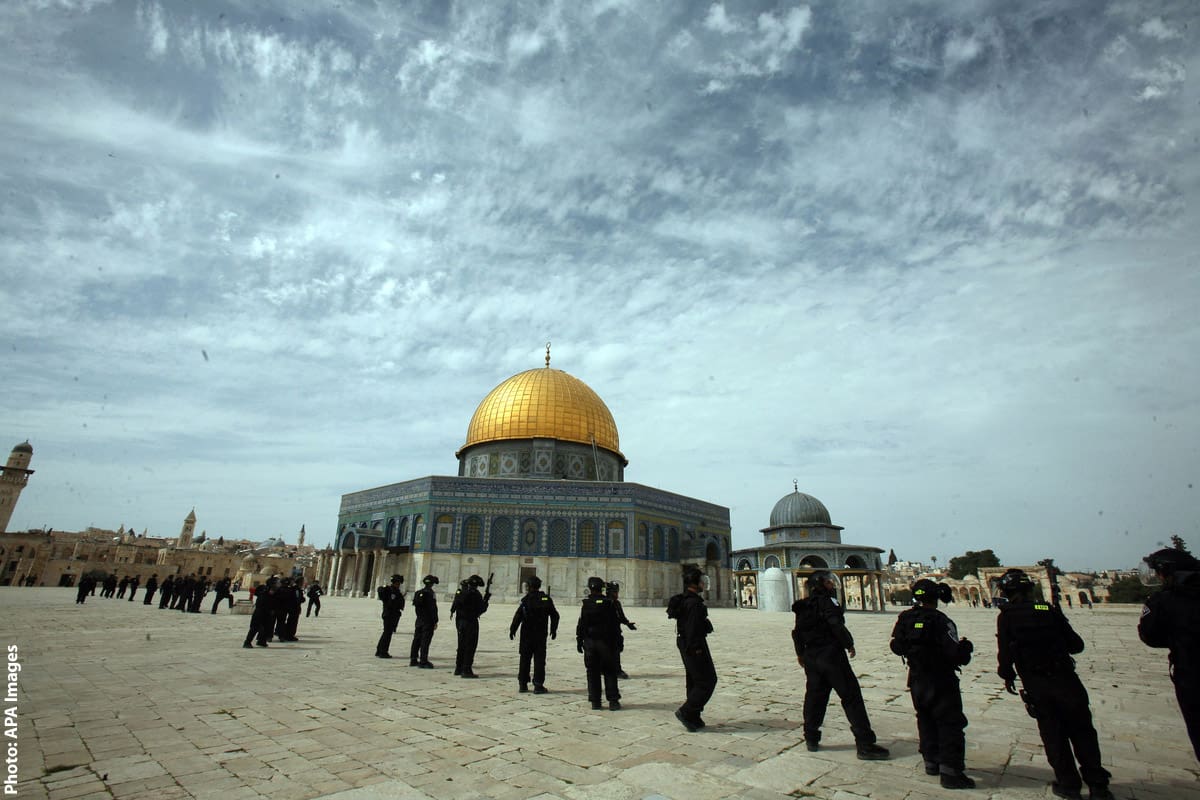
Dear friends, no doubt many of you will be aware of Israel's actions in Occupied East Jerusalem, repeatedly storming Haram al Sharif/Al Aqsa Mosque compound. Israeli Occupation Forces launched a three day assault on September 13, coinciding with the start of the Jewish New Year (Rosh Hashana) in order to facilitate access to the site by the Israeli Agricultural Minister, Uri Ariel and illegal Israeli settlers. Another attack took place yesterday on the last day of Eid to similarly facilitate access by illegal Israeli settlers and extremists.
Israel's attack on al Aqsa is not a new occurrence but has become more frequent in the last couple of months as the Israeli state and its agencies actively facilitates the entry the site by illegal Israeli settlers and other Zionist extremists who are part of the Temple Mount movement. The aim of this movement is to the physical destruction of Al Aqsa and its replacement with a Third Jewish Temple.
While many of the mainstream press both in Israel and Internationally have reported this as some sort of "religious war", it is nothing of the sort. Instead, it is simply a stepping up of Israel's settler-colonial and ethnic cleansing agenda, cloaked in religious dogma.
I have just finished writing an article on the recent attacks, which will appear in the next issueRed Flag (which is out tomorrow). In the meantime, I am going to post two excellent pieces, about Israel's settler colonial agenda in relation to Al Aqsa and Occupied East Jerusalem. The first one was published in February by the Palestinian policy agency, Al Shabaka, while the second is an analysis/ comment piece published last week by Al Jazeera which includes analysis and commentary by for Palestinian political activists, commentators and religious leaders.
The escalating clashes between Israeli settlers and Jerusalemite
Palestinians are the harbingers of a major eruption with incalculable
consequences. Immediately billed as a “religious war” by the media and
Israeli right wingers, they are in fact the outcome of longstanding
Israeli plans to Judaize the city and empty it of its Palestinian
inhabitants. Al-Shabaka Policy Member Nur Arafeh analyzes the major
changes that Israel has illegally imposed on Jerusalem and addresses the
Palestine Liberation Organization (PLO)/Palestinian Authority’s (PA)
effective abandonment of the population to fend for itself. She
concludes with policy recommendations to the PLO/PA, Palestinian
academics and analysts, and the international solidarity movement.
The Myth of Religious War
Jerusalem has been thrust into the spotlight due to the recent
clashes between Israeli settlers and Palestinians at the Al-Aqsa Mosque.
Also referred to as Al-Haram al-Sharif or the Noble Sanctuary, the
compound contains Al-Aqsa itself, Islam’s third holiest site, and the
Dome of the Rock, where Prophet Muhammad is said to have ascended to
heaven. Jews revere the site in the belief that it was once the location
of two ancient Jewish temples.
A number of ultra-Orthodox Jews have been repeatedly violating the
status quo that has been in place since 1967 by making incursions inside
the Al-Aqsa compound and calling for Israel to build a third temple on
what they term the Temple Mount. 1 A video posted recently
on YouTube by the Temple Institute, which is part of the so-called
Temple Mount and Land of Israel Faithful Movement, depicts a third
temple replacing Al-Aqsa Mosque and the Dome of the Rock.
The recent clashes between Palestinians and Israeli settlers and
police in Jerusalem were punctuated by horrific attacks like the
kidnapping and murder of the Palestinian youth, Mohammed Abu-Khdeir in
July 2014. After Yehuda Glick, a key figure in the Temple Institute and a
strong advocate of its messianic scheme, was allegedly shot
by a Palestinian, members of the Temple Mount Movement made further
incursions into Al-Aqsa, and on 30 October 2014 Israel banned prayers in
the compound for the first time since 1967. Tensions in Jerusalem
reached boiling point after an attack by two Palestinians on an
ultra-Orthodox synagogue on 18 November 2014 left four Jews and a Druze
police officer dead. The New Year began with a warning by the Mufti of Jerusalem of an Israeli organization’s plans to register Al-Aqsa Mosque as Israeli property.
But can this really be described as the start of a religious war? Has
the political conflict indeed been transformed into a war of beliefs?
According to The Guardian: “This is what a religious war looks like.” A Palestinian Al-Hiwar commentator agreed. Deputy Knesset Member Moshe Feiglin went even further and described it as a global fight “against the evil forces of the most extreme Islam.” Worse, the Temple Mount Movement stands reality on its head by proclaiming that
one of its long-term objectives is to “liberate the Temple Mount from
Arab [Islamic] occupation,” thus portraying the colonizers as the
colonized.
Yet the framing of these events as a religious war not only ignores
the reality of the power imbalance between the colonizer and the
colonized, but also fails to address the history and context in which
the recent events have unfolded.
Israel’s Longstanding Targeting of Al-Aqsa Mosque
Jewish religious law prohibits Jews from praying in the Al-Aqsa
compound; Jews are only expected to revere the site, but not to visit or
own it for fear of profaning the inner sanctum of the alleged Temple,
and are to pray at Al-Buraq Wall (renamed the Western Wall).
Nevertheless, extremists have early on targeted Al-Aqsa Mosque with a
view to rebuilding the Temple. In 1982, Meir Kahane, leader of the
far-right Kach party, marched on the compound holding plans of the Temple to be built on the ruins of Al-Aqsa. In 1990, 21 Palestinians were killed
and 150 were injured in clashes with members of the Temple Mount
Movement who attempted to enter Al-Aqsa and place the foundation stone
for the Temple. In 1996, Israeli excavations and the digging of tunnels near Al-Aqsa sparked violence that resulted in the killing of 70 Palestinians and 15 Israeli soldiers.
The Israeli government has also been supporting efforts to ensure Jewish control over the compound. Almost half of Likud party members
support the Temple Mount Movement, which has recently won funding from
the government. Between 2008 and 2011, the Temple Institute received an
annual donation of $107,000 from the Ministry of Education and the
Ministry of Culture, Science, and Sports. In 2012, an educational unit
in the Temple Institute was offered an additional $50,000 from the Ministry of Education.
However, the actions of specific groups to take control of Al-Aqsa
should not be seen as isolated incidents, but rather as part of a larger
Zionist project to Judaize Jerusalem and ensure Jewish supremacy over
the city.
Creation of a New Reality in Jerusalem
Since the occupation began in 1967, Israel has been committed to
transforming a multi-religious and multi-cultural city into a
“reunified” Jewish city under the exclusive control and sovereignty of
Israel. It has fast-tracked the Judaization of the city via policies
that impact on the geographical and physical space and are designed to
circumvent the “demographic threat” posed by Palestinians.
From the outset in 1967, Israel illegally annexed 70 km2 of West Bank territory, including East Jerusalem (6.5 km2), such that it maximized the area of land expropriated while minimizing the number of Palestinians.
It also razed the Arab neighborhoods of Bab al-Magharbeh and Harat
al-Sharaf to build the Jewish Quarter, Al-Buraq Wall plaza, houses for
settlers, and Jewish synagogues. Israel also reshaped the physical
landscape of Jerusalem by constructing a ring of settlements around the
city, linked to bypass roads to ensure geographic continuity with other
Israeli settlements in the West Bank. 2
The ensuing physical and political fragmentation of Jerusalem went
hand in hand with its economic isolation long before Israel embarked on
the construction of the Apartheid Wall in 2002, which redrew the borders
away from the pre-1967 armistice line. The construction of the Wall was
deliberately designed to cut inside the city and exclude areas
populated by Palestinians as a means to ensure a Jewish majority.
To deal with the “demographic threat” posed by Palestinians, Israel
designated Palestinians living in Jerusalem as “permanent residents” – a
civil status usually reserved for foreign citizens and which does not
guarantee residency rights. On this basis, resident IDs are often
revoked.
Between 1967 and 2013, Israel revoked the ID cards of more than 14,309 Palestinian residents. According to the 2003 Temporary Amendment to the Citizenship and Entry into Israel Law
(amended in 2005 and 2007), West Bank Palestinians married to Jerusalem
residents do not qualify for residency status and are only granted temporary permits
in exceptional circumstances. In contrast, Jews who immigrate to live
in Jerusalem are granted immediate citizenship, reflecting the apartheid
nature of the Israeli regime.
While strengthening the Jewish presence in Jerusalem, Israel has
sought to contain the urban and demographic expansion of Palestinians
via discriminatory urban and zoning policies consistent with ethnic
cleansing. More than one third of land in Palestinian neighborhoods has
been classified as “open landscape areas” where building is prohibited, constricting Palestinian building to only 14% of the land of East Jerusalem and causing an acute housing crisis. Moreover, since 1967, Israel has destroyed
1,673 housing units, affecting around 8,000 people between 1967 and
2013. With the implementation of all these policies, Israel is aiming to
achieve a ratio of 30% “Arabs” and 70% Jews within the Jerusalem municipality.
Discriminatory Israeli policies are also apparent in the
discrepancies in service provision between Palestinian and Jewish
neighborhoods. Less than 10% of the municipal budget is allocated to Palestinian districts despite Palestinians paying the same amount of arnona (property) tax as Jewish citizens.
Judaization has been accompanied by “de-Palestinianization” to
eradicate the Palestinian identity in Jerusalem. For example, Sultan
Suleiman al-Qanuni Street (a sultan of the Ottoman Empire) was renamed
King Solomon Street, and the Wadi Hilweh district of Silwan was renamed
“the city of David.” Furthermore, unnamed streets in Palestinian areas
were recently given Arabic names that are devoid of political and
national connotations. This renaming process is linked to the re-writing
of history in line with Zionist dicta, a process in which archeology
and excavations are exploited to create a fictitious Jewish history of
the city, while the heritage of other eras is ignored.
Israeli control over the historical narrative extends to the
educational system. Since March 2011, Israel has attempted to force
Palestinian schools that receive budget allocations from the Israeli
authorities to use textbooks prepared by the Jerusalem Education
Administration (so far, five have done so). These books present
Palestinian students with a one-sided history and censor any topic
related to Palestinian identity and heritage.
Palestinian institutions in Jerusalem have also been targeted to
erode Palestinian activism in the city. Since 2001, Israel has closed at
least 31 Palestinian institutions, including the Orient House, the
former headquarters of the PLO, and the Chamber of Commerce and
Industry. This climate of repression led many institutions to relocate
from Jerusalem and caused a huge institutional vacuum, accompanied by an
absence of leadership.
Other steps to de-Palestinianize Jerusalem include the latest five-year socio-economic “development” plan
for Palestinian areas approved in June 2014 by the Israeli cabinet.
This plan focuses on gaps in infrastructure, education, social welfare,
and employment between Palestinian and Jewish neighborhoods in an
apparent attempt to encourage the integration of Palestinians within
Israel and bolster security by thwarting “violence” and “stone
throwing.”
In other words, development is a tool to strengthen Israeli control
over Jerusalem and suppress Palestinian steadfastness and resistance to
the Israeli occupation. Thus, the plan cannot be seen as an initiative
to address the deteriorating socio-economic conditions of Palestinians
in Jerusalem in terms of the extremely high poverty rate (75% of
Palestinian residents live below the Israeli definition of the poverty
line); collapsing trade and tourism sectors; lack of investment;
depleted health and educational services; high unemployment rates (16.7%
in 2014); and high costs of living.
In this context, Palestinian clashes with Israeli Jews should be seen
as acts of resistance and desperation within the larger historical
struggle of Palestinians against occupation, apartheid, ethnic
cleansing, land theft, dispossession, forced displacement, and economic
marginalization. The recent intensification of incursions at Al-Aqsa and
calls to build a third temple simply ignited the flames of these
smoldering emotions. To focus on the religious dimensions of the recent
unrest while overlooking its root causes would only lead to further
violent clashes and eruptions of unprecedented magnitude. Religion is
being exploited to serve Israeli political and national goals as it
entrenches its colonial apartheid policies.
The Leadership Vacuum Leaves Palestinians Powerless
The recent unrest in Jerusalem, in which Palestinians have resorted
to new forms of resistance such as using vehicles and fireworks, should
be seen within the broader context of a city that lacks political
leadership. The PA has demonstrated a lack of genuine investment in
Jerusalem since signing the 1993 Oslo Declaration of Principles, of
which the PA was itself a product. This was already evident when the PLO
accepted to defer the issue of Jerusalem to the negotiations on the
final status of the Occupied Palestinian Territory (OPT). While the
PLO/PA clings tightly to the farcical peace process, Israel has
entrenched its occupation and control over Jerusalem.
In a clear divergence from its rhetoric of support, the PA allocates a negligible budget to the city. The total budget allocated
to the Ministry of Jerusalem Affairs and to the Jerusalem Governorate
was around $15 million in 2014, representing 0.4% of the total PA budget
expenditure for that year. Compare this shameful and insignificant
budget allocation to the supposed capital of the Palestinian state with
27% of the budget allocated to the security sector
in the same year. Moreover, most of the budget is disbursed in the
areas of Jerusalem that fall under Palestinian administration and
outside the Wall. Locations such as Shu’fat and Beit Hanina that lie
within the Israeli municipal boundaries of Jerusalem rarely receive any
funds. 3
This meager budget is the main reason that prompted Hatem Abdel-Qader
to resign 40 days after his appointment as the first minister for
Jerusalem Affairs in 2009. He noted that
the Palestinian “government fails to uphold its commitments to the
city, which is undergoing a difficult period.” Another Palestinian
intellectual, who served as a PA representative in Jerusalem, also
argued that, “The PA’s behavior was never in line with its stated goals.
It has continuously failed to implement the numerous studies and plans
made for the city.” 4
While Israel is turning its vision for Jerusalem into reality via
numerous policies and master plans (2020, 2030, and 2050), a coherent
strategy for the future of the city by the Palestinian leadership
remains absent. This was apparent in the omission of a development plan
for Jerusalem in the National Development Plan 2014-2016. Although it is true that the document refers back to the Strategic Multi-Sector Development Plan for East Jerusalem (SMDP) 2011-2013
issued by the Jerusalem Unit at the President’s Office, the SMDP was
published in 2010 and requires updating. Moreover, the Jerusalem Unit
itself, which was previously allocated most of the funds for Jerusalem,
was closed in 2010. 5
More significantly, the development approach used in the SMDP
disconnects development from political and colonial realities; it
reduces Palestinian struggle to that of “survival” instead of freedom
and takes the Israeli occupation as given rather than seeking to end it.
As the introductory section of the SMDP put it: “How can the PLO assist
Jerusalemites to survive and thrive within the existing context in order to have a solid foundation for the capital of the future Palestinian state?” (Emphasis added).
The lack of genuine official interest in the city, the emergence of
Ramallah as the de facto capital, and the absence of Palestinian
political leadership in Jerusalem leave Palestinians feeling abandoned
and resentful towards the PLO/PA. PA President Mahmoud Abbas is still
paying lip service to Palestinians in Jerusalem, while refusing to end
security collaboration with Israel or to support non-violent means of
resistance, such as the boycott of all Israeli goods. Meanwhile, Israel has responded to leaderless Palestinian protests
and resistance with characteristic force that includes land
confiscation, house demolitions, and collective punishment, such as
raids on homes, spraying neighborhoods with putrid water, and mass
arrests. For example, between June and September 2014, approximately 700
Palestinians were arrested in Jerusalem, the majority of them children,
according to Al-Dameer Association for Human Rights. 6
Israeli settlers who commit brutal crimes against Palestinians undergo
no such punishment. In fact, the Israeli government has eased gun
restrictions and increased funding to protect settlers in Jerusalem –
additional evidence of the institutionalized discrimination to which
Palestinians are subjected.
Protecting Jerusalem and Its Palestinians
The current turmoil in Jerusalem is the result of colonial
subjugation, institutionalized discrimination, dispossession, and
Israel’s establishment of facts on the ground to ensure it maintains
Jewish supremacy over the city. Israel’s plans should thus be resisted
locally and internationally, primarily by increasing their cost to
Israel. The apartheid system in South Africa only began to unravel once
the costs of preserving white supremacy became too high to bear. First and foremost, Palestinians need proactive leadership that will
propel the status of Jerusalem to the forefront of government commitment
and to the heart of the national struggle as a matter of urgency. It is
vital that Palestinians project a clear vision of Jerusalem to counter
the prevailing Israeli vision. Information and communication are key
tools to counter Israel’s re-writing of history and silencing of the
Palestinian narrative.
In particular, Palestinian leadership should confront Israeli
attempts to frame its colonial policies in religious terms and should
remind the world that the core issues are those of occupation,
dispossession, and land theft. It is imperative to challenge the power
of the Israeli discourse by exposing its shameful record of oppression
in Jerusalem and the rest of the occupied territory. The PLO/PA should
also further capitalize on the hard won status in international
organizations such as UNESCO to take legal steps to protect Al-Aqsa and
the Old City in Jerusalem.
Secondly, academics and policy analysts can play a crucial role in
putting Jerusalem in the vanguard. To date, Palestinian intellectuals
have been biased towards the analysis of socio-economic development in
the West Bank, and, to some extent, the Gaza Strip, to the detriment of
discussion about Jerusalem. Palestinians must emphasize Jerusalem in
their discourse and move beyond mere diagnosis of problems to devise
solutions. The concept of development under occupation itself needs to
be revised and redefined as a form of economic, political, and social
resistance embedded in the larger historical struggle of Palestinians
for self-determination, freedom, and justice.
Finally, the local boycott of Israeli goods and services is a vital
means of resisting the Israeli occupation. Not only is it a moral duty
for every Palestinian but also the boycott of Israeli products increases
the cost of Israel’s apartheid system and enhances the productive
capacity of the Palestinian economy. In parallel, thought must be given
to ways to develop a Palestinian economy capable of resisting
integration and dependence on the Israeli economy and that can pave the
foundations for a solid political base from which an emancipated and
self-determining society may emerge.
At the international level, the Palestinian-led Boycott, Divestment,
and Sanctions (BDS) movement and the pressure this imposes on Israel
worldwide should be maintained and intensified. Arab countries need to
engage in a significant way to isolate Israel for its designs on
Jerusalem and its multiple human rights violations.
Without concerted efforts by Palestinians with Arab and international
support to uphold Palestinian rights in Jerusalem, the present small
fires in the city could turn into a conflagration with permanent damage
to Palestinian and Arab heritage in the city and to the Palestinian
Jerusalemite presence in the city of their ancestors.
Notes:
Following Israel’s occupation and illegal annexation of East Jerusalem in 1967, the control of the mosque and
Noble Sanctuary were transferred to a Jordanian Islamic _waqf_ (trust).
The 1994 Wadi Araba agreement between Jordan and Israel stipulated
Jordan’s guardianship over all Muslim holy shrines in Jerusalem.
Two
plans were drafted specifically for this purpose: The Greater Jerusalem
Project intended to create a “greater Jerusalem” extending over an area
of 600 km2; and the E1 plan called for the expansion of the Ma’ale
Adumim settlement to ensure its connection with Jerusalem. Both plans
would cause geographical discontinuity between the northern and southern
parts of the West Bank and would further isolate the eastern part of
Jerusalem from the rest of the Occupied Palestinian Territory.
Author’s interview.
Unless otherwise stated, all quotes come from interviews conducted by the author in 2014.
'The
present struggle over Al-Aqsa is the consequence of Israel's use of
religious dogma as a cover for its violent settler-colonialism,' says
Abunimah [AP]Much of the media coverage of recent raids and protests by Israeli police and settlers at Al-Aqsa Mosque have focused on the"exclusive Muslim control"over
the compound in Israeli-occupied Jerusalem, and Palestinian fears of
the demand by Jewish settlers to "divide it". Lost in the religious
warfare narrative is the colonial impulse governing both Israeli actions
and Palestinian reactions. Where does the struggle for Al-Aqsa fit
within the wider Israeli-Palestinian conflict?
Four leading Palestinian figures give their take on the latest round of Israeli violence at Al-Aqsa. Salman Abu Sitta: founder and president of Palestine Land Society The escalating Israeli attempts to take over the Aqsa Mosque and the
rest of the Noble Sanctuary (al-Haram al-Sharif) in Jerusalem is a sign
of Israeli boldness to complete the occupation of all Palestine. It is
also a sign of Israeli realisation that neither Palestinians nor Arabs
have a determined leadership to defend Palestinian, Arab, and Muslim
rights.
This is a time of Israeli fanatic extremism at its height and the Arab defence at its lowest ebb. At its origins, Zionism was a pure colonial project to serve the
interests of wealthy European Jews who had financed European colonialism
in the 19th century. It was a secular movement which used religion at
later stages to recruit simple followers.
In his only visit to Jerusalem in 1898, [Theodor] Herzl found in
Jerusalem a miserable Jewish community, full of superstition and
fanaticism, and preferred to build his intended capital in Galilee.
Leading Zionists have expounded the priority of their aims clearly:
to acquire land and bring Jews to colonise it. The Zionist programme was
a gradual takeover of Palestine. It is the same today. But history and international law go against Zionist schemes. In July 1924, the British Mandate of Palestine, in spite of its bias
towards Zionism, promulgated an order-in-council that guaranteed the
status quo of religious sites and practises, which existed many
centuries before.
When Jewish fanatics broke the law and attacked the Buraq Wall
(Western Wall) in 1929, an international committee was convened to
investigate the situation; it determined that the Buraq Wall is an
absolute Muslim property and Jews are only allowed to pray there "as per
custom", provided they do not install any permanent structures.
The famous United Nations resolution 194 of December 1948, calling
for the return of refugees, states that "the holy places, religious
buildings, and sites in Palestine should be protected and free access to
them assured, in accordance with existing rights and historical
practise". The 1954 Hague Convention for the Protection of Cultural Property in
the Event of Armed Conflict states that "the high contracting parties
further undertake to prohibit, prevent and, if necessary, put a stop to
any form of theft, pillage or misappropriation of, and any acts of
vandalism directed against cultural property. They shall refrain from
requisitioning movable cultural property situated in the territory of
another high contracting party; and, they shall refrain from any act
directed by way of reprisals against cultural property". But Israel violates all these laws. After the Israeli destruction of the 800-year-old Moroccan Quarter in
June 1967, Jews wanted to take the Noble Sanctuary. The burning of
Saladin's minbar in August 1969, the slaughter of worshippers on many
occasions, and now, the brazen attempts to attack Al-Aqsa Mosque,
highlight Israel's unchecked behaviour.
This is a direct consequence of Israel revealing its true face of
fanaticism, racism, and extended occupation. It is futile to call this
Israeli government right-wing. Its basic structure is, as always, a
settlers' regime that now wants to ensure its full control of what is
left of Palestine and to make Jerusalem the unchallenged political and
religious capital of Greater Israel.
This development is a direct result of the absence of a trustworthy
Palestinian leadership, of its acquiescence in the Oslo Accords to serve
the Israeli occupation, of the failure of the Arab government to defend
Arab rights - with some actually siding with Israel - and of the
inability of 1.5 billion Muslims to defend the first Qibla and the third
holy mosque after Mecca. But resistance will undoubtedly rise, possibly from unexpected quarters.
Resistance can take many forms: legal, public, boycott, and
international sanctions, to name a few. The list is endless.The burden
will fall upon people, not governments.There is a great reservoir of
power there.
'The escalating Israeli attempts to take over the
Aqsa Mosque and the rest of the Noble Sanctuary is a sign of Israeli
boldness to complete the occupation of all Palestine,' says Abu Sitta
[AP]
Ali Abunimah, co-founder of The Electronic Intifada and author of The Battle for Justice in Palestine The present struggle over Al-Aqsa is the consequence of Israel's use
of religious dogma as a cover for its violent settler-colonialism and
ethnic cleansing in Jerusalem and the rest of the occupied West Bank
since 1967.
Recall that the key founders of Zionism and the Israeli state -
Theodor Herzl and David Ben-Gurion, for instance - were not particularly
religious and indeed anti-religious. Religious dogma was not the
most prominent feature of Zionism in its earliest phases. Rather,
Zionism was modelled after other 19th-century European Romantic
nationalist movements.
After 1967, Israel sought excuses for its colonisation of the newly
conquered West Bank, leading to the ascendancy of the so-called
national-religious trend and the formation of Gush Emunim, the right-wing group that spearheaded the new settlement movement in the West Bank.
Their doctrine, once seen as fringe even in Israel, is now entirely
mainstream. It posits that the modern-day Israeli state is justified in
settling the whole "Land of Israel" because of promises contained in
biblical texts.
In this sense, modern-day Zionist settler-colonialism is not terribly
different from its defunct cousins in South Africa and Northern
Ireland, where Afrikaners and Unionists respectively imagined themselves
as beleaguered peoples fulfilling a covenant with God by settling the
land. The logical extension of this post-1967 trend is the so-called
"temple movement", which today finds support in the heart of the Israeli
government and establishment.
Temple groups, funded by the state and the occupation municipality in
Jerusalem, are actively agitating for the construction of a Jewish "Third Temple" in place of Al-Aqsa Mosque.
These are the groups behind the increasingly aggressive incursions
into Al-Aqsa, under the guise of seeking more access for Jews. But the
outcome they seek is the destruction of Al-Aqsa in order to build the
temple; some groups have already developed detailed blueprints for it.
Many believe that violent provocations will bring about the conditions necessary to bring their vision to reality.
If they make a serious attempt to destroy Al-Aqsa - something that is
growing more likely by the day - there is no underestimating the
catastrophic geopolitical consequences.
The Palestinian and broader Muslim reactions to Israel's use of
religious dogma to justify its violent takeover of Jerusalem and the
rest of the West Bank has sometimes been to advance religious
counterclaims and to emphasise the Islamic sanctity of Al-Aqsa as the
prime motivation for defending it.
But recasting the anti-colonial struggle in Palestine in religious
terms would be a mistake, which ultimately plays into Israel's hands.
Zionists actively promote the idea that Jews, represented by Israel,
and Christians, represented by "the West", are engaged in a global
struggle against "radical Islam". A religious struggle has no ultimate
solution. It is an endless war. That suits Israel just fine.
A political, territorial and colonial struggle, by contrast, does
have a solution: decolonisation and the restoration of the rights of the
colonised people. That, of course, is the last thing Israel wants,
which is why it will continue to stoke religious strife at Al-Aqsa.
'Resistance will undoubtedly rise, possibly from unexpected quarters,' says Abu Sitta [Getty Images]
Khalil Toufakji, head of Maps and Survey Department at the Orient House, Jerusalem Israeli leaders have long strategised and planned to frame this
conflict along religious lines. All of their designs for Jerusalem, ever
since they occupied it in 1967, have been about how to increase the
Jewish population of the city and decrease the Palestinian Muslim and
Christian populations.
To achieve that end, Israel crafted several laws that favour
incremental Israeli control of the city and systematic expelling of its
Palestinian residents.
Israeli plans for Jerusalem are to put the Arab population in the
city at only 12 percent, while the remaining 88 percent would be Jewish,
with full Israeli sovereignty over all of Jerusalem, excluding the
villages of Beit Hanina and other outlying areas.
The conflict in Jerusalem is a demographic one that Israel is framing
along religious lines. In 1972, for example, then Israeli Prime
Minister Golda Meir wanted the percentage of the city's residents to be
78 percent Jewish and 22 percent Arab.
But now, the strategies have changed, with Israeli leaders speaking
about a "Metropolitan Jerusalem" that would comprise about 10 percent of
the entire land area of the West Bank. This would include all of the
Israeli settlements that are now outside the municipal boundaries of the
city and exclude the Palestinian areas located outside of the
separation wall. This is known as Israel's "master plan", the "Jerusalem 2020".
Accordingly, Israel plans to build a synagogue
inside the Aqsa courtyard to further enhance its religious narrative,
inflaming Muslims' religious passion and solidifying its religious
framing of the conflict.
Israel wants to drag Palestinians and Arabs into a religious war
between Muslims and Jews, altering the nature of the conflict from a
conflict over the Israeli occupation of Palestinian territories to a
religious war.
By framing the conflict as a religious one, Israel would argue on the
world stage that Jews are once again being threatened with a holocaust,
but this time around, at the hands of Muslims and in the Middle East,
rather than in Europe.
It is a hideous design that incorporates politics, geography, law and slick PR tactics in order to convince the world.
At the same time, it is Israel that has systematically undermined the
Palestinian Muslim and Christian historic presence in the city and
worked tirelessly to eradicate the Palestinian character of the city.
'The Israeli government should work to restrain
Jewish extremists before they drag the whole region into more conflict
and more violence,' says Pastor Noam [EPA]
Very Reverend Hosam Naom, Dean of St George the Martyr Cathedral in Jerusalem
What's happening in Al-Aqsa today is a very dangerous escalation, and
it does undermine the peace and stability of our city. The Israeli
government should work to restrain Jewish extremists before they drag
the whole region into more conflict and more violence.
We as Palestinian Christians have always stood with our Muslim
brothers and sisters in defence of our city and our holy places. We
condemn any act of vandalism against holy sites of all Abrahamic faiths.
We
also stress the importance of the status quo of the holy sites in
Jerusalem, and we value the role of the Hashemite Kingdom of Jordan as
custodian of these holy sites.
The tragic events at Al-Aqsa are a serious reminder to all of us of
the need to have a solution to this conflict, and we hope it will be a
peaceful one. We always pray for the peace of Jerusalem.
The Palestinian-Israeli conflict - and particularly in Jerusalem - is
not about religion; that is, it is not between Muslims and Jews or
Christians and Jews. The issue is much bigger than that.
From a Palestinian Christian perspective, the issue for us is the
same as for the rest of Palestinians who are not Christians.
Palestinians have the right to have their own state in their own
territories as per the agreements signed between Palestinian leaders and
Israel.
This conflict cannot be resolved along religious parameters or framed
as a religious one simply because it is not. A religious war is very
dangerous for all of us.
Palestinians aspire to be free in their own country, regardless of
the religious affiliation of anyone who is party to this conflict.
Dear friends, Please find below my latest article published by Red Flag on the struggle in Nabi Saleh. I have written extensively before on Nabi Saleh, as I have been fortunate enough to spend time in the village and have come to know many of residents of the village, calling many of them friends.
You can check out my earlier posts on Nabi Saleh below:(hopefully they are in chronlogical order, but they may not be)
Every Friday since December 2009, the
residents of the small Palestinian village of Nabi Saleh have taken to
their streets to protest against Israel’s ongoing occupation. Every Friday, they are met with violent repression from the Israeli
military. On 28 August, an Israeli soldier once again attempted to
arrest a child from the village. This time, however, the soldier’s
actions were caught on film. The video, shot by Bilal Tamimi, shows the
soldier grabbing 11-year-old Mohammed Tamimi, while the child’s
14-year-old sister Ahed, his mother Nariman and his aunt Nawal struggle
with and finally overpower the heavily armed man. Online, Bilal’s video amassed more than 1 million views in less than
three days, before it was pulled by YouTube on 1 September – supposedly
for violating “community guidelines”. The events caught on camera in Nabi Saleh are not new. Similar
stories of Palestinian women preventing the Israeli military arresting
children, youth and men, have been documented by Palestinian, Israeli
and international human rights organisations for decades. However, during the first and second intifadas, images of resistance
were not easily accessible because there wasn’t widespread access to
cameras, and the social media of today were either non-existent or in
their infancy. In the last decade, that has changed. Armed with hand-held
camcorders, cameras and smart phones, Palestinians are able to document
their struggle against Israel’s occupation, as well as the human rights
abuses they are subject to, and then distribute the unfiltered images
almost immediately. Ahed Tamimi, speaking with Middle East Eye on 30 August, said of the
image of her biting the soldier’s hand: “I didn’t know what I was doing;
I was just doing anything to get my brother free”. Nariman said similarly: “I wasn’t thinking about anything but getting that soldier off of my son, no matter what”. Ahed and Nariman have been at the forefront of village demonstrations
since they started. Along with Ahed’s father, Bassem Tamimi, and other
relatives in the village, both have played a leading role in the
non-violent popular struggle. In 2011, Bassem was declared an Amnesty International prisoner of
conscience after he was jailed, along with another village activist,
Naji Tamimi, for playing a leading role in the weekly protests. Nariman
has also been arrested twice for her activism. Increasing documentation of resistance by Palestinians engaged in
struggle against Israel’s 48-year military occupation has resulted in
backlash not only from Israel’s occupation forces and politicians but
also from supporters of the Zionist state. Following the incident, the Israeli military threatened to have the
Tamimi women arrested. It has stepped up harassment in the village,
carrying out night raids and arresting three young men on 8 September. Israeli politicians, furious at the humiliation of one of their
soldiers, have ordered a review of live-fire regulations, with an eye to
giving the military more room to kill Palestinian youth. Zionist
apologists have dubbed the video of the women as “Pallywood” – a
virulent racist slur used within Zionist circles to discredit any
Palestinian documentation of Israel’s human rights abuses. These reactions to the video demonstrate an Israeli sense of
entitlement as occupier and coloniser of Palestinian land, and ingrained
Zionist racism against Palestinians. Ahed Tamimi and her family have indeed become some of the most
visible faces of resistance in Palestine, but not because what they are
doing is staged. It is because the Tamimis and their extended kin refuse
to be cowed by Israel’s occupation. Speaking with Red Flag, Bassem Tamimi explained that his
family would continue to protest and document their struggle: “The media
is very important. The pictures say a lot. It gives us the opportunity
to raise our voices to the free people all over the world and show the
reality of the Palestinian people”.
Israeli Occupation Forces have issued arrest warrants for the women and girls in Nabi Saleh who recently prevented an Israeli Occupation Force soldier from kidnapping and arresting a 12 year old child with a broken arm.
The arrest warrants have been reportedly issued for 14 year old Ahed Tamimi, her cousin Mahara, as well as her mother Nariman and another female relative Nawal. Images of the women went viral a week ago when they overpowered and Israeli soldier who was attempting to arrest Ahed's brother and Nariman's son, Mohammed Tamimi.
Over the past week, Ahed has done several interviews and there has been a range of article done on her and the other women in the village.
Mondoweiss ran an interview/profile with both Ahed and Marah (I am
not sure why but in the article, Marah is called Nour). You can read
the original post on Mondoweiss by clicking here.
I have also included video produced by Al Jazeera, which include an interview with Ahed.
I will keep you updated as news comes to hand on whether the arrest take place or not.
in solidarity, Kim
Israeli Occupation Forces have issued arrest warrants and are
currently threatening to arrest teenage Palestinian girls, cousins Ahed
and Marah Tamimi, along with Ahed's mother Nariman and another relative
Nawal because they overpowered and humiliated an Israeli soldier
preventing him from kidnapping a 12 year old child with a broken arm in
Nabi Saleh (the child, Mohammed is the brother of Ahed and son of
Nariman).
Photo: Ahed and Marah drinking coffee and eating nuts in their home, awaiting arrest. Photo by Nariman Tamimi - 6 Sept 2015
***
VIDEO:
Interview with Ahed Tamimi
Video published by Al Jazeera. To see original post, click here
Video of Israeli solider attacking 12 year old Palestinian boy. Video published by Al Jazeera. To see original post, click here.
Dear friends, by now many of you would have seen the viral video and images of the amazing women and girls of Nabi Saleh. Every week my friends in Nabi Saleh protest against Israel's
occupation, their courage and determination is inspiring. The women and
girls of Nabi Saleh have been at the forefront of the demonstrations
from the very start. They have been beaten, arrested and jailed but
every week they come back and stand up to Israel's occupation Forces. This week was no different. When an Israeli soldier tried to kidnap and arrest one 11 year old Mohammed Tamimi from the village, his mother (Nariman) and sister (A'hd), along with another relative (Nawal) over powered the soldier and were able to free Mohammed. The occupation solider was forced scurry off in
shame. Mohammed's arm a few days before hand when the IOF fired teargas in to his home and he was hit by a high velocity tear gas canister. No doubt because the Israeli Occupation
Forces have been humiliated by a bunch of women and girls from the
Tamimi family, they are now seeking to arrest them. Israeli politicians have also state
that the soldier should have shot them and Mohammed's parent's Nariman
and Bassem have been detained (but later released) at the entrance of
their village.
Unsurprisingly, Zionists and Israeli apologists are trying to discredit the very real human
rights abuses that Israel's military carry out and which were captured on
camera. And predictably they are claiming the footage of the Tamimi
women overpowering an Israeli solider to stop him kidnapping a 12 year
old is "Pallywood" - a virulent racist slur used in Zionist circles to
try and discredit any Palestinian documentation of Israel's human rights
abuses. But of course, in order to discredit they have to deliberately
lie and mislead, which is why they have been posting a photos of Mohammed
Tamimi saying that his injury is a fake (with the cast/bandage appearing on the other arm). However, what they are not mentioning in their posts is that the comparison photo they are using was taken in May 2014, more than a year ago.
I will post more interviews and updated on the struggle in Nabi Saleh over the next couple of days.
An
Israeli soldier tried to detain a minor during clashes in the West Bank
village of Nabi Saleh on Friday, but a number of Palestinian women and
children managed to stop him.
According to the army, the youth was throwing stones at the troops, who did not realize he was a minor.
Photographs
taken by Reuters and AFP show the soldier surrounded by women and
children. In one of the images, a young girl is seen biting his hand.
The
soldier was lightly wounded as a result of the altercation. The
commander in the area decided to release the minor. The army said that
one other Palestinian was detained in Friday's clashes, along with one
foreign activist.
Activists
who were at Friday's protest said that the soldier used violence
against the 12-year-old boy, whose arm was in a cast at the time of the
attempted arrest. Jonathan Pollak, one of the activists present, said
that the boy did not throw stones and that the IDF force, which was in
an abandoned building before approaching to detain the boy, could see he
was a minor. Pollak told Haaretz that the soldier pointed his gun at
the boy when he was detaining him.
The
Israeli army spokesman responded in a statement that there was "a
violent disturbance of the peace in Nabi Saleh, in which Palestinians
threw stones at IDF forces that were in the place. The youth who was
photographed was identified by the lookout force as a stone-thrower, and
because of this it was decided to detain him. At the time of the
arrest, a violent provocation by a number of Palestinians developed,
including women and children. In light of the violent altercation, the
commander decided to not to go ahead with the detention."***
This
is the remarkable moment a young girl and two women overpower an
Israeli soldier who grappled a Palestinian boy with a broken arm to the
floor at gunpoint.
The
soldier placed the boy in a headlock while armed with a machine gun
during clashes between Israeli security forces and Palestinian
protesters in the West Bank.
With
terror etched on his face, the boy is powerless to move as the gunman
towers over him, with the muzzle of his weapon just inches from his
cheek.
Palestinians
fight to free a Palestinian boy held by an Israeli soldier during
clashes between Israeli security forces and Palestinian protesters
But
as he pins the boy to a rock, the soldier suddenly finds himself
ambushed by a young girl who forces the weapon from his grasp and bites
his hand.
Meanwhile, two women claw at his balaclava-clad face and drag him off the youngster, who has his arm in a sling.
Eventually, the gunman flees the scene, leaving the young girl to cradle the terrified boy in her arms.
It
is not clear what the boy had done to provoke the soldier into taking
such drastic action, but it is not uncommon for protesters, and
sometimes children, to hurl stones at security forces during
demonstrations.
Terrified: An Israeli soldier puts a
young boy in a headlock at gunpoint during clashes between security
forces and Palestinian protesters following a march against Palestinian
land confiscation to expand the Jewish Hallamish settlement in the West
Bank village of Nabi Saleh
With terror etched on his face, the
boy is powerless to move as the gunman towers over him, the muzzle of
his weapon inches from his cheek
+11
Attacked: As he pins the boy to a
rock, the soldier finds himself ambushed by a girl, who forces the
weapon from his grasp, and two women
Ambushed: As the girl bites his hand,
two women claw at his balaclava-clad face and drag him off the
youngster, who has his arm in a sling
The soldier fights back as the girl
tries to prevent him from detaining the boy during a protest in the
West Bank village of Nabi Saleh
+11
In her loving arms: Eventually, the gunman flees the scene, leaving the young girl to cradle the terrified boy on the floor
The
clash happened in the village of Nabi Saleh, near Ramallah, during
protests against Palestinian land confiscation to expand the nearby
Jewish Hallamish settlement.
In
another flashpoint, Palestinian protester hurled stones at Israeli army
bulldozer during clashes which following a protest against Israeli
settlements in Qadomem, Kofr Qadom village, near the the West Bank city
of Nablus.
They
come a day after the European Union's outgoing envoy to the Palestinian
territories said the 28-nation bloc was moving forward with measures
against Jewish West Bank settlements.
The
envoy, John Gatt-Rutter, did not provide a timeframe. But his remarks
to reporters underline European discontent with Israel's continued
expansion of settlements in territory that Palestinians want for a
future state.
Dear friends, today I am sharing a very good new documentary made by two young American Jewish women, which explores how Israel is taught in American Jewish Day Schools. According to the film makers, Ali Kriegsman and Jana Kozlowski, "Between The Lines
offers a deep-dive into how Jewish Day Schools teach Israel's
controversial narrative, and the students who emerge with quivering
loyalty toward their community and the State. We explore the scope of
content offered on Israel's history and the Israeli-Palestinian conflict
in various Jewish Day schools across the country."
In the documentary, Kriegsman and Kozlowski seek to explore not only the structure of Jewish day school curricula on Israel and what is and isn't taught about the Israel-Palestine conflict, but also what happens to the students when they go onto college and then feel they were miseducated or undereducated.
What is clear from the documentary is the level of indoctrination about Israel that young American students are receiving is extremely high and that much of the information they are receiving is inaccurate, biased and occurs primarily in order to politically bolster and protect the Israeli state from criticism.
The
makers are Ali Kriegsman and Jana Kozlowski, and they say they want to
motivate Jewish communities around the country, including “synagogues,
camps, schools, programs – to stray from a whitewashed Israel narrative
and instead engage alternative perspectives and current day
complexities, criticisms, and accomplishments.” - See more at:
http://mondoweiss.net/2015/08/student-hysterically-massacre#sthash.amPtBmza.dpuf
Watching the documentary, I was reminded of similar stories recounted to me by many of my American Jewish friends who had become active in Palestine solidarity movement. In particular, it reminded me of a young American Jewish woman I worked with in Palestine several years ago, who story was very similar to many of the young people interviewed in this documentary. This young woman - who has since gone on to become a Rabbi and active in the pro-Palestine BDS campaign - came from a staunchly Zionist family and recounted how during her teenage years she had been active a range of Zionist youth organisations and had regularly visited Israel with her family. Israel was very much central to her life, so much so that she had decided she would make aliyah (ie. migrate and take up Israeli citizenshp). However, all of this changed when she began attending university in Jerusalem.
For the first time every she encountered Palestinian students who challenged the Zionist narrative she had been taught all her life. Speaking with me, this young woman recounted how she got in heated arguments with Palestinians students about Nakba. She refused to believe their account of what happened, refuting that Israel had stolen Palestinian land and had ethnically cleansed Palestinians in 1948. For her Israel was a saviour of people, not an ethnic cleanser. She said it was devastating to be told that Israel had carried out human rights abuses and was not the light unto all nations she had been taught. This began a journey for her, where she started to volunteer with a Jewish peace group to try and learn more. She traveled into the occupied Palestinian territories and began to speak with Palestinians. But still she held her love of Israel.
Then when Israel began bombing Gaza once more, she organised a gathering in her home town in the USA, which involved prayers for peace and included Jewish, Christian and Muslim worship leaders. She was taken to task by her school for doing so. My colleague went on to recount how this propelled her even more into wanting to learn why her community could not bear to engage with anything challenged the dominate Zionist narrative. She explained to me how betrayed she felt, by her school, by her religious teachers, by her family and everyone around her. She felt she had been lied too and deceived and felt a deep sense of betrayal. Eventually, her journey brought to becoming an advocate for Palestine and rejecting Zionism. This caused a major rift with her family, as well as the rest of her community.
I was fascinated by her story and asked if I could interview her for my blog. She agreed. But within months of making the interview with her public, she asked me to remove it. At first, this young woman would not tell why she wanted me to take it down. Her explanation was very confusing. Eventually she admitted that she was being targeted by Zionists at her school, where she was studying to be a Rabbi. They were attempting to get her kicked out of the school and were using the interview she had done with me to try and get her expelled. While I would have liked to have kept the interview on my blog, I also did not want her to have to endure any more harassment during a vital stage of her studies, so I agreed to take down the interview.
Hopefully this new documentary will go someway towards the goals that its film makers have set - to encourage American Jewish high school students to do their own outside learning when it comes to Israel's history and current events; to encourage educators to rethink the curriculum being taught in Jewish Day Schools and Jewish communities to engage with more a critical narrative of Israel rather than continuing to promote a whitewashing of Israel history and actions.
You can check out the website for the documentary by clicking here.
Dear friends, please find below my latest article for Red Flag on the murder of Ali Dawabsha and settler violence in the Occupied West Bank.
in solidarity, Kim **
Settler violence a logical consequence of Israeli government policies
18 August 2015 | Kim Bullimore
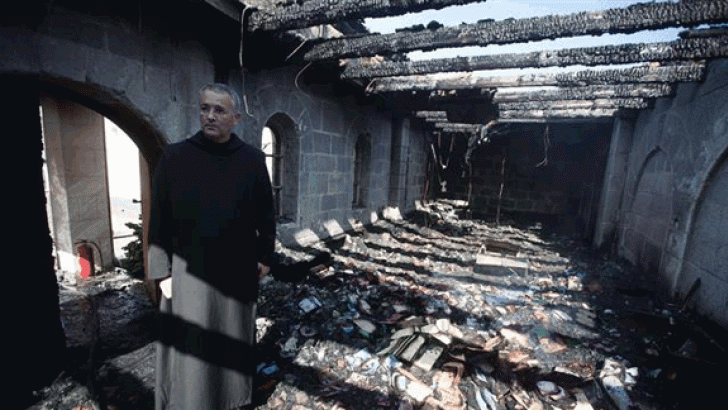
Church in Palestine torched by settlers in June
Eighteen-month-old
Ali Dawabsha was burnt alive in the occupied West Bank on 31 July.
Israeli settlers firebombed his family’s house at 2am.
A week after Ali’s charred body was pulled from the home, his
30-year-old father Saad died from injuries sustained in the same attack.
Both Saad and his wife, Reham, suffered second-degree burns to more
than 80 percent of their bodies. Their other son, Ahmed, sustained burns
to 60 percent of his body.
“Burning Palestinian children to death is becoming an annual event”,
tweeted independent journalist Dan Cohen – noting that baby Ali’s death
occurred just one year after the murder of Muhammed Abu Khdeir on 2 July
2014.
Kidnapped by Israeli settlers from outside his home in occupied
East Jerusalem, the 16-year-old was taken to a forest, where he was
tortured and made to drink petrol before being set alight.
In the aftermath of both Muhammed’s and Ali’s deaths, Israeli prime
minister Benjamin Netanyahu and numerous other Israeli politicians
expressed “shock” at the brutal murders. In both instances, Netanyahu
promised to bring the full force of Israeli law against the
perpetrators.
However, the platitudes and condemnations by Netanyahu and other
Israeli political figures cannot be taken seriously. They are a
performance staged for international consumption. Just one day before
the kidnapping of Abu Khdeir, Netanyahu issued a call for vengeance
after three missing Israeli settlers were found dead in the West Bank. A
week later, Netanyahu launched a murderous 51-day assault on Gaza,
killing more than 2,200 Palestinians, including 551 children.
Less than 24 hours after the Dawabshas’ home was firebombed, Israel’s
army murdered two more Palestinian teenagers in cold blood. Muhammed
Hamid al-Masri was shot dead in Gaza, while Laith al-Khaldi was murdered
at Atara checkpoint. Both were 17 years old.
Netanyahu has been one of the leading figures bearing responsibility
for settler presence in the occupied West Bank. Elected prime minister
in 1996 on a platform of expanding illegal settlement construction,
Netanyahu declared during a visit to the illegal Israeli colony of
Ariel: “We will be here permanently, forever”.
At the time, 140,000 Israeli settlers were living illegally in the
occupied Palestinian territories. Today there are more than 650,000.
Campaigning for re-election in January this year, Netanyahu made clear
his continued support for the illegal colonies. “I do not intend to
evacuate any settlements”, he told Israel’s Channel Two.
In the two weeks since the death of baby Ali, settlers have continued
to firebomb Palestinian homes and attack Palestinian villages.
According to the UN Office for the Coordination of Humanitarian Affairs
(UNOCHA), settlers have carried out at least 120 violent attacks with
impunity on Palestinians in occupied East Jerusalem and the West Bank
since the start of 2015.
The murders of Ali and Muhammed are not aberrations, but logical
results of the Israeli government’s continued occupation, apartheid and
ethnic cleansing.
Dear friends, a really wonderful blog by Neveen Hammad about Palestinian women, dress and culture. This was first published on the Arab American Institute website, but I have added some additional photos at the conclusion of the article.
When a Palestinian woman wears her thobe, or traditional Palestinian dress, she is displaying her heritage on her sleeves. Palestinian embroidery, or tatreez,
is the artwork featured on each woman’s thobe, and the shapes and
colors of the tatreez can be read to understand a woman’s background,
heritage, and struggle. Tatreez dates back to the 8th century CE, and the
arrangement of colors and patterns typically indicate what village a
woman is from. Although it is most often found on women’s thobe, this
embroidery is also exhibited on pillowcases and other home accessories.
Tatreez embroidery is typically created separately on small pieces of
cloth then sown onto larger fabric pieces. Common tatreez designs
include geometric shapes and elements of nature, including the sun,
moon, stars, mountains, and water. This embroidery is a woman’s form of
expression. If a woman from Hebron desires to have children, she would
embroider a doll figure on her thobe. Women from the village of Beit
Dajan often embroider orange blossoms because that village is known for
its orange orchards. Examining a woman’s thobe is to read about her roots. Certain fabric
and thread colors can inform you where she is from, or at least where
her thobe was made. While women in the Ramallah region mainly use red
for their tatreez designs, which symbolizes life and happiness, other
women in Hebron mainly use brown and reddish brown for their tatreez
designs. Similarly, the way a woman uses certain colors and designs can
tell you about her identity and skill. Fabrics used to make a thobe include: linen, cotton, wool, and silk.
These materials are either produced in Palestine or imported from Egypt,
Syria, Europe, India, Damascus, Greece, or Turkey. A type of material
used for traditional thobe dresses is referred to as malak, or “royal,” which is a linen material with a high percentage of silk and is predominately used for bridal dresses in Bethlehem. Traditionally, only a few Palestinian families specialized in the
production dyes – using their own secret recipes. Red dye was created
from pomegranate skins or insects; the sumac plant was used to make
yellow or green dye; purple was made from crushed murex shells; walnut
skins were used to produce black dye; and grape leaves produced yellow
dye. While indigo fabrics were popular among Bedouins, Biltajeh
is a specific indigo-dyed cotton fabric with colored silk borders and
is mainly used for dresses in cities along the coast of Palestine.
Citizens of Ramallah and Beit Dajan villages prefer white linen and
cotton fabrics. Women in refugee camps in countries other than Palestine still
maintain this tradition, which demonstrates that women play an integral
role in preserving their ancestral roots, culture, and traditions
despite difficult circumstances. Neither war, conflict, nor displacement
is capable of erasing national identity, culture, or the ability for
Palestinians to unite. Tatreez keeps the Palestinian heritage alive.
Some Palestinian villages may be gone forever, but tatreez will last and
preserve the Palestinian identity, which continues to be under constant
threat.
Palestinian thobes
Soraya Burnat wore a traditional Palestinian thobe at the Oscars in 2014, when her husband Emad Burnat was nominated for an Oscar for Best Documentary for his film, 5 Broken Camera about their village Bil'in and the struggle of the village and Palestinians against the Israel's apartheid wall and occupation.
Palestinian thobes from different Palestinian cities and regions.